Geopolitical Implications of Potential Russia Ukraine Land Swap Deals
Source:Indian Express ↗
Why It Matters
The Russia-Ukraine war is a defining conflict of the 21st century, deeply impacting global supply chains, food security, and energy dynamics. Understanding the possible peace settlements, such as a land swap, is crucial for UPSC aspirants as it influences the global geopolitical order, the relevance of NATO, and India's strategic balancing between the West and Russia.
Summary
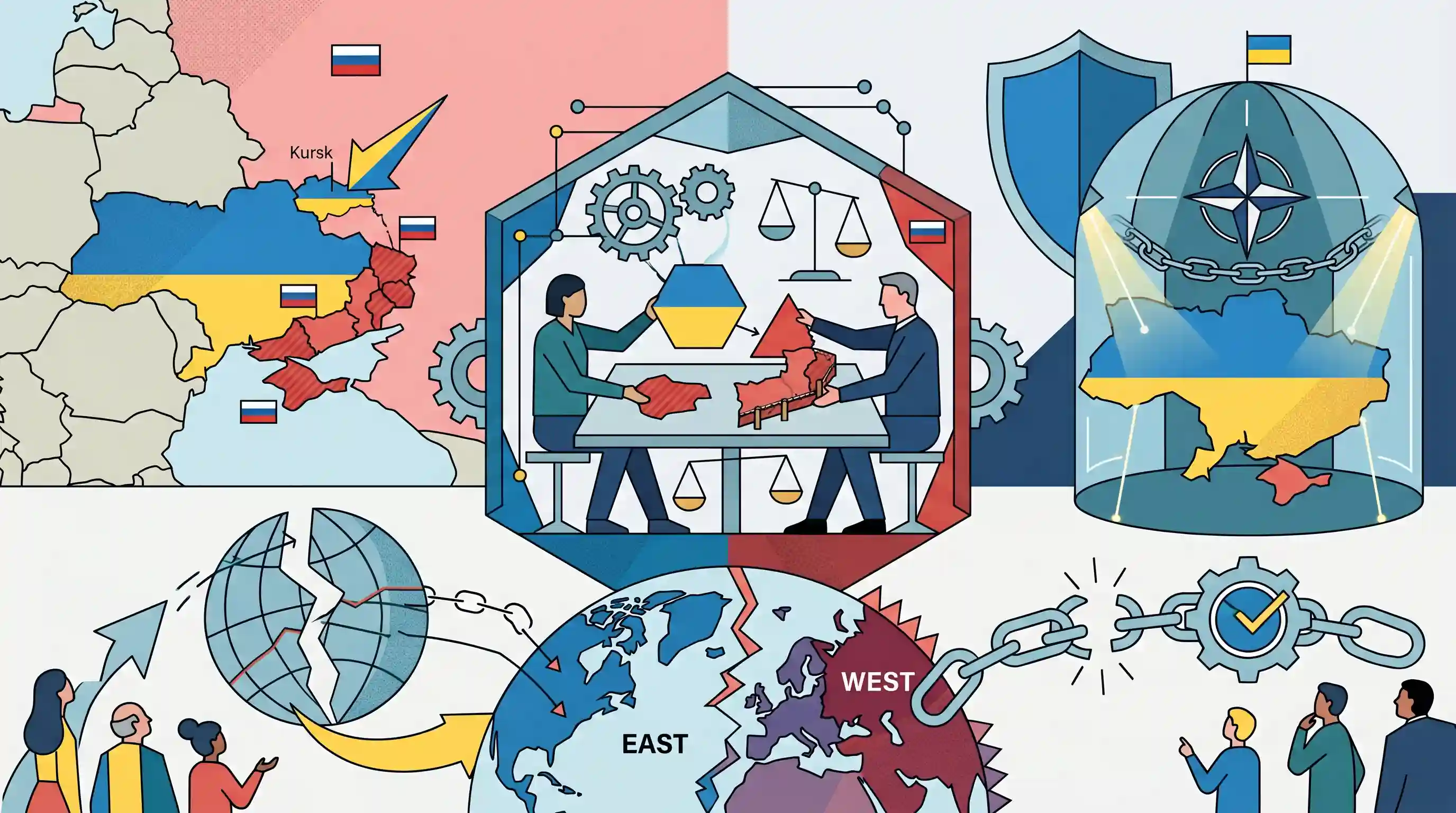
The article explores the potential contours of a 'land swap' between Russia and Ukraine to end the ongoing conflict. With Ukraine's recent incursion into Russia's Kursk region, Kyiv has secured a potential bargaining chip to trade Russian territory for Ukrainian land occupied by Russian forces. However, negotiations are highly complex as Russia has constitutionally annexed four Ukrainian regions and Crimea, viewing them as integral Russian territory. A durable peace deal involving territorial swaps would also require stringent security guarantees for Ukraine, such as NATO membership, to prevent further aggression. The diplomatic resolution of this conflict carries massive implications for global geopolitics, sovereignty norms, and the future of the East-West divide.
Key Points
- A 'land swap' in the Russia-Ukraine context refers to a potential peace settlement where both nations trade currently occupied territories to establish a stable ceasefire line.
- Ukraine's recent cross-border offensive into Russia's Kursk region has provided Kyiv with a crucial bargaining chip—occupying Russian sovereign territory to potentially trade for Ukrainian lands held by Russia.
- Russia has formally annexed four Ukrainian regions (Luhansk, Donetsk, Zaporizhzhia, and Kherson) alongside Crimea, often declaring their status non-negotiable, complicating any direct swap.
- Any territorial concessions by Ukraine would likely be contingent on robust Western security guarantees, potentially including fast-tracked NATO membership, to deter future invasions.
- The outcome of such a negotiation will have deep implications for the global geopolitical order, testing the resilience of sovereignty norms and the effectiveness of international law.
Important Terms
Minsk Agreements

Two peace accords (2014 and 2015) aimed at ending fighting in eastern Ukraine’s Donbas region. They involved a ceasefire, withdrawal of heavy weapons, and autonomy for separatist-held areas.
UPSC context
GS II: International Relations. Demonstrates challenges of 'frozen conflicts' and the failure of diplomatic frameworks to prevent full-scale war.
NATO Article 5
The collective defense clause of the North Atlantic Treaty, stating that an attack against one member is an attack against all. Current peace proposals suggest 'Article 5-like' guarantees for Ukraine.
UPSC context
GS II: Important International Institutions. Crucial for understanding global security architecture and 'collective security' concepts in IR.
Kursk Region
A Russian border province and site of a 2024 Ukrainian military incursion. It serves as a strategic 'bargaining chip' for Ukraine to potentially trade for occupied Ukrainian land.
UPSC context
Prelims: World Geography. GS II: Current Affairs. Highlights how military leverage influences diplomatic outcomes and territorial negotiations.
Annexation
The legal or forceful incorporation of territory into another political entity. Russia constitutionally annexed Crimea (2014) and four other Ukrainian regions (2022), declaring them integral Russian soil.
UPSC context
GS II: International Relations. Tests understanding of sovereignty, international law (UN Charter), and 'revisionist' state behavior in global politics.
Territorial Integrity
A core principle of international law (UN Charter Article 2) asserting that a nation's borders are inviolable and should not be forcibly altered by another state.
UPSC context
GS II: Bilateral and Global Groupings. A fundamental concept often tested against 'Right to Self-Determination' in the context of separatism and war.
Prelims Trap
Kursk is one of the eastern Ukrainian regions formally annexed by Russia.
Kursk is internationally recognized Russian sovereign territory. Ukraine recently invaded it to gain a bargaining chip. Russia annexed Luhansk, Donetsk, Zaporizhzhia, and Kherson from Ukraine.
Static Concepts Connected
Which key water bodies are strategically tied to the Russia-Ukraine conflict zone?
- Sea of Azov: An inland sea bounded by Ukraine and Russia; it is now entirely controlled by Russia following the occupation of coastal cities like Mariupol.
- Kerch Strait: The critical chokepoint connecting the Sea of Azov to the Black Sea, spanned by the highly contested Crimean Bridge.
- Black Sea: The primary maritime theatre for the conflict, vital for grain exports and providing naval access to the Mediterranean via the Bosporus.
What is the principle of Collective Defence under NATO's Article 5?
- Core Principle: The treaty states that an armed attack against one or more NATO members is considered an attack against all of them.
- Action Mandate: If invoked, it requires each member to take "such action as it deems necessary, including the use of armed force," to restore security.
- Relevance: Ukraine's demand for this specific guarantee in any land-swap deal is a major red line for Russia, which views NATO expansion as an existential threat.
Cross-Topic Patterns
Land Swaps & India-Bangladesh LBA
The diplomatic mechanism of exchanging territory to resolve conflict mirrors the 2015 India-Bangladesh Land Boundary Agreement (100th Constitutional Amendment), which exchanged enclaves to secure a peaceful, permanent border.
Energy Security & CAATSA pressures
Prolonged territorial stalemates and delayed peace deals keep global energy supply chains volatile, complicating India's strategic autonomy balancing act between Russian discounted oil and Western CAATSA scrutiny.

Expect a 'places in news' Prelims question matching regions (Kursk, Zaporizhzhia, Luhansk) to their geographic features or countries.
Linked PYQs · 3
Linked PYQs · 3
- 2023MainsGS2
‘The expansion and strengthening of NATO and a stronger US-Europe strategic partnership works well for India.’ What is your opinion about this statement ? Give reasons and examples to support your answer.
- 2023PrelimsGS1
Consider the following countries: 1. Bulgaria 2. Czech Republic 3. Hungary 4. Latvia 5. Lithuania 6. Romania How many of the above-mentioned countries share a land border with Ukraine?
- 2025MainsGS2
"With the waning of globalization, post-Cold War world is becoming a site of sovereign nationalism.” Elucidate.
