Escalation of Aerial Strikes in Russia Ukraine Conflict
Source:The Hindu ↗
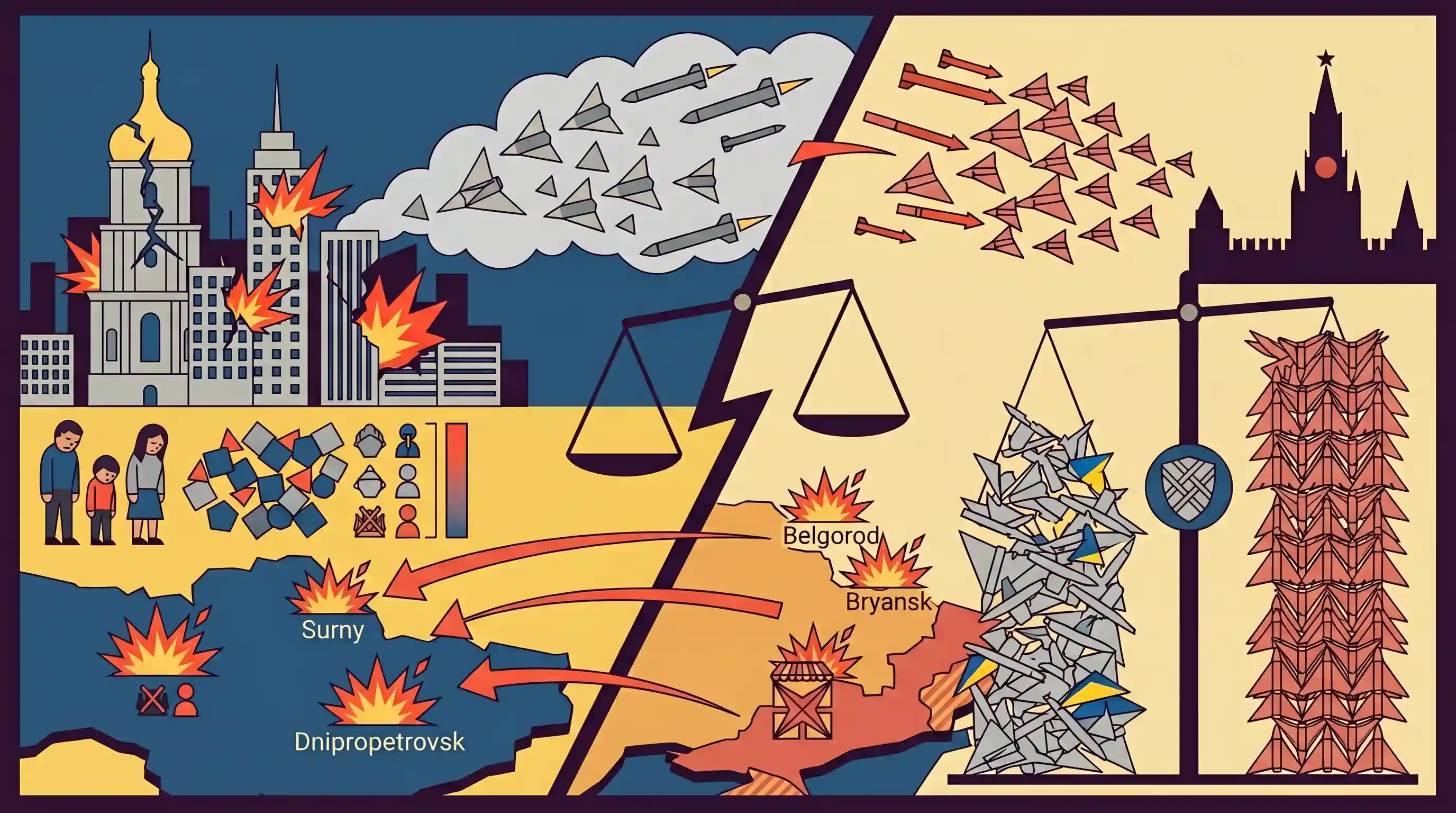
Why It Matters
This article highlights the ongoing escalation of the Russia-Ukraine war, demonstrating how regional conflict points (like Zaporizhzhia and Sumy) remain crucial geographic indicators for UPSC Prelims. Additionally, the extensive, mass-scale deployment of UAVs/drones highlights a major shift in modern warfare tactics, directly relating to GS Paper 3 (Security) and GS Paper 2 (Global Geopolitics and India's strategic neutrality).
Summary
Following one of the most intense drone and missile attacks on Ukraine's capital Kyiv since the 2022 invasion—which killed at least 30 people—Russia and Ukraine exchanged reciprocal deadly strikes. Ukrainian attacks hit a market in Russian-occupied Zaporizhzhia and targeted Belgorod and Bryansk. Concurrently, Russian airstrikes hit Sumy and Dnipropetrovsk, inflicting further civilian casualties. The scale of the clash was marked by massive drone deployment, with over 100 Russian drones launched and 155 Ukrainian drones reportedly intercepted by Russia.
Key Points
- Russia and Ukraine exchanged intensive and deadly aerial strikes following a massive Russian attack on Kyiv on July 2, 2026, which killed at least 30 civilians.
- In reciprocal actions, Ukrainian strikes targeted Russian-occupied Zaporizhzhia, killing five people at a market, alongside strikes on Russia's western border regions of Belgorod and Bryansk.
- Russian counter-strikes hit Ukraine's northeastern Sumy region (killing four, including a toddler) and the central eastern Dnipropetrovsk region.
- The conflict highlights massive deployments of unmanned aerial vehicles (UAVs): Kyiv reported 105 Russian drones and 2 missiles launched overnight, while the Russian Defence Ministry claimed to have shot down 155 Ukrainian drones over its territory and annexed Crimea.
Important Terms
NATO (North Atlantic Treaty Organization)

An intergovernmental military alliance established in 1949 by the Washington Treaty to provide collective defense against external aggression and maintain European security architecture [1.2.4].
UPSC context
GS Paper II: International Relations. Crucial for understanding global security alliances, collective defense treaties, and geopolitical conflicts.
Asymmetric Warfare
Conflict between belligerents of unequal military capabilities, where the weaker side uses unconventional tactics and cost-effective technologies like drones to offset conventional disadvantages [2.2.4].
UPSC context
GS Paper III: Internal Security. Evaluates changing warfare doctrines, drone technology, and cost-benefit imbalances in modern defensive strategies.
Ukrainian Air Force (Kyiv's Air Force)
The official aerial warfare branch of Ukraine's armed forces, tasked with safeguarding national airspace, countering missile strikes, and operating modernized air fleets [1.1.1, 1.1.3].
UPSC context
GS Paper III: Security / GS Paper II: IR. Tests knowledge of military modernization, air defense capabilities, and theater operations.
Russian Defence Ministry
The federal executive body of the Russian Federation responsible for implementing state defense policy, managing the country's armed forces, and executing military operations [2.3.1].
UPSC context
GS Paper II: International Relations. Important for analyzing military command structures and defense communication of key global powers.
Ukrainian Red Cross
The largest humanitarian relief organization in Ukraine, providing emergency first aid, medical assistance, and vital relief supplies to conflict-affected civilian populations [2.3.1, 2.3.2].
UPSC context
GS Paper II: International Relations. Relevant to international humanitarian laws, role of global NGOs, and disaster management.
Prelims Trap
The Dnieper River, which flows through Kyiv and Zaporizhzhia, empties directly into the Sea of Azov.
The Dnieper River empties into the Black Sea. It is the Don River (flowing through Russia) that empties into the Sea of Azov.
Static Concepts Connected
What is the geography of the Black Sea basin?
- Littoral states: Six nations border the sea: Ukraine, Russia, Georgia, Turkey, Bulgaria, and Romania (easily remembered using the mnemonic BURGER-T).
- Key straits: It connects to the Sea of Azov via the Kerch Strait and to the Aegean Sea/Mediterranean via the Bosporus and Dardanelles straits.
- River outlets: Major European rivers including the Danube, Dnieper, and Dniester drain directly into the Black Sea.
Cross-Topic Patterns
UAV warfare and export control regimes
Massive drone deployments highlight gaps in dual-use technology flows, forcing regimes like the Wassenaar Arrangement to tighten export controls on consumer-grade semiconductor components.
Nuclear safety and international law
Military actions around Zaporizhzhia expose the limit of the IAEA's non-binding mandates, fueling debates on reform of global nuclear safety governance during active conventional conflicts.

Prelims is highly likely to pair Ukrainian river basins like the Dnieper with Black Sea maritime choke points in a map-based matching format.
Linked PYQs · 3
Linked PYQs · 3
- 2023PrelimsGS1
Consider the following pairs: Regions often mentioned in news Reason for being in news 1. North Kivu and Ituri : War between Armenia and Azerbaijan 2. Nagorno-Karabakh : Insurgency in Mozambique 3. Kherson and Zaporizhzhia : Dispute between Israel and Lebanon How many of the above pairs are correctly matched?
- 2023MainsGS3
The use of unmanned aerial vehicles (UAVs) by our adversaries across the borders to ferry arms/ammunitions, drugs, etc., is a serious threat to the internal security. Comment on the measures being taken to tackle this threat.
- 2023PrelimsGS1
Consider the following countries: 1. Bulgaria 2. Czech Republic 3. Hungary 4. Latvia 5. Lithuania 6. Romania How many of the above-mentioned countries share a land border with Ukraine?
