Russia Supports India and Brazil for Permanent UNSC Seats
Source:Indian Express ↗
Why It Matters
This development highlights the evolving alignments in global governance and multilateral diplomacy regarding UNSC expansion, which is a core syllabus area under India's bilateral and global relations.
Summary
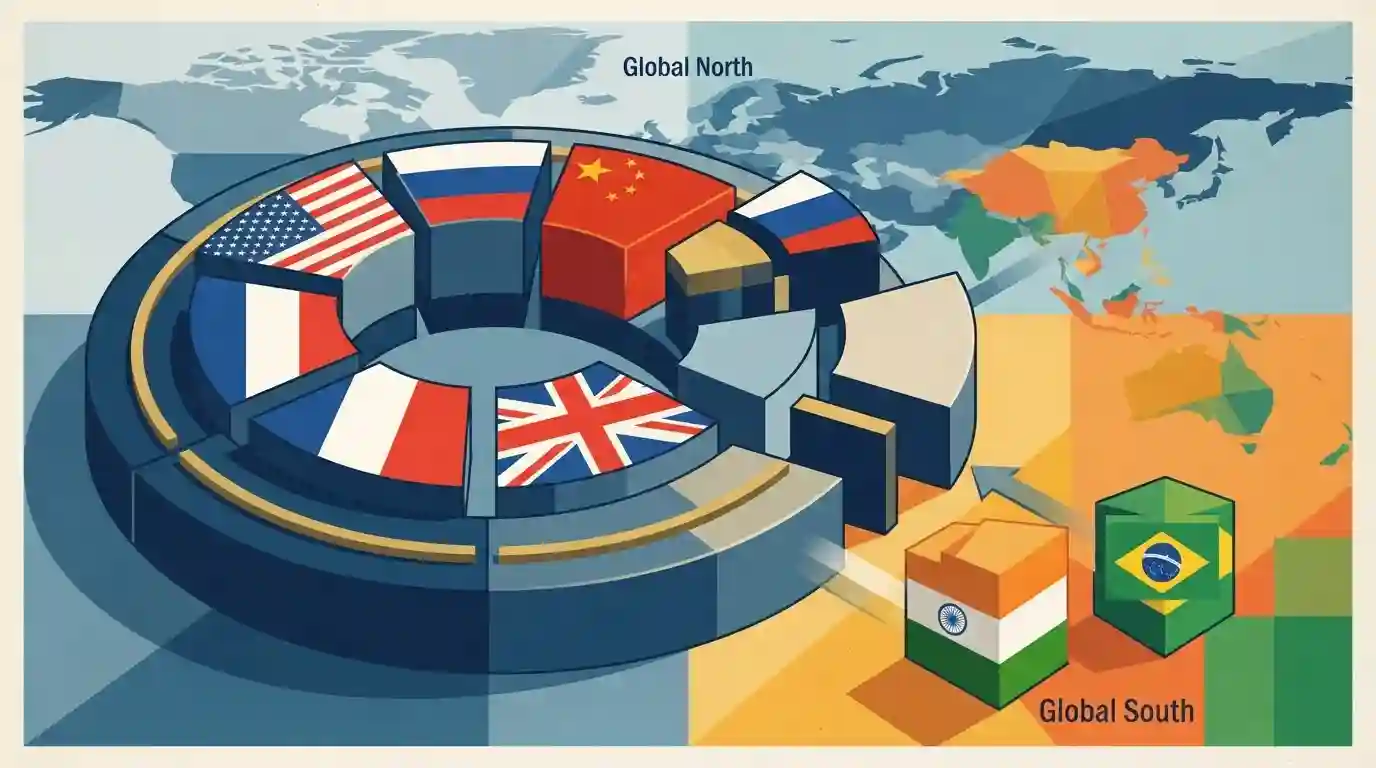
Russia has reiterated its explicit support for India and Brazil to secure permanent seats in an expanded United Nations Security Council (UNSC), highlighting the urgency of reforming global governance bodies to better represent developing nations and contemporary geopolitical realities.
Key Points
- Russia reiterated its strong support for India and Brazil to become permanent members of the United Nations Security Council (UNSC).
- Russian Foreign Minister Sergey Lavrov highlighted the need to make the UNSC more democratic and representative by including developing nations from Asia, Africa, and Latin America.
- Russia emphasized that the current composition of the UNSC does not reflect contemporary geopolitical realities.
- India and Brazil have long sought permanent seats in an expanded UNSC, often cooperating via platforms like G4 and BRICS.
Important Terms
United Nations Security Council

The principal organ of the United Nations responsible for maintaining international peace and security, consisting of five permanent members with veto power and ten non-permanent members elected for two-year terms.
UPSC context
GS Paper II (International Relations) - Important International Institutions, agencies and fora, their structure, mandate, and reforms.
BRICS
An intergovernmental organization comprising Brazil, Russia, India, China, South Africa, and newly added members, serving as an influential platform for emerging economies to foster multipolarity and reform global governance.
UPSC context
GS Paper II (International Relations) - Bilateral, regional and global groupings and agreements involving India and/or affecting India's interests.
Static Concepts Connected
What are the core legal requirements and roadblocks for amending the UN Charter to reform the UNSC?
- UNGA Majority: Requires a two-thirds majority vote of the UN General Assembly (at least 129 of 193 member states).
- P5 Ratification: Requires formal ratification by two-thirds of UN member states, including all five permanent members (P5) exercising their domestic constitutional processes.
- Veto Power: Any single P5 member can exercise its veto or withhold ratification to block permanent expansion proposals.
Cross-Topic Patterns
UNSC Reform + Multilateral Groupings Dynamics
UNSC reform proposals are consistently stalled by regional rivalries (e.g., Coffee Club / Uniting for Consensus) and the P5 veto power, testing multilateral diplomacy in forums like BRICS and G4.

UNSC reform mechanics, P5 veto dynamics, and G4 vs Uniting for Consensus groupings are frequently tested in Prelims and Mains.
Linked PYQs · 2
Linked PYQs · 2
- 2025MainsGS2
"The reform process in the United Nations remains unresolved, because of the delicate imbalance of East and West and entanglement of the USA vs. Russo-Chinese alliance.” Examine and critically evaluate the East-West policy confrontations in this regard.
- 2015MainsGS2
Discuss the impediments India is facing in its pursuit of a permanent seat in UN Security Council.
