Russia Reaffirms Support for India Permanent UNSC Seat
Source:Indian Express ↗
हे का महत्त्वाचे आहे
Understanding the dynamics of UNSC reform, major power alignments, and India's pursuit of a permanent seat is critical for questions concerning India's foreign policy and global multilateral governance under GS Paper 2.
सारांश
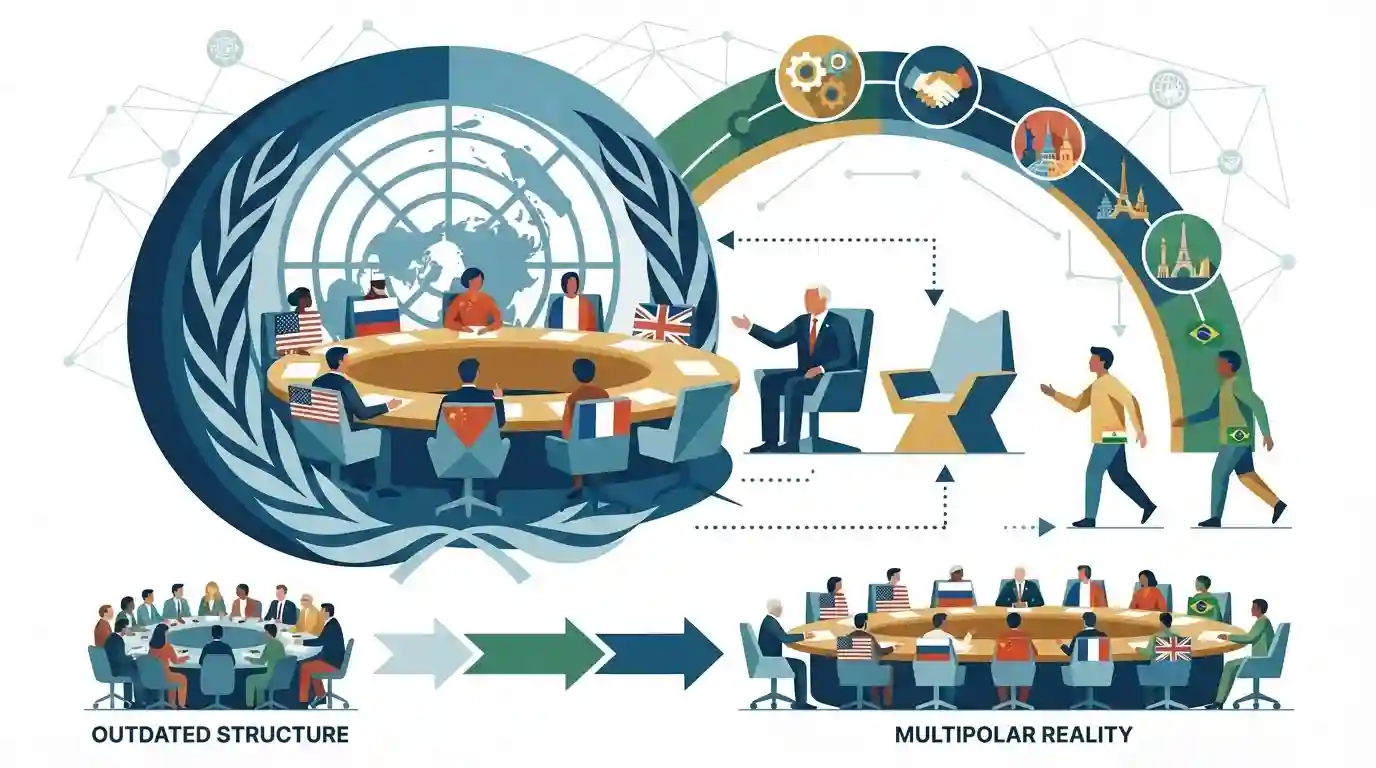
Russia has reaffirmed its backing for India and Brazil to secure permanent seats in an expanded United Nations Security Council (UNSC), highlighting the growing global consensus on reforming outdated multilateral institutions to align with multipolar geopolitical realities.
मुख्य मुद्दे
- Russia reiterated its strong support for India and Brazil to become permanent members of the United Nations Security Council (UNSC).
- The support emphasizes the need to reform global governance structures to reflect contemporary multipolar realities.
- India and Brazil, alongside Germany and Japan (G4 grouping), have long sought expansion of the UNSC to make it more representative, inclusive, and effective.
महत्त्वाच्या संज्ञा
UNSC

The principal organ of the United Nations responsible for maintaining international peace and security, consisting of five permanent veto-wielding members and ten non-permanent members elected for two-year terms.
UPSC context
Important for GS Paper II (International Relations / Global Groupings) — tests understanding of multilateral governance, global security architecture, and India's bid for permanent membership.
United Nations
An international organization founded in 1945 to promote global peace, security, and cooperation among member states, serving as the primary forum for multilateral diplomacy and international law.
UPSC context
Relevant for GS Paper II (International Institutions) — tests knowledge of global governance frameworks, multilateralism, and India's multilateral diplomacy.
पूर्वपरीक्षा सापळा
G4 nations demand identical veto powers as the P5 from day one of permanent membership.
Aspirants often assume G4 nations demand immediate veto power upon induction, but they pragmatically offered to forgo veto rights for the first 15 years.
संबंधित स्थिर संकल्पना
What is the composition and veto power structure of the United Nations Security Council (UNSC)?
- Core Composition: It consists of 15 members: 5 permanent (P5: US, UK, France, Russia, China) and 10 non-permanent elected for two-year terms.
- Veto Power: Each P5 member holds veto power, meaning a negative vote by any permanent member prevents the adoption of a resolution.
- Non-Permanent Status: Non-permanent members do not have veto power and are distributed regionally to ensure geographic representation.
आंतर-विषय नमुने
UNSC Reform + Global South Diplomacy
India's pursuit of a permanent UNSC seat is closely tied to its leadership in plurilateral groupings like BRICS and the Global South narrative.
G4 Bids + Regional Rivalries (Coffee Club)
The Coffee Club's opposition to the G4 model highlights regional geopolitical rivalries, such as Pakistan opposing India and Italy opposing Germany.

UNSC expansion model (G4 + Veto compromise + Coffee Club opposition) is a prime candidate for a multi-statement prelims question.
संबंधित PYQ · 3
संबंधित PYQ · 3
- 2009PrelimsGS1
The Security Council of UN consists of 5 permanent members, and the remaining 10 members are elected by the General Assembly for a term of
- 2022PrelimsGS1
With reference to the United Nations General Assembly, consider the following statements: 1. The UN General Assembly can grant observer status to the non-member States. 2. Inter-governmental organisations can seek observer status in the UN General Assembly. 3. Permanent Observers in the UN General Assembly can maintain missions at the UN headquarters. Which of the statements given above are correct?
- 2022PrelimsGS1
With reference to the "United Nations Credentials Committee", consider the following statements : 1. It is a committee set up by the UN Security Council and works under its supervision. 2. It traditionally meets in March, June and September every year. 3. It assesses the credentials of all UN members before submitting a report to the General Assembly for approval. Which of the statements given above are correct?
