NATO Defence Spending and Geopolitical Risks to Alliance
Source:The Hindu ↗
Why It Matters
It emphasizes the economic implications of prolonged military conflicts and arms races on global security architectures like NATO, reflecting key themes in global geopolitics and the evolving balance of power.
Summary
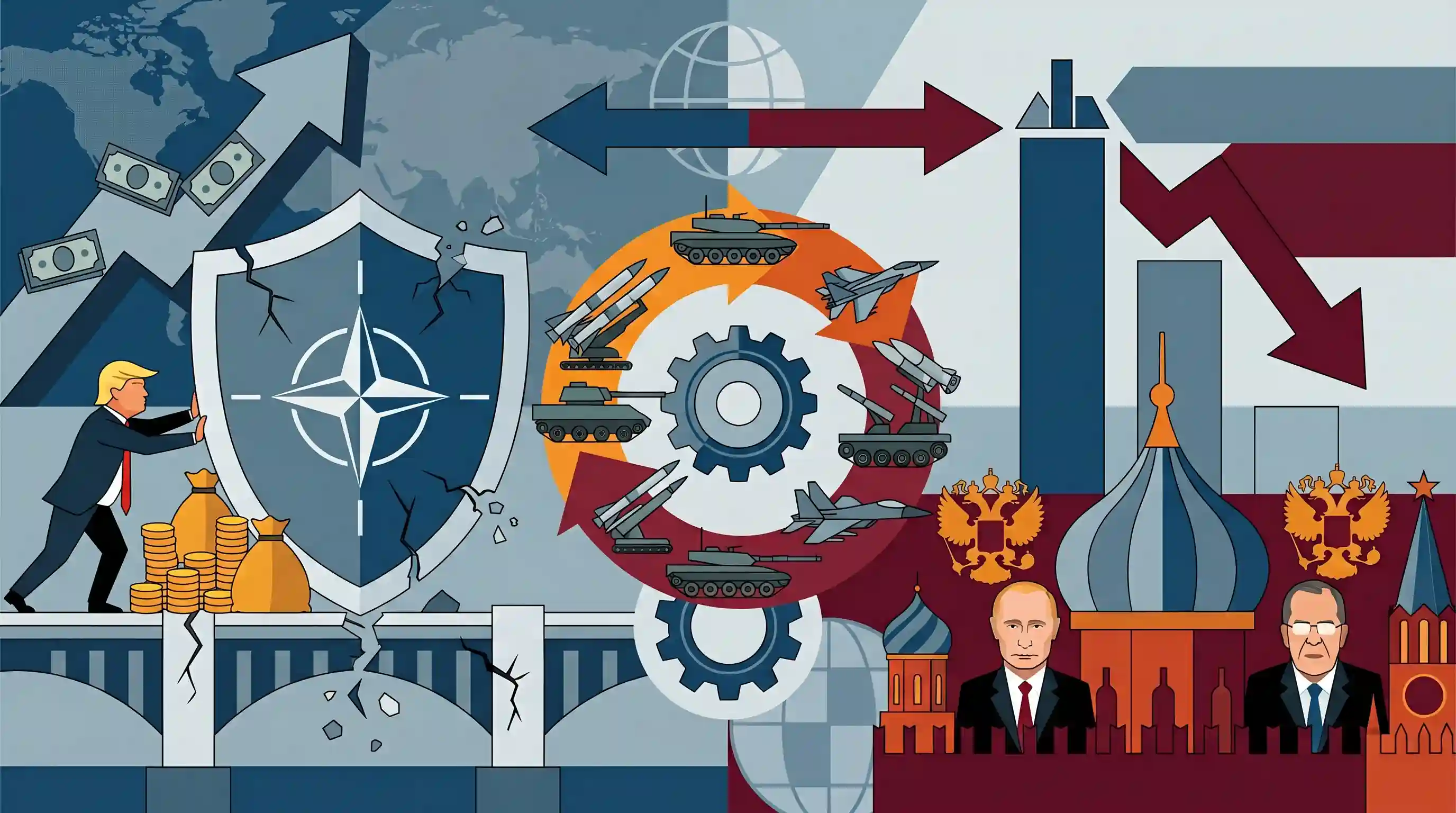
Russian Foreign Minister Sergei Lavrov asserted that NATO's significant increase in defence spending—spurred by U.S. President Donald Trump—could trigger the alliance's collapse. While Russia's national defence spending reached 6.3% of its GDP in 2025 (the highest since the Cold War), President Vladimir Putin announced plans to cut military expenditure starting next year. The diplomatic exchange highlights the escalating security dilemma and arms race between Russia and the West in the context of the protracted Ukraine war.
Key Points
- Russian Foreign Minister Sergei Lavrov claimed that NATO's increased defence spending could lead to the alliance's collapse.
- NATO members have backed significant increases in defence budgets, driven by demands from U.S. President Donald Trump.
- Russia plans to reduce its military expenditure in the coming year, after previously increasing it to 6.3% of its GDP in 2025, the highest level since the Cold War.
- The dynamic reflects a growing security dilemma and arms race between Russia and the West in the backdrop of the Ukraine conflict.
Important Terms
NATO (North Atlantic Treaty Organization)

An intergovernmental military alliance established by the 1949 Washington Treaty, providing collective security for North American and European members against external threats.
UPSC context
GS Paper II: International Relations. Essential for understanding regional security alliances and India's strategic balancing.
Collective Defence
Enshrined in Article 5 of the North Atlantic Treaty, this principle asserts that an attack against one member is considered an attack against all allies.
UPSC context
GS Paper II/III: Security. Tests knowledge of deterrence mechanisms and military commitment levels in international law.
Security Dilemma
A situation where one state's efforts to increase its security—such as military buildup—inadvertently threatens others, leading to a cycle of escalation.
UPSC context
GS Paper II: IR Theory. A core concept in Realism used to explain conflict escalation without initial aggressive intent.
Defence-to-GDP Ratio
The proportion of a nation's total economic output (GDP) allocated to military expenditure, used as a benchmark for burden-sharing in alliances.
UPSC context
GS Paper III: Economy/Security. Evaluates a state's 'war footing' vs. social spending trade-offs.
Geopolitics
The study of how geographical factors, such as borders and territory, influence international politics, power distributions, and state relations.
UPSC context
GS Paper II: International Relations. Fundamental for analyzing territorial conflicts and shifting global power centers.
Arms Race
A competitive buildup of military capabilities between two or more nations to achieve technological or numerical superiority.
UPSC context
GS Paper II: Global Security. Relevant for discussing nuclear proliferation, militarization of space, and regional stability.
Prelims Trap
NATO's defence spending targets are legally binding obligations under the Washington Treaty.
These targets (e.g., the 2014 Wales Summit 2% pledge) are political commitments, not legally binding clauses with punitive mechanisms in the Washington Treaty.
Static Concepts Connected
What is the 'Security Dilemma' in International Relations?
- Definition: A situation where a state's defensive actions, like augmenting military budgets, are perceived as offensive threats by adversaries.
- Consequence: Triggers reciprocal arms buildups and escalating tensions, even if neither side originally intended to initiate a conflict.
- Contemporary Relevance: It explains the current NATO-Russia dynamic, where NATO's budget hikes and Russian militarization feed a continuous spiral of mutual threat perception.
What are 'Internal' and 'External' balancing in geopolitics?
- Internal Balancing: A state enhancing its own economic and military capabilities to counter threats (e.g., Russia raising defense spending to 6.3% of GDP).
- External Balancing: Forming or expanding alliances to check an adversary's power (e.g., NATO's collective defense mechanisms and eastward expansion).
Cross-Topic Patterns
European Security vs. Strategic Autonomy
The NATO-Russia arms race deepens Moscow's reliance on Beijing, complicating India's strategic autonomy by straining its critical defense partnership with a China-aligned Russia.
End of the Peace Dividend
Spiking national defense budgets mark a global retreat from post-Cold War peace dividends, diverting capital away from developmental goals towards militarized self-reliance and sovereign nationalism.

Expect a Mains question linking the European 'Security Dilemma' to India's strategic autonomy and its Indo-Pacific balancing act.
Linked PYQs · 3
Linked PYQs · 3
- 2023MainsGS2
‘The expansion and strengthening of NATO and a stronger US-Europe strategic partnership works well for India.’ What is your opinion about this statement ? Give reasons and examples to support your answer.
- 2025MainsGS2
"The reform process in the United Nations remains unresolved, because of the delicate imbalance of East and West and entanglement of the USA vs. Russo-Chinese alliance.” Examine and critically evaluate the East-West policy confrontations in this regard.
- 2025MainsGS2
"With the waning of globalization, post-Cold War world is becoming a site of sovereign nationalism.” Elucidate.
