Russia rejects European peace troops and swift Ukraine summit
Source:The Hindu ↗
Why It Matters
The evolving conditions for peace negotiations in the Russia-Ukraine war, including the debate over security guarantees and potential peacekeeping forces, are critical for understanding contemporary geopolitical realignments and the limits of Western intervention in Eastern Europe.
Summary
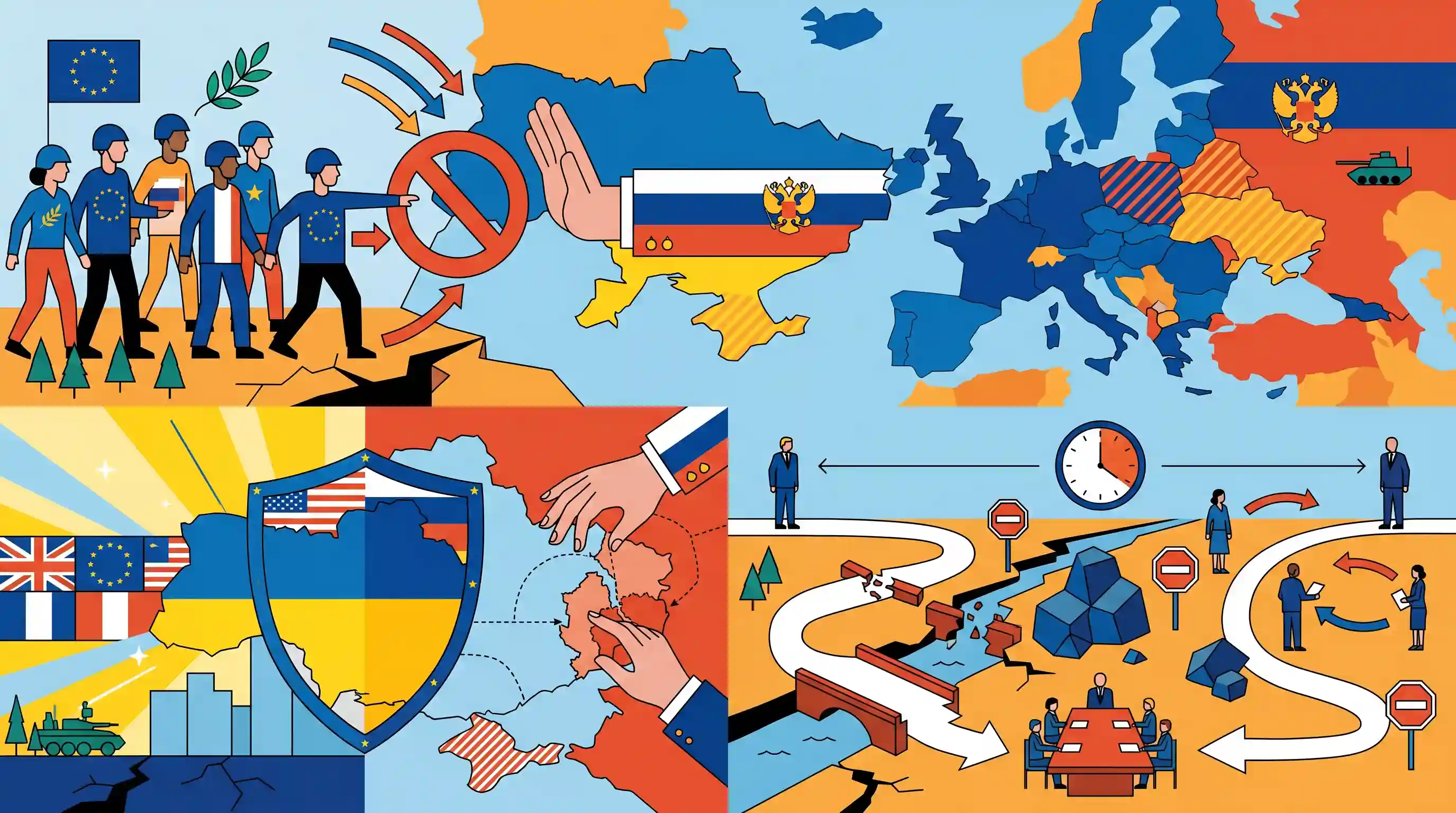
The Kremlin has rejected the idea of European peacekeeping troops being deployed in Ukraine and dismissed the possibility of a speedy meeting between Russian President Vladimir Putin and Ukrainian President Volodymyr Zelenskyy. Moscow views a potential European force as a means for NATO to establish a military presence in Ukraine, which it cites as a root cause of the conflict. While Ukraine pushes for strong Western-backed security guarantees, Russia insists on territorial concessions in eastern Ukraine as part of any settlement. Kremlin spokesman Dmitry Peskov noted that while negotiating teams are in touch, a top-level summit must be thoroughly prepared to be effective.
Key Points
- Russia strongly opposed the suggestion of deploying European peacekeeping forces in Ukraine, viewing it as a thinly veiled effort to establish a NATO military presence in the country.
- The Kremlin rejected the idea of a near-term summit between Presidents Vladimir Putin and Volodymyr Zelenskyy, stating that high-level talks require extensive preparation.
- Ukraine continues to demand robust, Western-backed security guarantees to prevent future Russian aggression.
- Russia maintains its demand that Kyiv must cede more territory in eastern Ukraine as a precondition for any peace agreement.
Important Terms
NATO (North Atlantic Treaty Organization)

An intergovernmental military alliance of 32 North American and European countries based on collective defense (Article 5).
UPSC context
GS II (International Relations); central to discussions on global security architecture and Russia's stated security concerns.
European Union (EU)
A unique economic and political union of 27 European countries; it supports Ukraine through candidacy status, financial aid, and sanctions.
UPSC context
GS II (International Institutions); involves regional groupings and agreements affecting India's interests in Europe.
Security Guarantees
Formal diplomatic assurances provided by major powers or international bodies to protect a state from external threats or aggression.
UPSC context
GS II (International Relations); critical for conflict resolution frameworks and sovereign protection in geopolitics.
Territorial Integrity
The international law principle that a sovereign state's borders are sacrosanct and should not be forcibly altered.
UPSC context
GS II (International Law); underpins debates on annexations, sovereignty, and the UN Charter's foundational principles.
Minsk Agreements
A series of international agreements (2014-15) that sought to end the war in Donbas, now largely defunct.
UPSC context
GS II (International Relations); background knowledge for the evolution of the Russia-Ukraine conflict.
Donbas
An industrial region in Eastern Ukraine comprising Donetsk and Luhansk, currently a central point of territorial dispute.
UPSC context
GS II (International Relations); key geography for understanding strategic objectives and conflict flashpoints.
Prelims Trap
UN Peacekeeping missions can be deployed in a conflict zone by UNSC mandate without requiring the consent of the warring nations.
Traditional UN Peacekeeping strictly requires the consent of the main parties to the conflict. Without Russia and Ukraine's mutual consent, a standard UN blue-helmet mission cannot legally deploy.
Static Concepts Connected
What are the three fundamental principles of UN Peacekeeping operations?
- Consent of parties: Missions are deployed only with the agreement of the main parties involved in the conflict.
- Impartiality: Peacekeepers must not take sides or show bias toward any party in the conflict.
- Non-use of force: Force is used only in self-defense and defense of the mandate, distinct from peace enforcement operations.
What was the 1994 Budapest Memorandum concerning Ukraine?
- Nuclear Disarmament: Ukraine agreed to completely relinquish its Soviet-era nuclear arsenal, transferring the weapons to Russia.
- Security Assurances: The US, UK, and Russia pledged to respect Ukraine's independence, sovereignty, and existing borders.
- Non-binding nature: It was a diplomatic document of security assurances, not a formal, legally binding collective defense treaty like NATO's Article 5.
Cross-Topic Patterns
India's UNPKF legacy + Mediator Role
India's historic neutrality and status as a top UN troop-contributing country position it uniquely for future missions in Ukraine, contrasting sharply with Russia's rejection of EU or NATO forces.
UNSC Vetoes + Multilateral Paralysis
The inability to deploy UN peacekeepers due to Russia's veto power highlights the paralysis of multilateral institutions, frequently driving the Global South's demands for urgent UNSC reform.

Expect a Prelims question differentiating UN Peacekeeping (requires consent) from Peace Enforcement (Chapter VII), tied to Ukraine.
Linked PYQs · 2
Linked PYQs · 2
- 2023MainsGS2
‘The expansion and strengthening of NATO and a stronger US-Europe strategic partnership works well for India.’ What is your opinion about this statement ? Give reasons and examples to support your answer.
- 2025MainsGS2
"With the waning of globalization, post-Cold War world is becoming a site of sovereign nationalism.” Elucidate.
