India Russia strategic autonomy and bilateral energy cooperation
Source:Indian Express ↗
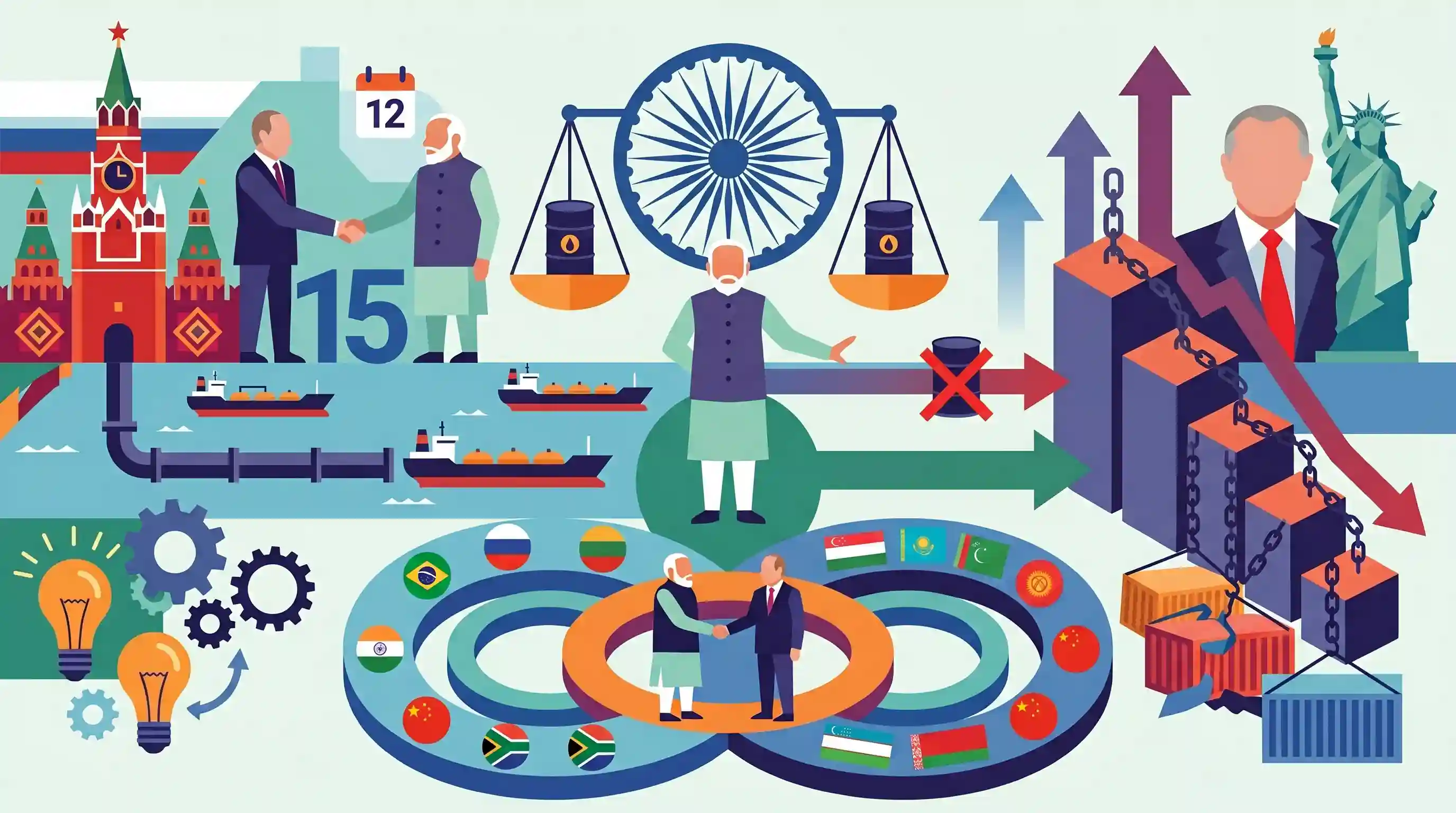
Why It Matters
This development is a prime example of India exercising 'strategic autonomy' in a multipolar world. It demonstrates how India balances its traditional strategic partnership and energy dependence on Russia against economic pressure and tariff threats from the United States. It is directly relevant for GS Paper 2 (Bilateral, regional and global groupings and agreements involving India and/or affecting India’s interests).
Summary
Russian President Vladimir Putin is slated to travel to India in December for the 23rd India-Russia Annual Summit, an event that coincides with the 15th anniversary of their 'Special and Privileged Strategic Partnership'. The announcement comes at a critical geopolitical juncture, just after US President Donald Trump proposed doubling tariffs on Indian goods and levying an extra 25% duty in response to India's purchase of Russian crude oil. Despite potential US economic pressure, India has strongly reiterated its strategic autonomy, stating that its energy procurement strategy is driven strictly by national interest and market dynamics. Additionally, Putin and PM Modi are set to meet at the upcoming SCO Summit in China, underscoring the sustained high-level engagement between the two nations across bilateral and multilateral platforms.
Key Points
- Russian President Vladimir Putin is scheduled to visit India in December for the 23rd India-Russia Annual Summit.
- The year marks the 15th anniversary of the elevation of bilateral ties to a 'Special and Privileged Strategic Partnership'.
- Putin and PM Modi are also expected to meet on the sidelines of the upcoming SCO Summit in Tianjin, China.
- The visit takes place against the backdrop of US President Donald Trump proposing an additional 25% duty on Indian goods due to India's continued purchase of Russian crude oil.
- India maintains that its energy procurement is guided by national interest, market dynamics, and a commitment to global economic stability, asserting its strategic autonomy.
Important Terms
Special and Privileged Strategic Partnership

The highest tier of bilateral relations between India and Russia, elevated from a standard 'Strategic Partnership' in 2010 to reflect deep cooperation in defense, nuclear energy, and space.
UPSC context
GS Paper 2 (International Relations); tests understanding of India's long-standing pillars of defense and energy security.
Shanghai Cooperation Organisation (SCO)
A Eurasian political, economic, and security alliance founded in 2001. It currently includes 10 members and focuses on regional stability and counter-terrorism via its Regional Anti-Terrorist Structure (RATS).
UPSC context
GS Paper 2 (International Organizations); vital for questions on India's 'extended neighborhood' and regional security dynamics.
BRICS
An influential grouping of major emerging economies (including Brazil, Russia, India, China, South Africa) advocating for a multipolar world and reforms in global financial institutions like the IMF and World Bank.
UPSC context
GS Paper 2 (International Relations); essential for topics on South-South cooperation and the transition to a multipolar world order.
Strategic Autonomy
A foreign policy doctrine where a nation exercises independent decision-making based on national interest, avoiding formal military alliances or coercion from external powers.
UPSC context
GS Paper 2 (Foreign Policy); a core conceptual framework for mains answers regarding India's multi-alignment and sovereign choices.
Prelims Trap
India shares a "Special and Privileged Strategic Partnership" with both Russia and the United States.
India's tie with Russia is specifically designated a "Special and Privileged Strategic Partnership". With the US, it is a "Comprehensive Global Strategic Partnership". UPSC often swaps these diplomatic tiers.
Static Concepts Connected
What is the framework of the Countering America's Adversaries Through Sanctions Act (CAATSA)?
- Core Targets: Enacted by the US to impose sanctions on Iran, North Korea, and Russia.
- Secondary Sanctions: Authorizes secondary sanctions against nations engaging in "significant transactions" with Russian defense or intelligence sectors.
- Presidential Waiver: Contains a modified waiver authority allowing the US President to exempt countries based on national security interests.
How has the formal diplomatic structure of India-Russia relations evolved?
- 1971 Treaty: The historic Indo-Soviet Treaty of Peace, Friendship and Cooperation provided the Cold War foundation.
- Strategic Partnership (2000): Formally declared during Vladimir Putin's visit to India, establishing institutionalized annual summits.
- Special & Privileged (2010): Elevated to reflect deep, exclusive cooperation in defense, civilian nuclear energy, and space exploration.
Cross-Topic Patterns
Tariff diplomacy & strategic energy security
The US linking punitive tariffs to India's Russian crude imports merges trade policy with geopolitical secondary sanctions, pushing India to accelerate non-dollar trade mechanisms and rupee-ruble workarounds.
Institutional balancing via SCO & Quad
India explicitly balances its defense and tech commitments in the Quad by maintaining high-level structural engagement with Russia and China in forums like the SCO, operationalizing 'strategic autonomy'.

Expect a multi-statement Prelims question analyzing India's crude oil import profile, Western secondary sanctions, and Rupee trade barriers.
Linked PYQs · 5
Linked PYQs · 5
- 2021MainsGS2
Critically examine the aims and objectives of SCO. What importance does it hold for India?
- 2023MainsGS2
‘Virus of Conflict is affecting the functioning of the SCO’ In the light of the above statement point out the role of India in mitigating the problems.
- 2022PrelimsGS1
Consider the following: 1. Asian Infrastructure Investment Bank 2. Missile Technology Control Regime 3. Shanghai Cooperation Organisation India is a member of which of the above?
- 2025MainsGS2
"Energy security constitutes the dominant kingpin of India's foreign policy, and is linked with India's overarching influence in Middle Eastern countries.” How would you integrate energy security with India's foreign policy trajectories in the coming years?
- 2020MainsGS2
What is the significance of Indo-US defence deals over Indo-Russian defence deals? Discuss with reference to stability in the Indo-Pacific region.
