Intensified Aerial Attacks on Kyiv Test Air Defense Systems
Source:The Hindu ↗
Why It Matters
The evolving Russia-Ukraine war continues to shape the global geopolitical order. For UPSC aspirants, understanding the strategic shift in U.S. foreign policy under the Trump administration, along with the tactical evolution of modern warfare involving drone swarms and decoy systems, is critical for both International Relations (GS2) and Internal Security (GS3).
Summary
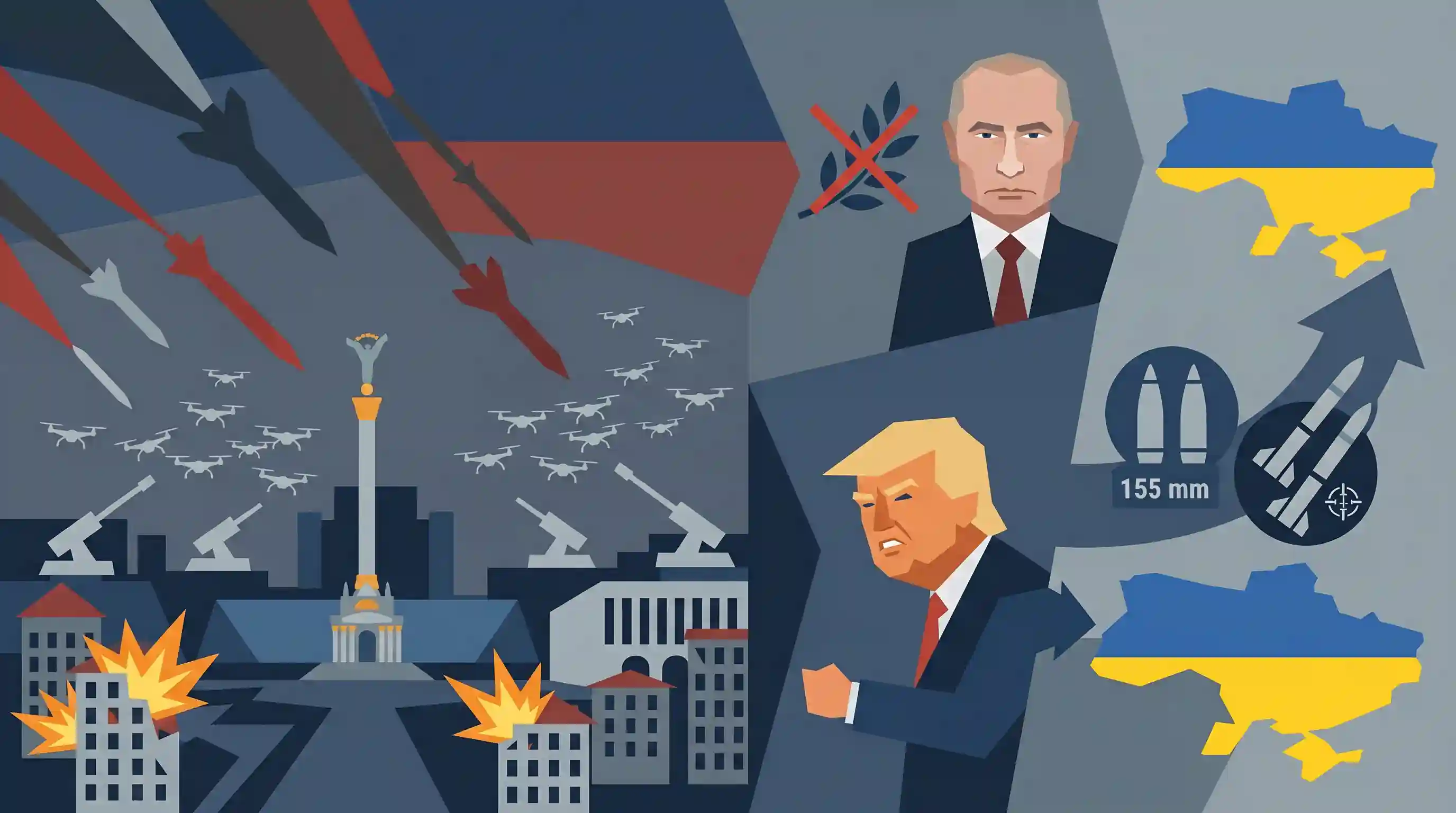
Russia subjected Ukraine's capital, Kyiv, to a massive overnight missile and drone assault, marking one of the heaviest aerial attacks in the ongoing war. The bombardment, which heavily featured decoy drones designed to overwhelm air defenses, caused civilian casualties and widespread damage to residential areas. Amid the escalating violence, U.S. President Donald Trump voiced frustration over Russian President Vladimir Putin's refusal to soften his peace demands. Consequently, the United States has resumed supplying Ukraine with vital weaponry, including 155 mm artillery munitions and GMLRS precision rockets, ending a brief pause in military aid.
Key Points
- Russia launched one of the heaviest aerial bombardments of the three-year war on Kyiv, utilizing over 700 attack and decoy drones to overwhelm Ukrainian air defenses.
- The strikes resulted in civilian casualties, extensive infrastructure damage, and have forced residents into underground shelters amid exhaustion from relentless warfare.
- U.S. President Donald Trump expressed dissatisfaction with Vladimir Putin's rigid stance on ceasefire and peace demands since Trump took office in January 2025.
- Reversing a recent pause, the United States resumed the delivery of critical military aid to Ukraine, including 155 mm munitions and precision-guided GMLRS rockets.
Important Terms
155 mm Artillery Munitions

Standard NATO-caliber heavy shells used by modern howitzers for long-range bombardment. They are a staple of conventional land warfare and essential for military logistics.
UPSC context
GS Paper III: Security and Science & Tech. Tests knowledge of artillery standards, defense procurement, and interoperability in modern warfare.
GMLRS (Guided Multiple Launch Rocket System)
High-precision, GPS-guided rocket system with a range of roughly 70-80 km. It allows for accurate strikes on high-value targets while minimizing collateral damage.
UPSC context
GS Paper III: Modern Warfare and Security Challenges. Crucial for understanding technical military aid and precision-strike technology.
Decoy Drones
Low-cost unmanned aerial vehicles designed to mimic missiles or aircraft to saturate and deplete enemy air defense systems, protecting more valuable strike assets.
UPSC context
GS Paper III: Internal Security/Modern Warfare. Relevant to the evolving nature of aerial combat, drone swarms, and electronic warfare.
Air Defense Systems
Integrated networks of radars, sensors, and interceptor missiles (e.g., Patriot or S-400) designed to detect, track, and destroy incoming aerial threats.
UPSC context
GS Paper III: Internal Security and Science & Tech. Tests understanding of national defense architecture and major defense acquisitions.
Asymmetric Warfare
Conflict where one side’s military capabilities differ significantly. It often involves the use of low-cost technology like drones to offset a larger adversary’s conventional power.
UPSC context
GS Paper III: Security Challenges. Key concept for understanding modern conflicts involving drones and non-state actors.
Prelims Trap
Because India historically relies on Russian military hardware, its indigenous ATAGS system uses the Russian 152mm artillery standard.
False. India's indigenous Advanced Towed Artillery Gun System (ATAGS) and Dhanush howitzers are specifically designed around the NATO-standard 155mm caliber.
Static Concepts Connected
How do decoy drone swarms challenge conventional Air Defense Systems (ADS)?
- Radar Saturation: Swarms overwhelm the tracking capacity of radar systems, creating false targets and masking the actual lethal payload.
- Cost Asymmetry: Defenders are forced to expend multi-million dollar interceptor missiles to shoot down cheap, commercially assembled drones, creating a severe financial imbalance.
- Low Signature: Small drones often fly at extremely low altitudes, exploiting terrain and the earth's curvature to evade traditional ground-based radar detection.
What is the significance of the 155mm artillery caliber for India?
- NATO Standard: It is the standard NATO-caliber for heavy artillery, offering an optimal balance between maximum firing range and high explosive payload.
- Indigenous Integration: Moving away from legacy Russian calibers, India's flagship indigenous artillery platforms like the Advanced Towed Artillery Gun System (ATAGS) utilize the 155mm standard.
- Strategic Interoperability: Manufacturing 155mm shells aligns India with global military supply chains, enhancing interoperability with Western partners and boosting defense export potential.
Cross-Topic Patterns
Drone proliferation & border security
Tactics seen in Ukraine (cheap decoys overwhelming ADS) are directly relevant to India's western border, where drones are increasingly deployed by non-state actors for smuggling and surveillance.
Defense standardization & exports
The massive global depletion of 155mm shells during the Ukraine war opens opportunities for India's defense manufacturing sector to supply standard ammunition to friendly foreign nations.

Expect a Prelims tech question on drone swarm evasion tactics or a comparative statement on India's indigenous artillery standards (ATAGS).
Linked PYQs · 3
Linked PYQs · 3
- 2023MainsGS2
‘The expansion and strengthening of NATO and a stronger US-Europe strategic partnership works well for India.’ What is your opinion about this statement ? Give reasons and examples to support your answer.
- 2025MainsGS2
"The reform process in the United Nations remains unresolved, because of the delicate imbalance of East and West and entanglement of the USA vs. Russo-Chinese alliance.” Examine and critically evaluate the East-West policy confrontations in this regard.
- 2023MainsGS3
The use of unmanned aerial vehicles (UAVs) by our adversaries across the borders to ferry arms/ammunitions, drugs, etc., is a serious threat to the internal security. Comment on the measures being taken to tackle this threat.
