Sumy missile strike and international humanitarian law
Source:The Hindu ↗
Why It Matters
The Russia-Ukraine conflict directly impacts global energy security, supply chains, and diplomatic alliances. The use of cluster munitions highlights ongoing debates in international humanitarian law and arms control, while the fluctuating peace talks underscore the complexities of international mediation.
Summary
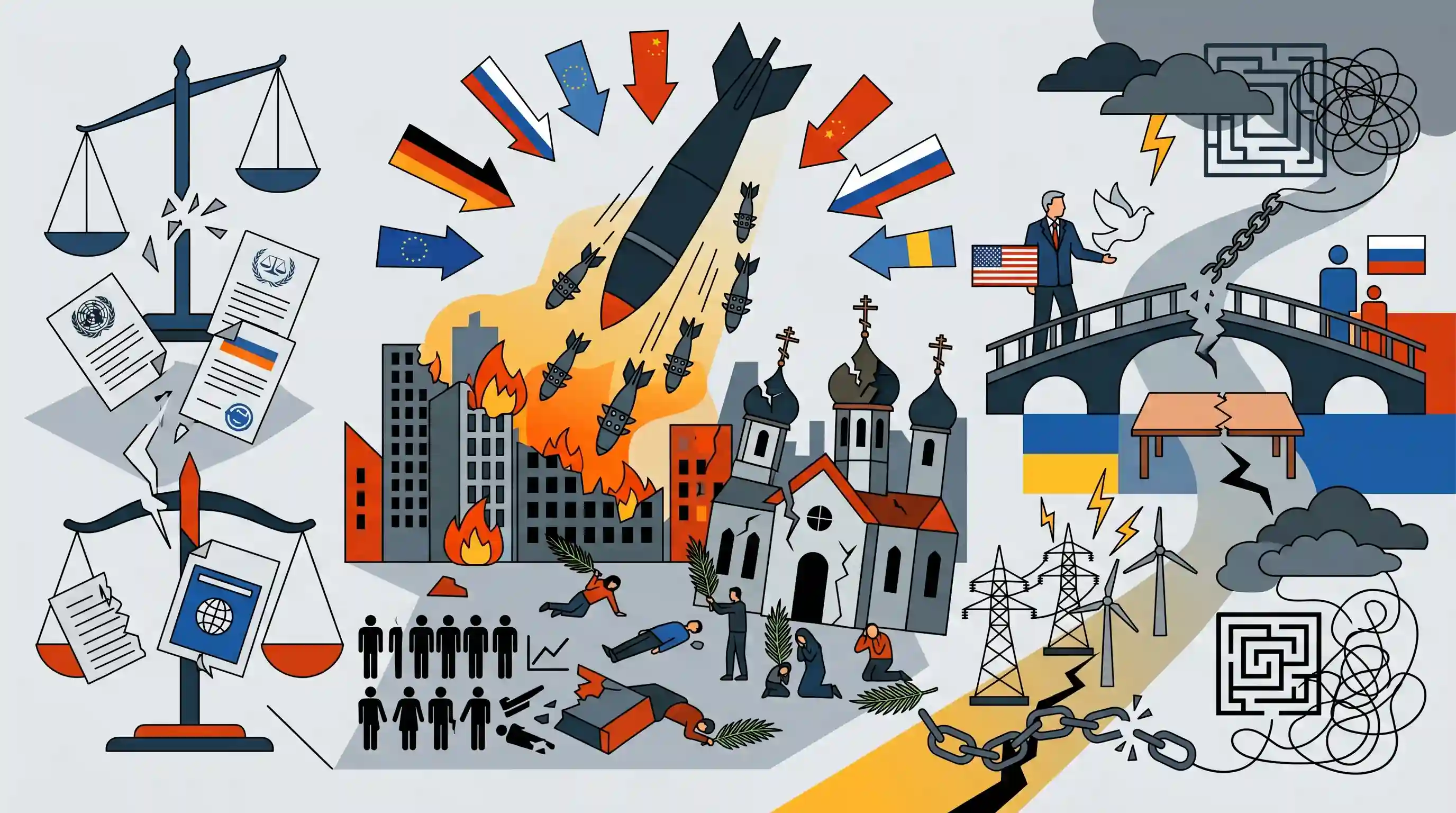
A Russian ballistic missile attack on the Ukrainian city of Sumy killed over 30 people and injured dozens during Palm Sunday celebrations. The use of cluster munitions in civilian areas has drawn widespread international condemnation and significantly undermined ongoing U.S.-brokered peace efforts. This escalation challenges a tentative, localized truce regarding energy infrastructure strikes and complicates future diplomatic negotiations.
Key Points
- A devastating Russian missile strike using ballistic missiles and cluster munitions hit the Ukrainian city of Sumy during Palm Sunday, resulting in significant civilian casualties.
- The attack has drawn sharp international condemnation from leaders such as French President Emmanuel Macron and key US officials.
- The escalation threatens to derail a fragile U.S.-brokered peace initiative aimed at bringing Russia and Ukraine to the negotiating table.
- The attacks occur amidst a tentative, localized agreement to halt strikes on energy infrastructure, highlighting the volatile nature of the conflict.
Important Terms
International Humanitarian Law (IHL)

Body of law (Geneva/Hague Conventions) regulating armed conflict to limit its effects. It protects non-combatants and restricts means and methods of warfare to minimize human suffering.
UPSC context
GS-II: International Relations/Institutions. Tests understanding of legal frameworks governing global conflicts and civilian protection.
Convention on Cluster Munitions (CCM)
An international treaty (2008) prohibiting the use, production, and stockpiling of cluster bombs. Neither Russia, Ukraine, nor the U.S. are currently signatories to this convention.
UPSC context
GS-II/III: International Treaties and Internal Security. Tests knowledge of global disarmament efforts and specific weapon regulations.
Cluster Munitions
A weapon that scatters numerous small explosive 'submunitions' over a wide area. They are condemned for high civilian casualty rates and long-term danger from unexploded duds.
UPSC context
GS-III: Security Challenges. Relates to warfare ethics and the impact of specific weaponry on civilian populations.
Iskander-M
A Russian short-range, nuclear-capable ballistic missile system. It is used for precision strikes but criticized when deployed in populated urban areas during the Ukraine conflict.
UPSC context
GS-III: Science and Technology/Defense. Relevant for identifying strategic military assets and their role in modern geopolitics.
Energy Infrastructure
Critical physical systems (power plants, grids) necessary for a state's functioning. Targeting these during war impacts civilian survival, often testing the legal limits of 'military necessity.'
UPSC context
GS-III: Infrastructure/Security. Examines the shift toward hybrid warfare and its socio-economic consequences.
Principle of Distinction
A core IHL rule requiring parties to an armed conflict to always distinguish between the civilian population and combatants, and between civilian objects and military objectives.
UPSC context
GS-II: International Relations. A foundational concept for assessing war crimes and humanitarian violations in UPSC Mains.
United Nations (UN)
The primary global intergovernmental organization responsible for maintaining international peace. In this conflict, it monitors human rights violations and facilitates humanitarian aid through agencies like OCHA.
UPSC context
GS-II: International Institutions. Focuses on the effectiveness and limitations of multilateralism in resolving high-stakes regional conflicts.
Prelims Trap
"India, along with major UN powers, is a signatory to the Convention on Cluster Munitions to protect civilians."
Major military powers including India, the US, Russia, China, and Ukraine have explicitly refused to sign the CCM due to strategic military reliance.
Static Concepts Connected
What is the Convention on Cluster Munitions (CCM)?
- Core Prohibition: An international treaty banning the use, transfer, production, and stockpiling of cluster bombs due to their indiscriminate area effect.
- Humanitarian Hazard: Unexploded submunitions act as landmines, violating International Humanitarian Law (Fourth Geneva Convention) by causing indiscriminate civilian harm long after conflicts.
- India's Stance: India is not a signatory, maintaining that cluster munitions are legitimate weapons if used strictly against military objectives.
How do Ballistic missiles differ from Cruise missiles?
- Propulsion: Ballistic missiles are rocket-powered only in the initial boost phase. Cruise missiles are jet-propelled and powered throughout their entire flight.
- Trajectory: Ballistic missiles follow a high-altitude, unpowered parabolic arc. Cruise missiles fly at lower altitudes, often hugging the terrain to evade radar.
Cross-Topic Patterns
Defense tech + International Treaties
The use of cluster munitions ties Defense Technology (missile types, submunitions) with IR Treaties (CCM, Geneva Convention), a classic UPSC linkage testing both technical and diplomatic knowledge.
Evacuation operations mapping
Sumy's location near the Russian border makes it a critical geography pin, famously serving as the focal point for India's Operation Ganga evacuations in 2022.

Expect a multi-statement Prelims question pairing Ukraine border cities (Sumy) with India’s non-signatory status on Cluster Munitions.
Linked PYQs · 3
Linked PYQs · 3
- 2012MainsGS2
Does Putin's return as President of Russia mark a shift to a confrontationist stance in international diplomacy towards the West?
- 2024PrelimsGS1
What is the common characteristic of the chemical substances generally known as CL-20, HMX and LLM-105, which are sometimes talked about in media?
- 2025PrelimsGS1
What is the common characteristic of the chemical substances generally known as CL-20, HMX and LLM-105, which are sometimes talked about in media?
