Russia Ukraine War Escalates with Massive Drone and Missile Assaults
Source:Indian Express ↗
Why It Matters
The article underscores the geopolitical dynamics of the Russia-Ukraine war, the strategic use of energy sanctions in global diplomacy, and the evolving nature of modern warfare involving massive drone swarms, which are critical themes for UPSC GS-2 (International Relations) and GS-3 (Security).
Summary
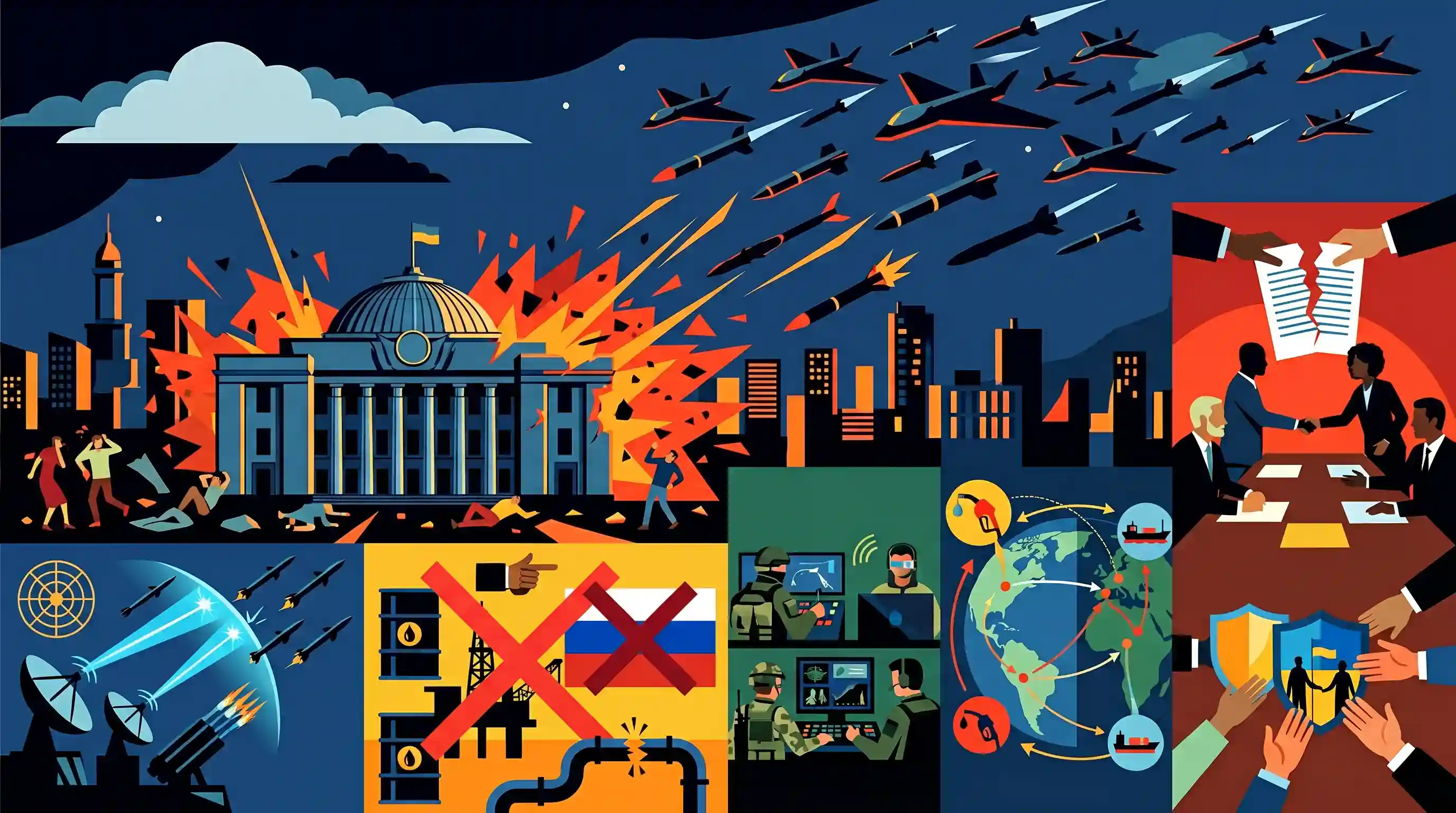
Russia conducted its largest overnight air assault on Ukraine, utilizing over 800 drones and multiple missiles, significantly escalating the ongoing conflict. The attack targeted Kyiv and struck the main government building in the Pecherskyi district for the first time, resulting in civilian casualties. In response, Ukrainian leadership emphasized the critical need for advanced air defense systems and urged the international community to enforce stringent sanctions against Russian oil and gas. The assault reflects the intensifying nature of modern warfare through large-scale drone usage and complicates the prospects for diplomatic negotiations amid allied reassurances to support Ukraine.
Key Points
- Russia launched its largest air attack on Ukraine since the war began, deploying 810 drones and decoys alongside 13 missiles.
- The strike damaged Ukraine's main government building in Kyiv for the first time, leaving at least two people dead.
- Ukrainian leaders called for urgent global action and demanded stronger sanctions against Russian oil and gas exports to curb its war efforts.
- The escalation occurred as European leaders urged an end to the war, and 26 of Ukraine's allies pledged troops as a post-war reassurance force.
Important Terms
Drone Warfare

The strategic and tactical use of Unmanned Aerial Vehicles (UAVs) for reconnaissance, surveillance, and combat. It introduces 'asymmetric warfare' where low-cost equipment can neutralize high-value assets.
UPSC context
GS Paper 3: Internal Security & Defense Technology. Tests understanding of modern combat, UAV swarms, and India's anti-drone requirements.
Economic Sanctions
Non-military penalties, such as trade embargoes, asset freezes, and financial restrictions, imposed by nations to influence another country's foreign policy or behavior.
UPSC context
GS Paper 2: International Relations. Tests knowledge of diplomatic tools, global supply chain disruptions, and the impact of unilateral measures.
Air Defense Systems
Integrated networks of sensors, radars, and interceptors designed to detect, track, and destroy incoming aerial threats like missiles and drones to protect critical infrastructure.
UPSC context
GS Paper 3: Science and Technology (Defense). Relates to India's S-400 acquisition and multi-layered 'no-fly' doctrines.
Global Energy Security
The reliable, sustainable, and affordable availability of energy sources. It involves diversifying energy mixes and securing supply lines against geopolitical disruptions.
UPSC context
GS Paper 3: Economy & Infrastructure. Crucial for India's oil-dependency challenges and the transition to renewable energy.
International Humanitarian Law (IHL)
A set of international rules, primarily the Geneva Conventions, that seek to limit the effects of armed conflict by protecting civilians and restricting means of warfare.
UPSC context
GS Paper 2: International Law. Relevant for ethical issues in conflict and the legality of targeting dual-use infrastructure.
Cabinet of Ukraine
The highest executive authority in Ukraine, composed of the Prime Minister and ministers. It is accountable to the President and the Verkhovna Rada (Parliament).
UPSC context
GS Paper 2: Comparative Polity. Tests understanding of executive structures in semi-presidential or unitary systems during crises.
Russian Military
The unified military force of the Russian Federation, including land, sea, and air branches, currently focused on high-intensity and hybrid warfare doctrines in Eurasia.
UPSC context
GS Paper 2: International Relations. Key to analyzing major power dynamics and their impact on India’s defense hardware strategy.
Prelims Trap
The UN Security Council has imposed strict, binding global sanctions on Russian oil and gas exports.
Sanctions on Russian energy are imposed unilaterally or multilaterally by Western nations (US, EU, G7). The UNSC cannot impose them because Russia holds veto power.
Static Concepts Connected
What distinguishes loitering munitions (kamikaze drones) from conventional cruise missiles?
- Loitering capability: Drones can hover over a target area for extended periods to passively search for, identify, and attack targets of opportunity.
- Cost asymmetry: Mass-produced drones are significantly cheaper than the advanced surface-to-air missiles required to intercept them, creating a defensive financial burden.
- Payload and speed: Missiles typically have much larger explosive payloads and travel at supersonic or hypersonic speeds, whereas drones are slower with smaller payloads.
How do unilateral energy sanctions affect third countries like India?
- Price volatility: Restricting access to major suppliers causes global price spikes, directly impacting the import bill and domestic inflation of energy-dependent nations.
- Payment mechanisms: Exclusion of the sanctioned state from SWIFT forces third countries to devise alternative settlement systems, like Rupee-Ruble trade, which carry exchange rate risks.
- Secondary sanctions risk: Entities in third countries face the risk of penalties or losing access to Western financial markets if they violate the primary sanctioning nation's rules.
Cross-Topic Patterns
Drone Swarms + Red Sea Crisis
The oversaturation tactic used by Russia mirrors Houthi strategies in the Red Sea, highlighting the vulnerability of conventional, expensive defense systems to cheap, mass-produced drones.
Energy Sanctions + Forex Management
Calls for stricter Russian oil sanctions directly impact India's current account deficit and inflation targeting, forcing strategic diversification of crude oil imports to manage macroeconomic stability.

Expect a 2026 Prelims question comparing the operational features of loitering munitions with conventional cruise missiles.
Linked PYQs · 4
Linked PYQs · 4
- 2023MainsGS2
‘The expansion and strengthening of NATO and a stronger US-Europe strategic partnership works well for India.’ What is your opinion about this statement ? Give reasons and examples to support your answer.
- 2025MainsGS2
"With the waning of globalization, post-Cold War world is becoming a site of sovereign nationalism.” Elucidate.
- 2025MainsGS2
"Energy security constitutes the dominant kingpin of India's foreign policy, and is linked with India's overarching influence in Middle Eastern countries.” How would you integrate energy security with India's foreign policy trajectories in the coming years?
- 2023MainsGS3
The use of unmanned aerial vehicles (UAVs) by our adversaries across the borders to ferry arms/ammunitions, drugs, etc., is a serious threat to the internal security. Comment on the measures being taken to tackle this threat.
