Russian Diplomatic Mediation in US Iran Nuclear Tensions
Source:The Hindu ↗
Why It Matters
The handling of Iran's enriched uranium is central to global nuclear non-proliferation efforts and stability in the Middle East. Russia's role as a mediator highlights shifting geopolitical dynamics, which have direct implications for global energy security and India's strategic interests in the region.
Summary
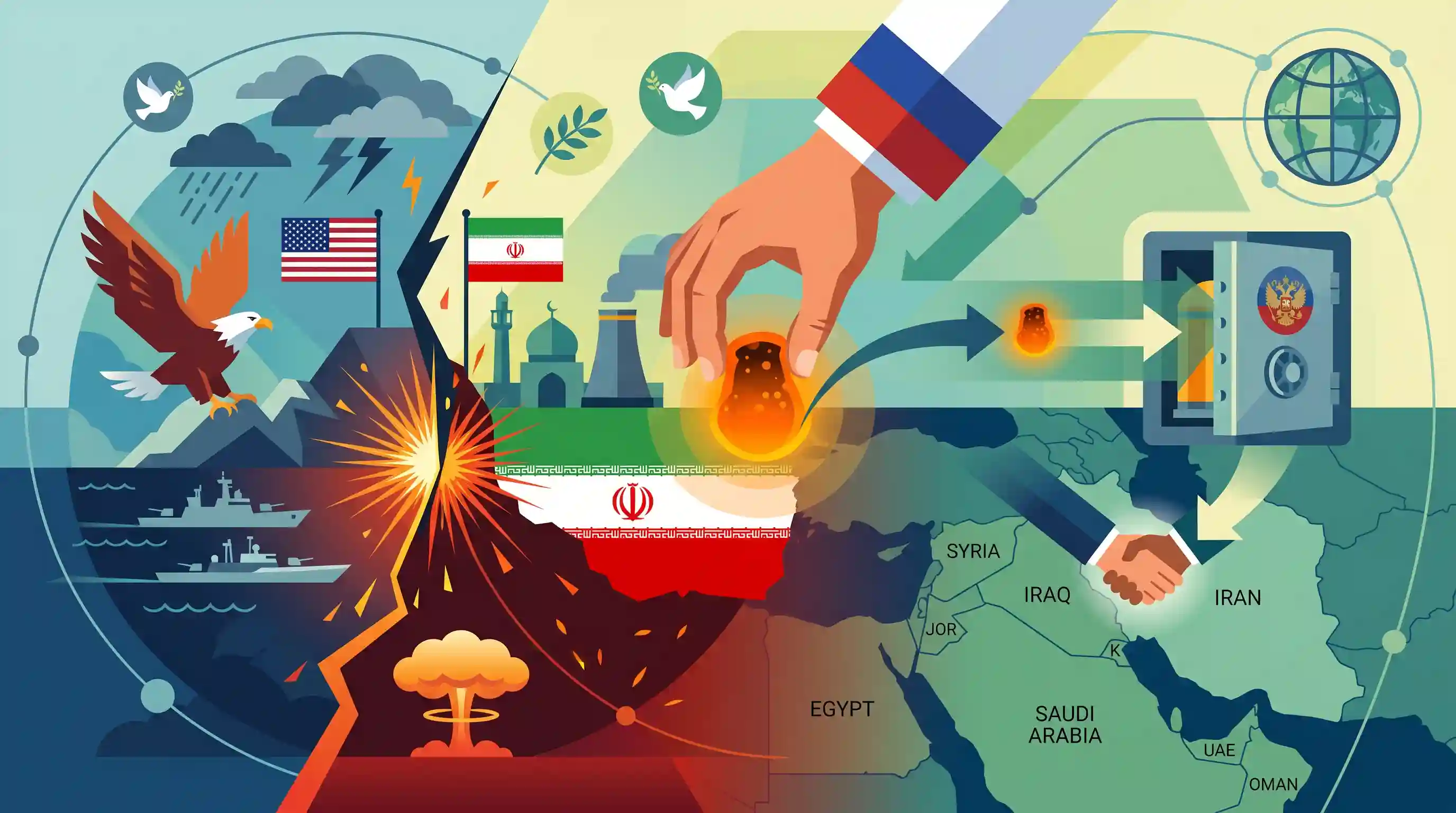
The Kremlin announced that Russia is attempting to de-escalate tensions between the United States and Iran by offering to process or store Iran's enriched uranium. This proposal aims to mitigate geopolitical friction and address nuclear proliferation concerns amid escalating threats of a broader regional conflict in the Middle East.
Key Points
- Russia is actively attempting to de-escalate the heightened tensions between the United States and Iran.
- The Kremlin has proposed processing or storing Iran's enriched uranium to address nuclear proliferation concerns.
- This proposal has reportedly been discussed over a long period with both Iran and the US to remove major geopolitical 'irritants'.
- The diplomatic maneuver comes amidst threats of military action and a broader regional war involving US forces and Iran.
Important Terms
Kremlin

A fortified complex in Moscow that is the official residence of the Russian President; the term is used metonymically to represent the Russian government and its foreign policy authority.
UPSC context
GS Paper 2 (International Relations). Crucial for analyzing the diplomatic stances and strategic influence of major global powers in regional conflicts.
Enriched Uranium
Uranium processed to increase the concentration of the fissile isotope U-235. Low-enriched uranium fuels power reactors, while uranium enriched to around 90% is required for nuclear weapons.
UPSC context
GS Paper 3 (Science & Tech). Tests understanding of the nuclear fuel cycle, energy security, and weaponization thresholds.
Nuclear Non-Proliferation
Global efforts to prevent the spread of nuclear weapons and technology, largely centered on the Non-Proliferation Treaty (NPT), while encouraging the peaceful use of nuclear energy under safeguards.
UPSC context
GS Paper 2 (IR). Vital for understanding global security architecture and India’s distinct stance on discriminatory international treaties.
JCPOA (Joint Comprehensive Plan of Action)
The 2015 agreement between Iran and the P5+1 powers that limited Tehran's nuclear activities—such as uranium enrichment—in exchange for relief from international economic sanctions.
UPSC context
GS Paper 2 (IR). Relevant for questions on West Asian stability, energy security, and India’s strategic interests in Iran.
IAEA (International Atomic Energy Agency)
The UN-affiliated global nuclear watchdog that promotes peaceful nuclear energy use and conducts inspections to ensure nations comply with non-proliferation agreements.
UPSC context
GS Paper 2 (International Institutions). Tests knowledge of global governance, safeguards, and the monitoring of sensitive nuclear programs.
Geopolitics
The study of how geographical factors, including location and natural resources, shape the political relations between nations and the strategic interests of global powers.
UPSC context
GS Paper 2 (IR). Core concept for analyzing power dynamics, regional stability, and the influence of major powers like Russia and the US.
Prelims Trap
The 2015 JCPOA was a bilateral nuclear agreement solely between the USA and Iran.
Aspirants often assume JCPOA was strictly US-Iran. It was a P5+1 multilateral deal (including Russia, China, UK, France, Germany) where Russia actively managed Iran's uranium.
Static Concepts Connected
What are the different grades of Uranium enrichment?
- Low-Enriched Uranium (LEU): Enriched below 20% U-235 (typically 3-5%), primarily used to fuel commercial light-water nuclear power reactors.
- Highly Enriched Uranium: Enriched to 20% or higher, utilized in specialized research reactors, medical isotope production, or naval propulsion.
- Weapons-Grade Uranium: Typically enriched to 90% or higher U-235, which is the standard concentration required to manufacture functional nuclear warheads.
How does US-Iran friction impact India's strategic connectivity?
- Chabahar Port viability: Crucial for bypassing Pakistan to access Afghanistan and Central Asia. Repeated US sanctions on Iran deter foreign investment and equipment procurement for the port.
- INSTC scaling bottlenecks: This multimodal transport network (India-Iran-Russia) suffers operational and scaling delays when Western sanctions restrict financial transactions with Iranian and Russian entities.
Cross-Topic Patterns
Geopolitics vs. India's macroeconomic stability
Middle East escalation directly impacts India's macroeconomic stability by risking Brent crude spikes, widening the Current Account Deficit (CAD), and exacerbating imported inflation.
Compartmentalized diplomacy in US-Russia relations
Despite adversarial relations over Ukraine, Russia and the US occasionally align on non-proliferation goals regarding Iran, highlighting how superpowers compartmentalize global diplomacy.

Uranium enrichment thresholds (LEU vs HEU) combined with India's INSTC/Chabahar stakes are highly probable as a linked 2026 Prelims MCQ.
Linked PYQs · 1
Linked PYQs · 1
- 2018MainsGS2
In what ways would the ongoing US-Iran Nuclear Pact Controversy affect the national interest of India? How should India respond to this situation?
