NATO triggers consultations after drone incursion into Polish airspace
Source:Indian Express ↗
Why It Matters
The incident highlights the volatile spillover risks of the Russia-Ukraine conflict into bordering NATO territories. It serves as a real-world case study of airspace sovereignty violations by unmanned aerial vehicles (UAVs) and tests the institutional mechanisms of NATO's collective security framework (specifically Article 4).
Summary
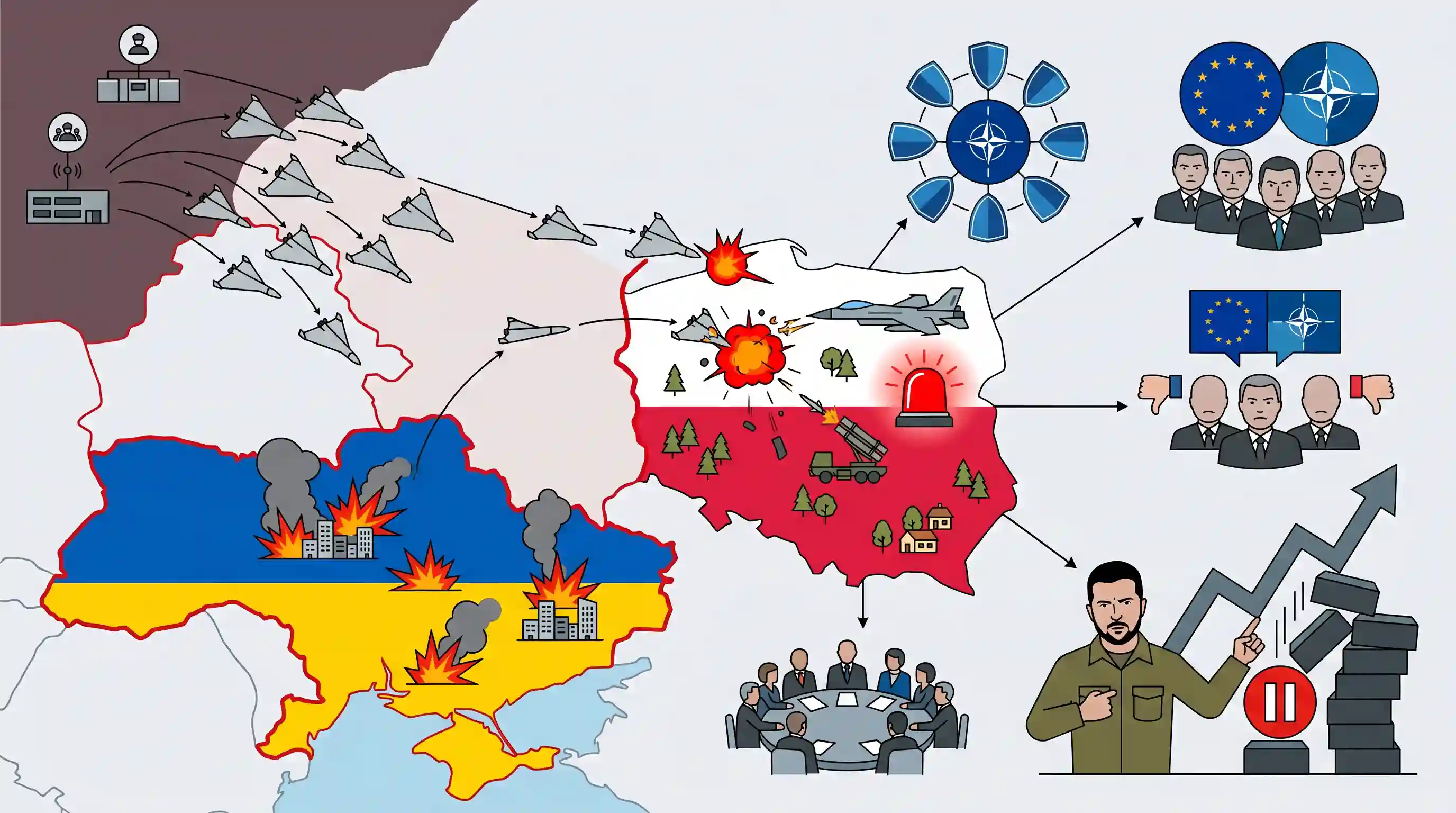
Russian 'Shahed' drones intentionally entered Polish airspace during a large-scale attack on Ukraine, prompting Poland to shoot them down and activate Article 4 of the NATO Treaty for allied consultations. The European Union and NATO strongly condemned the incursion as a deliberate provocation, while Ukrainian President Volodymyr Zelenskyy warned of further escalation and demanded an end to pauses in anti-Russia sanctions.
Key Points
- Multiple Russian-operated Shahed drones violated Polish airspace during a massive strike on Ukraine involving over 415 drones and 40 missiles.
- Poland shot down the drones and formally requested the activation of Article 4 of the NATO Treaty, initiating emergency allied security consultations.
- The European Union and NATO condemned the airspace violation, characterizing it as a deliberate and intentional provocation rather than an accident.
- Ukrainian President Zelenskyy called the incident a significant escalation and urged Western allies to end the pause on sanctions against Russia.
Important Terms
NATO (North Atlantic Treaty Organization)

A military and political alliance of 32 North American and European countries established by the 1949 North Atlantic Treaty to guarantee collective security through mutual defense.
UPSC context
GS Paper II: International Relations. Essential for understanding global security architecture, multilateral groupings, and India's evolving stance on Western alliances.
Article 4 of the NATO Treaty
A provision in the North Atlantic Treaty allowing any member state to call for formal consultations with allies when its territorial integrity, political independence, or security is perceived to be under threat.
UPSC context
GS Paper II & III: IR and Security. Tests the distinction between diplomatic consultation (Article 4) and collective military action (Article 5).
Airspace Sovereignty
The fundamental principle that a nation has complete and exclusive control over the atmosphere above its land and territorial waters, as codified in the 1944 Chicago Convention.
UPSC context
GS Paper II: International Law and IR. Critical for analyzing territorial disputes, border incursions, and international civil aviation regulations.
Shahed Drones
Iranian-origin low-cost, one-way-attack unmanned aerial vehicles (UAVs) that explode on impact. Known as 'kamikaze' drones, they are used to overwhelm air defenses through mass 'swarm' tactics.
UPSC context
GS Paper III: Security and Science & Tech. Highlights asymmetric warfare, the economics of attrition, and modern defense challenges like drone swarming.
European Union (EU)
A supranational political and economic union of 27 European member states that coordinates security policies, economic sanctions, and crisis management complementary to NATO's military role.
UPSC context
GS Paper II: Regional Groupings. Important for studying international organizations, trade relations with India, and the use of economic statecraft (sanctions).
Prelims Trap
"An armed drone crossing into a NATO member's airspace automatically triggers Article 5 collective defense."
Article 4 is solely for emergency consultations when a member feels threatened. It is Article 5 that invokes the famous "collective defense" mutual military retaliation.
Static Concepts Connected
What distinguishes NATO's Article 4 from Article 5?
- Article 4: Allows any member to request emergency consultations if their territorial integrity, political independence, or security is threatened.
- Article 5: The "collective defense" principle which states that an armed attack against one NATO member is considered an attack against all.
- Invocation history: Article 4 has been invoked multiple times (e.g., by Turkey and Poland), whereas Article 5 has only been invoked once, following the 9/11 attacks.
What are "loitering munitions" in modern warfare?
- Kamikaze Drones: Unmanned aerial vehicles (UAVs) designed to hover around a target area and strike by crashing into the target with built-in warheads.
- Swarm Tactics: Often deployed in large numbers to overwhelm traditional air defense radars and surface-to-air missile systems through sheer volume.
- Radar Evasion: Their low-altitude flight profiles allow them to evade standard radar detection, complicating early warning systems.
Cross-Topic Patterns
Cost asymmetry in modern drone warfare
The use of cheap Shahed drones forces nations to expend million-dollar interceptors. This highlights a stark cost-asymmetry in defense economics, linking warfare tactics directly to macroeconomic strain.
Chicago Convention and Airspace Sovereignty
The 1944 Chicago Convention grants states exclusive jurisdiction over national airspace. This legal baseline is increasingly tested by modern asymmetric warfare, including spy balloons and loitering munitions.

Expect a 2026 Prelims pair-matching question on NATO Articles (4 vs 5) or international aviation treaties (Chicago vs Warsaw Convention).
Linked PYQs · 4
Linked PYQs · 4
- 2023MainsGS2
‘The expansion and strengthening of NATO and a stronger US-Europe strategic partnership works well for India.’ What is your opinion about this statement ? Give reasons and examples to support your answer.
- 2014MainsGS3
International civil aviation laws provide all countries complete and exclusive sovereignty over the airspace above their territory. What do you understand by 'airspace'? What are the implications of these laws on the space above this airspace? Discuss the challenges which this poses and suggest ways to contain the threat.
- 2023MainsGS3
The use of unmanned aerial vehicles (UAVs) by our adversaries across the borders to ferry arms/ammunitions, drugs, etc., is a serious threat to the internal security. Comment on the measures being taken to tackle this threat.
- 2012MainsGS2
Does Putin's return as President of Russia mark a shift to a confrontationist stance in international diplomacy towards the West?
