Geopolitical Dynamics of the Russia Ukraine Conflict and Warfare
Source:The Hindu ↗
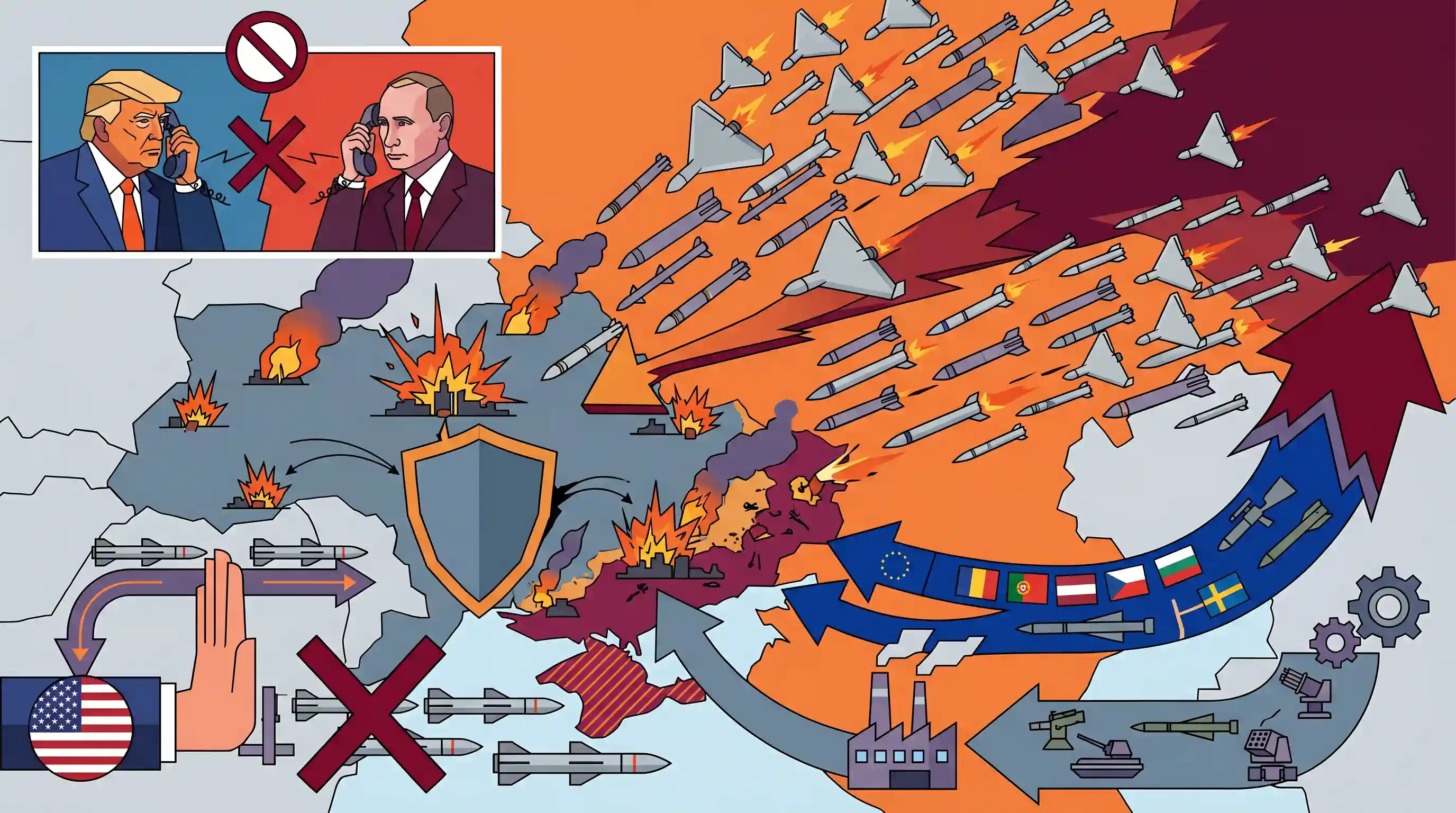
Why It Matters
Highlights the changing geopolitical dynamics of the Russia-Ukraine war, the increasing reliance on drone swarms in modern warfare, and the impact of shifting US foreign policy on ongoing global conflicts.
Summary
Russia launched its largest aerial assault on Ukraine since the war began, firing 550 drones—mostly Shaheds—and missiles at Kyiv and other regions. The barrage, which resulted in significant casualties and infrastructure damage, coincided with a phone call between US President Donald Trump and Russian President Vladimir Putin that failed to advance peace efforts. Concurrently, the US paused deliveries of crucial air defense missiles, exacerbating the strain on Ukraine's military capabilities and prompting reliance on European allies and domestic arms production. The timing and scale of the attack signal Moscow's intent to sustain military pressure and dictate terms amid faltering diplomatic initiatives.
Key Points
- Russia launched a record-breaking 550 drones (primarily Shahed) and 11 missiles at Ukraine, marking the largest aerial assault since the 2022 invasion.
- The attack coincided with a phone call between US President Donald Trump and Russian President Vladimir Putin, which yielded no progress toward ending the war.
- The US Pentagon has paused shipments of crucial air defense missiles to Ukraine, putting pressure on European allies to compensate.
- Ukrainian air defenses intercepted 270 targets, but the barrage resulted in casualties and widespread damage across multiple regions, including Kyiv.
- The assault reflects Russia's strategy of escalating long-range attacks to pressure Ukraine's front lines while peace negotiations remain stalled.
Important Terms
NATO (North Atlantic Treaty Organization)

An intergovernmental military alliance of 32 nations established in 1949 to ensure collective security. Its core principle, Article 5, mandates that an attack on one member is an attack on all.
UPSC context
GS Paper 2 (International Relations); tests understanding of global security architectures and India's strategic autonomy amid Western-led alliances.
Shahed Drones
Iranian-developed one-way attack (OWA) unmanned aerial vehicles used by Russia. Often called "suicide drones," they are cost-effective, fly at low altitudes to evade radar, and explode on impact.
UPSC context
GS Paper 3 (Science & Tech); highlights evolving threats in asymmetric warfare and the role of disruptive technologies in modern conflict.
Loitering Munitions
A category of weapons that hover over a target area before identifying and striking a specific target. They combine features of cruise missiles and surveillance drones to enable precision strikes.
UPSC context
GS Paper 3 (Defense/Security); crucial for understanding new-age warfare, indigenization of defense, and modern battlefield dynamics.
Air Defense Systems
Defensive hardware, including radars and interceptor missiles, designed to protect infrastructure by neutralizing incoming aerial threats like drones and missiles. Examples include the US Patriot and Russian S-400 systems.
UPSC context
GS Paper 3 (Internal Security); essential for analyzing India’s layered defense strategy and the impact of technological shifts on national security.
The Pentagon
The headquarters of the United States Department of Defense, used as a metonym for US military leadership and its global defense policy, including international military aid programs.
UPSC context
GS Paper 2 (International Relations); relevant for assessing US-India defense cooperation and the influence of American military strategy on global geopolitics.
Prelims Trap
Shahed drones are advanced, reusable combat UAVs deployed by Russia for continuous reconnaissance and precision strikes.
Shahed drones are low-cost "loitering munitions" (kamikaze drones) designed to detonate on impact. They are not reusable surveillance UAVs; their primary strategic advantage is expendability.
Static Concepts Connected
What distinguishes loitering munitions from traditional missiles and UAVs?
- Operational hybrid: They are hybrids that "loiter" in an area to identify targets before attacking by detonating on impact, blurring the line between UAVs and cruise missiles.
- Cost asymmetry: They are extremely cheap to produce (e.g., $20k) but force adversaries to use expensive interceptors (multi-million dollar missiles), draining enemy defense budgets.
- Swarm capability: They can be deployed in massive numbers to deliberately exhaust and overwhelm traditional air defence systems through saturation strikes.
How do major global air defence systems compare?
- Patriot & NASAMS: US/NATO systems designed for medium to long-range interception of aircraft, cruise missiles, and ballistic missiles. Ukraine uses these to counter Russian barrages.
- S-400 Triumf: Russian mobile surface-to-air missile system, capable of engaging aircraft, UAVs, and ballistic missiles at long ranges (India has procured these).
- Iron Dome: Israeli short-range air defence system specifically optimized to intercept unguided rockets and artillery shells using a cost-effective radar-to-interceptor calculation.
Cross-Topic Patterns
Border drone threat & cost asymmetry
The use of cheap kamikaze drones to saturate defenses in Ukraine mirrors internal security challenges India faces with low-cost cross-border narco-terror drones in Punjab and Jammu & Kashmir.
NATO burden sharing & European autonomy
The US pause on air-defense supplies forces European strategic autonomy, linking to broader geopolitical shifts where the EU must accelerate its own defense industrial base independent of NATO.

Expect a Prelims matching question on global Air Defence Systems (Patriot/S-400/Iron Dome) or a Mains Q on drone cost-asymmetry.
Linked PYQs · 3
Linked PYQs · 3
- 2025MainsGS2
"The reform process in the United Nations remains unresolved, because of the delicate imbalance of East and West and entanglement of the USA vs. Russo-Chinese alliance.” Examine and critically evaluate the East-West policy confrontations in this regard.
- 2023MainsGS2
‘The expansion and strengthening of NATO and a stronger US-Europe strategic partnership works well for India.’ What is your opinion about this statement ? Give reasons and examples to support your answer.
- 2023MainsGS3
The use of unmanned aerial vehicles (UAVs) by our adversaries across the borders to ferry arms/ammunitions, drugs, etc., is a serious threat to the internal security. Comment on the measures being taken to tackle this threat.
