Russia Launches Record Aerial Barrage Against Ukraine
Source:The Hindu ↗
Why It Matters
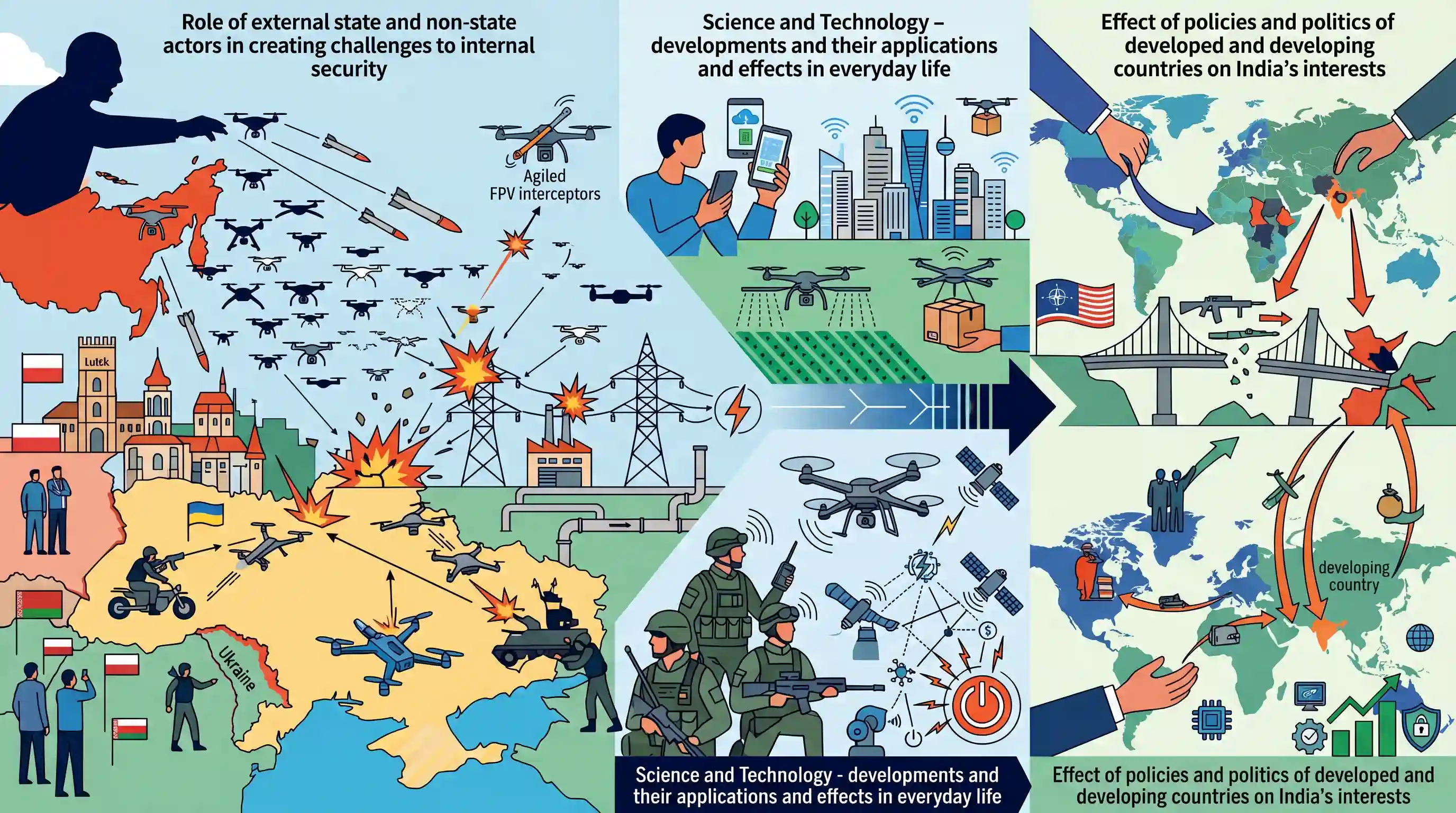
The unprecedented scale of drone swarm attacks and the use of decoys in the Russia-Ukraine war offer critical insights into the future of modern, asymmetric warfare. This has direct implications for India's defense preparedness, particularly concerning border security and the urgent need to develop cost-effective counter-UAV (drone) technologies against adversaries. Furthermore, the geopolitical maneuvering around NATO supply lines impacts global strategic balances.
Summary
Russia executed its largest aerial attack of the war, firing a record 728 drones and 13 missiles at Ukraine. The barrage heavily targeted the western city of Lutsk, situated near the Polish and Belarusian borders, to disrupt energy grids and logistical routes vital for Western military aid. The attack showcased advanced swarm tactics, utilizing a high volume of decoy drones to deplete Ukrainian air defenses. The event underscores the rapidly evolving nature of drone warfare—with Ukraine deploying FPV interceptor drones in response—and highlights the ongoing geopolitical vulnerabilities linked to fluctuating U.S. and NATO military support.
Key Points
- Russia launched an unprecedented overnight barrage against Ukraine, firing a record 728 drones and 13 missiles, marking a significant escalation in aerial warfare.
- The attack strategically targeted the western city of Lutsk, located near the borders of Poland and Belarus, aiming to disrupt key logistical and energy infrastructure close to NATO supply lines.
- A large portion of the Russian swarm consisted of decoy drones without warheads, deployed specifically to overwhelm and exhaust Ukraine's air defense systems.
- In response to the evolving threat, Ukraine has increasingly utilized First-Person View (FPV) interceptor drones as a cheaper, effective countermeasure against incoming Russian UAVs.
- The escalation occurs against a backdrop of geopolitical uncertainty, notably regarding U.S. military aid under President Donald Trump, highlighting Ukraine's critical dependence on continuous Western support.
Important Terms
NATO (North Atlantic Treaty Organization)

A 32-member intergovernmental military alliance established by the 1949 North Atlantic Treaty. It operates on the principle of collective defense, where an attack on one member is an attack on all.
UPSC context
GS Paper II: International Relations. Crucial for understanding global security architecture and India’s strategic autonomy in a multipolar world.
Swarm Tactics
A military strategy using large numbers of coordinated, low-cost unmanned aerial vehicles to saturate and overwhelm enemy air defenses, exploiting the inability of traditional systems to track multiple targets simultaneously.
UPSC context
GS Paper III: Security and S&T. Tests knowledge of asymmetric warfare and defense innovations relevant to India's border security.
FPV Interceptor Drones
Unmanned aircraft piloted via real-time video feeds, increasingly used as kinetic interceptors to destroy other drones. They represent a rapid shift from reconnaissance to active air-to-air combat roles.
UPSC context
GS Paper III: Science & Technology. Focuses on emerging defense technologies and their tactical applications in modern high-intensity conflicts.
Decoy Drones
Unarmed UAVs designed to mimic the radar and thermal signatures of combat drones or missiles. They are used to confuse defenses and deplete expensive interceptor missile stockpiles.
UPSC context
GS Paper III: Internal Security. Related to resource depletion strategies and the cost-asymmetry challenge in modern air defense.
Asymmetric Warfare
A conflict where participants' military power or tactics differ significantly. It often involves a weaker actor using low-cost technology (like drones) to inflict disproportionate damage on a stronger adversary.
UPSC context
GS Paper III: Security. Essential for analyzing non-traditional threats from state and non-state actors targeting critical infrastructure.
Hybrid Warfare
A military strategy that blends conventional warfare with irregular tactics, including cyberattacks, disinformation, and the systematic targeting of civilian energy and logistical infrastructure to erode national resilience.
UPSC context
GS Paper III: Internal Security. Crucial for understanding evolving threats that bypass traditional battlefield boundaries to target civilian life.
Prelims Trap
"FPV interceptor drones rely primarily on GPS or satellite navigation for terminal guidance."
False. FPV drones are manually controlled via real-time video feeds. This independence from GPS makes them highly resilient to satellite jamming and electronic warfare.
Static Concepts Connected
What are the primary counter-drone technologies (C-UAS) used in warfare?
- Kinetic Kill: Using localized projectiles, anti-aircraft guns, or smaller interceptor drones to physically destroy the target.
- Electronic Warfare (EW): Jamming radio frequencies and spoofing GPS signals to sever the drone's command-and-control link.
- Directed Energy Weapons: Using high-energy lasers or microwaves to fry a drone's electronics at a very low cost-per-shot.
Which countries share a land border with Ukraine?
- North & East: Belarus to the north, and Russia to the north and east.
- West: Poland, Slovakia, and Hungary, which serve as crucial NATO logistical hubs.
- Southwest: Romania and Moldova, with the Black Sea providing the southern maritime boundary.
Cross-Topic Patterns
Swarm drones + India's border security
The use of cheap decoys to exhaust advanced defenses is a major challenge for India's BSF in Punjab and Jammu, pushing the military toward cost-effective anti-drone systems.
Cost asymmetry + Directed Energy Weapons
Using multi-million dollar missiles against $500 drones is economically unsustainable. This cost asymmetry drives India's push for indigenous Directed Energy Weapons (like DURGA II) to neutralize cheap aerial threats.

Expect a 2026 Sci-Tech prelims statement differentiating autonomous AI swarm drones from manually controlled, GPS-independent FPV drones.
Linked PYQs · 3
Linked PYQs · 3
- 2023PrelimsGS1
Consider the following countries: 1. Bulgaria 2. Czech Republic 3. Hungary 4. Latvia 5. Lithuania 6. Romania How many of the above-mentioned countries share a land border with Ukraine?
- 2023MainsGS2
‘The expansion and strengthening of NATO and a stronger US-Europe strategic partnership works well for India.’ What is your opinion about this statement ? Give reasons and examples to support your answer.
- 2023MainsGS3
The use of unmanned aerial vehicles (UAVs) by our adversaries across the borders to ferry arms/ammunitions, drugs, etc., is a serious threat to the internal security. Comment on the measures being taken to tackle this threat.
