Massive Drone and Missile Strikes Target Ukrainian Energy Grid
Source:The Hindu ↗
Why It Matters
The conflict exemplifies modern asymmetric warfare through the extensive use of UAVs (drones) to target critical national infrastructure, presenting lessons for global internal security and defense architectures. It also highlights the shifting geopolitical landscape and U.S. foreign policy transition, illustrating how major power mediation influences regional security frameworks.
Summary
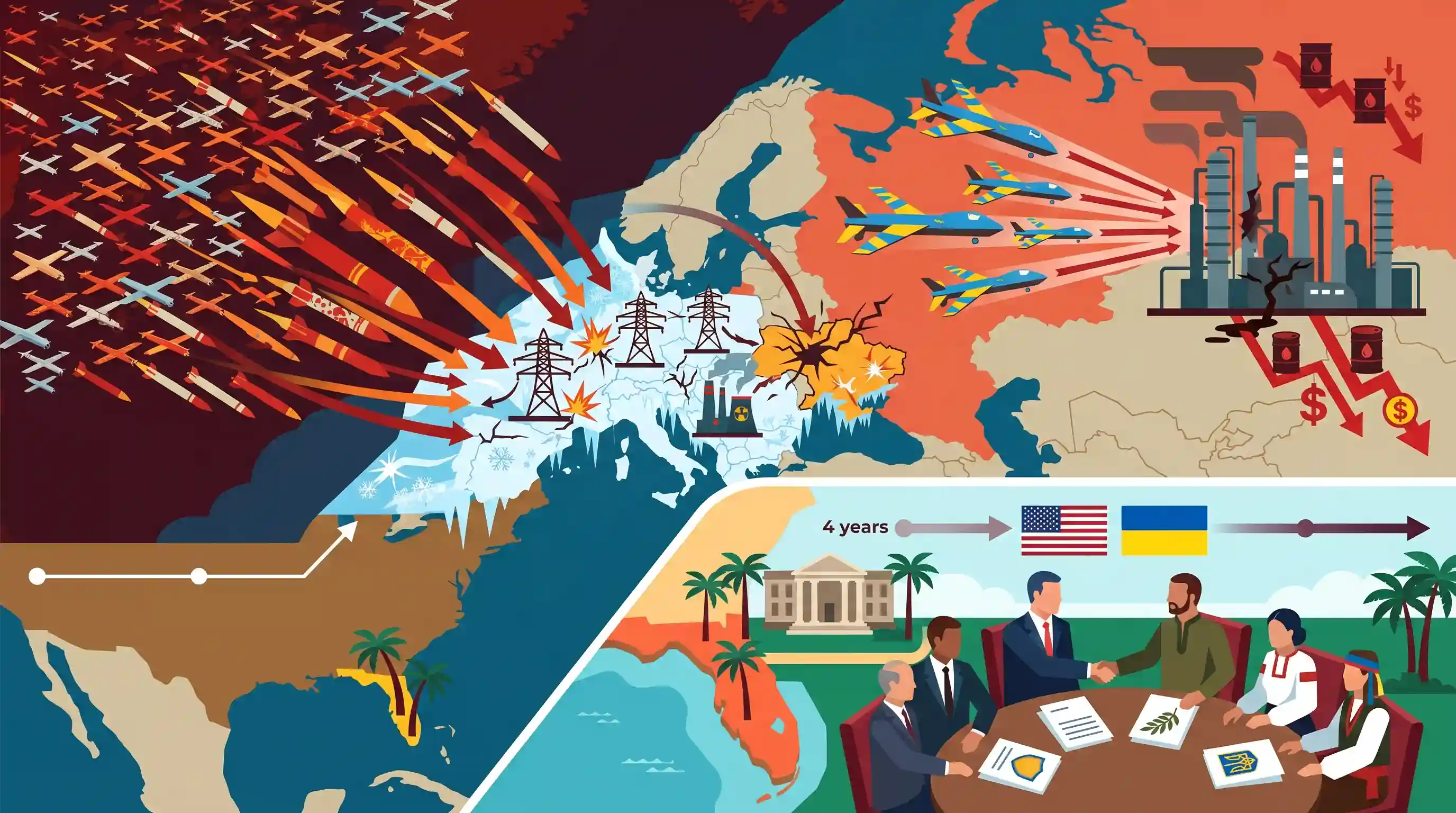
Russia executed a massive coordinated attack on Ukraine using 653 drones and 51 missiles, primarily targeting energy infrastructure to weaponise the impending winter. In retaliation, Ukraine launched long-range drone strikes on Russia\'s Ryazan Oil Refinery, aiming to curtail Moscow's oil export revenue. The intense military escalation contrasts with ongoing diplomatic efforts in Florida, where U.S. President Donald Trump's special envoys and Ukrainian negotiators are working on a postwar security framework to end the nearly four-year-old conflict.
Key Points
- Russia launched a massive barrage of 653 drones and 51 missiles against Ukraine, heavily targeting energy infrastructure and the Fastiv train station.
- Ukraine reported neutralising 585 drones and 30 missiles, while also reportedly striking Russia\'s Ryazan Oil Refinery with long-range drones to disrupt oil export revenues.
- The escalation coincides with the \'weaponisation\' of winter, as Russia aims to cripple the Ukrainian power grid and deny civilians access to heating and electricity.
- Simultaneously, U.S. mediated peace talks are underway in Florida involving Trump advisers and Ukrainian officials to establish a postwar security framework.
Important Terms
Ukrenergo

Ukraine's state-owned electricity transmission system operator. It manages the national power grid and ensures stability, especially during Russian strikes on critical energy infrastructure to prevent widespread winter blackouts.
UPSC context
GS Paper 2 & 3: International Relations and Infrastructure. Tests understanding of energy security and the role of critical infrastructure in modern warfare.
Ryazan Oil Refinery
One of Russia's largest oil refineries, owned by Rosneft. It is a strategic target for Ukrainian drone strikes aimed at disrupting Russian military fuel supplies and reducing Moscow's oil export revenue.
UPSC context
GS Paper 2: International Relations. Illustrates economic warfare and the strategic importance of energy assets in geopolitical conflicts.
United States Government
The federal government of the United States, which under the Trump administration (2025) acted as a mediator, proposing security frameworks and ceasefire deals to end the Russia-Ukraine conflict.
UPSC context
GS Paper 2: International Relations. Tests knowledge of bilateral ties, global diplomacy, and the role of major powers in regional conflict resolution.
Armed Forces of Ukraine
The military organization of Ukraine responsible for national defense. In the current conflict, they employ asymmetric warfare, including long-range drone strikes on Russian economic targets, to offset conventional disadvantages.
UPSC context
GS Paper 3: Internal Security & Defense. Tests understanding of contemporary military strategies, asymmetric warfare, and national sovereignty.
Ministry of Defence (Russia)
The executive body responsible for Russia’s military policy and operations. It coordinates the massive missile and drone campaigns targeting Ukrainian infrastructure to achieve strategic and political objectives.
UPSC context
GS Paper 2: International Relations. Relevant for studying state actors, military aggression, and the impact of great power politics on global stability.
Security Framework
A proposed set of guarantees and diplomatic arrangements intended to ensure the long-term stability and territorial integrity of Ukraine following a potential ceasefire or peace agreement.
UPSC context
GS Paper 2: International Relations. Tests understanding of post-conflict reconstruction, international law, and diplomatic mechanisms for peace.
Prelims Trap
Under the UN Charter, a Permanent Member (P5) must abstain from using its veto power if it is a direct party to the conflict.
False. Article 27(3) requires abstention only for Chapter VI (peaceful settlement) disputes. For Chapter VII (use of force/sanctions), P5 members like Russia retain full veto power, causing UN paralysis.
Static Concepts Connected
What are the key elements of Asymmetric Warfare and Drone Swarm tactics?
- Cost Asymmetry: Inexpensive kamikaze drones (e.g., Shaheds) are deployed to financially exhaust multi-million dollar traditional air defense interceptors like Patriot missiles.
- Swarm Tactics: Interconnected UAVs communicate and coordinate to saturate and overwhelm sophisticated radar and interceptor batteries through sheer numbers and redundancy.
- Strategic Attrition: The primary goal shifts from direct territorial conquest to the economic and logistical exhaustion of the adversary.
How does International Humanitarian Law protect civilian infrastructure during conflicts?
- Geneva Conventions: Additional Protocol I strictly prohibits attacking, destroying, or rendering useless objects indispensable to the survival of the civilian population.
- Principle of Distinction: Parties to a conflict must at all times distinguish between military objectives and civilian objects (e.g., power grids, civilian heating plants).
- Rule of Proportionality: Incidental harm to civilians or civilian infrastructure must not be excessive in relation to the concrete and direct military advantage anticipated.
Cross-Topic Patterns
Energy chokepoints and global imported inflation
Attacks on Russian oil refineries and Ukrainian power grids disrupt global energy supply chains, directly connecting European energy security challenges to imported inflation in nations like India.
UNSC paralysis and extra-institutional diplomacy
Hosting peace talks in Florida outside formal UN frameworks highlights the Security Council's systemic deadlock, reflecting a shift toward ad-hoc, informal mediation in modern geopolitics.

Expect a 2026 prelims statement linking drone swarm tactics (asymmetric warfare) with the cost-exhaustion of traditional air defense systems.
Linked PYQs · 2
Linked PYQs · 2
- 2025MainsGS2
"The reform process in the United Nations remains unresolved, because of the delicate imbalance of East and West and entanglement of the USA vs. Russo-Chinese alliance.” Examine and critically evaluate the East-West policy confrontations in this regard.
- 2023MainsGS3
The use of unmanned aerial vehicles (UAVs) by our adversaries across the borders to ferry arms/ammunitions, drugs, etc., is a serious threat to the internal security. Comment on the measures being taken to tackle this threat.
