Kyiv Drone Attacks and US Russia Diplomatic Talks
Source:The Hindu ↗
Why It Matters
The ongoing Russia-Ukraine conflict and the associated diplomatic maneuvering between the U.S. and Russia are central to global geopolitics. Understanding these dynamics is crucial for GS-2 (International Relations), as it highlights the interplay between direct military confrontation (like drone warfare) and complex back-channel diplomacy among superpowers.
Summary
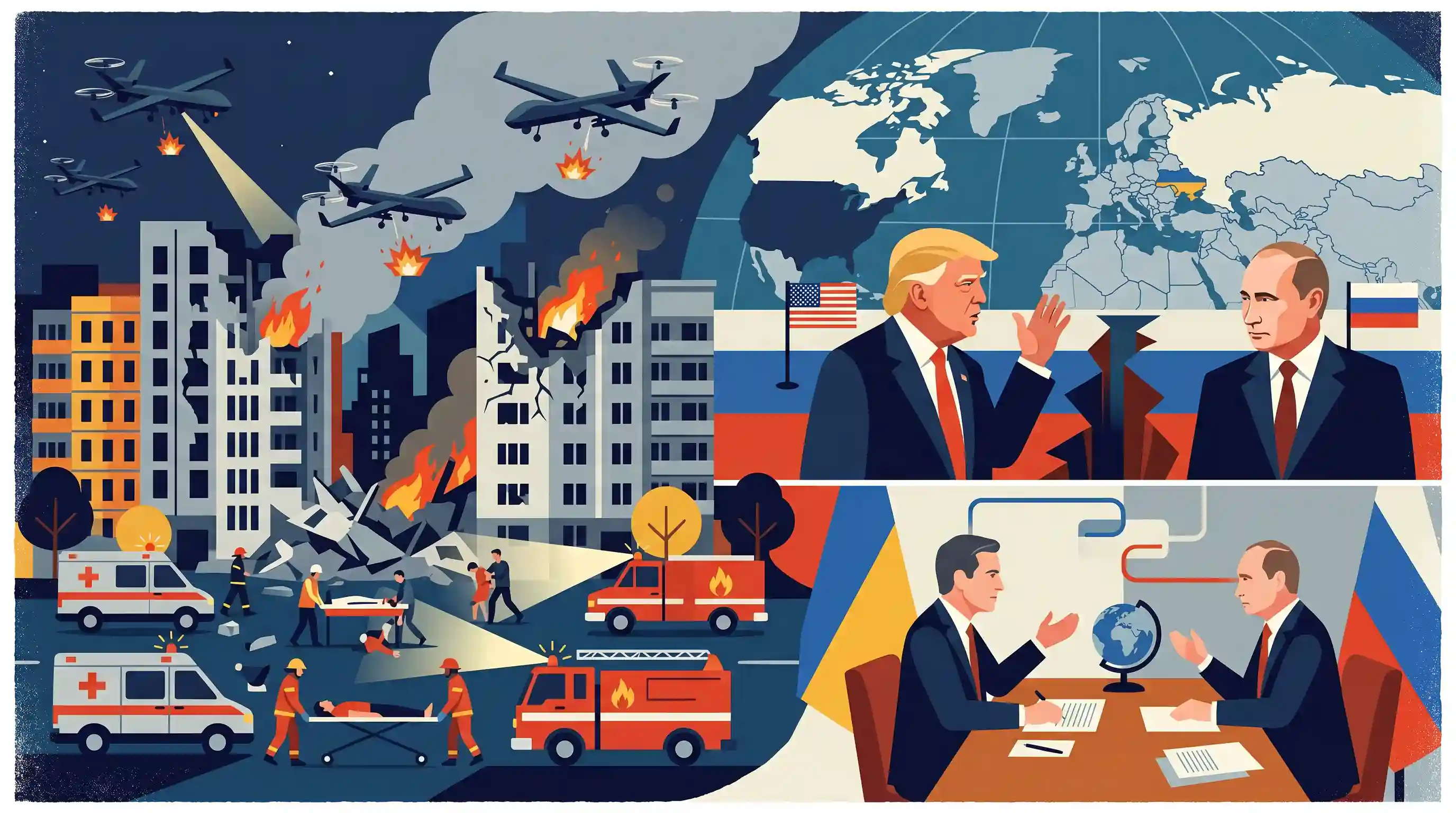
A recent overnight Russian drone attack on Kyiv resulted in three fatalities and 27 injuries, severely damaging multiple residential buildings according to Mayor Vitali Klitschko. While military hostilities escalate with the use of unmanned aerial vehicles, diplomatic efforts continue in the background. U.S. President Donald Trump publicly dismissed the prospect of an immediate summit with Vladimir Putin. Concurrently, ongoing discussions are taking place between Kremlin negotiator Kirill Dmitriev and Trump's special envoy Steve Witkoff, reflecting complex U.S.-Russia back-channel diplomacy amidst the broader Russia-Ukraine war.
Key Points
- An overnight Russian drone attack on Kyiv killed three people and wounded 27 others, severely damaging residential buildings in the Ukrainian capital.
- Kyiv Mayor Vitali Klitschko reported significant destruction across multiple districts, highlighting the ongoing impact of drone warfare on civilian infrastructure.
- U.S. President Donald Trump publicly downplayed the prospect of an immediate summit with Russian President Vladimir Putin, stating he was not going to waste his time.
- Simultaneously, back-channel diplomatic efforts persist, with Kremlin negotiator Kirill Dmitriev meeting U.S. special envoy Steve Witkoff to discuss the conflict.
Important Terms
The Kremlin

A metonym for the Government of the Russian Federation, specifically the executive branch. Historically a fortified complex in Moscow, it now symbolizes Russian sovereign power and decision-making.
UPSC context
GS Paper II (International Relations). Key for understanding bilateral ties and the central authority driving Russian foreign policy during global conflicts.
Back-channel diplomacy
Secret or unofficial communication between states that bypasses formal diplomatic channels. It allows adversaries to explore policy shifts or sensitive peace deals without immediate public or bureaucratic scrutiny.
UPSC context
GS Paper II. Crucial for conflict resolution topics, testing a candidate's understanding of informal vs. formal negotiation mechanisms in IR.
Unmanned Aerial Vehicles (UAVs)
Aircraft operated without a human pilot onboard, either remotely or autonomously. Used for ISR (Intelligence, Surveillance, Reconnaissance) and precision strikes, they are central to modern asymmetric warfare.
UPSC context
GS Paper III (Science & Tech; Internal Security). Tests knowledge of disruptive military technologies and their impact on global and national security.
Special Envoy
A high-ranking diplomat appointed by a head of state for a specific, often temporary, mission or to handle a particular international crisis/region outside regular embassy channels.
UPSC context
GS Paper II. Relevant to the machinery of international relations and executive-led diplomatic interventions in high-stakes negotiations.
Geopolitics
The study of how geographical factors, such as location, resources, and terrain, influence international politics and the strategic relationships between nations.
UPSC context
GS Paper II. The foundational framework for analyzing global power shifts, regional conflicts, and India's strategic positioning between major powers.
Trump administration
The executive branch of the U.S. government under Donald Trump. In a 2025 context, it signifies a shift toward transactional diplomacy, potential normalization with Russia, and protectionist trade policies.
UPSC context
GS Paper II. Focuses on the "Effect of policies of developed countries on India’s interests," specifically regarding trade tariffs and strategic alignment.
Prelims Trap
Track II diplomacy consists of secret, back-channel negotiations conducted by official government envoys and sitting diplomats.
Track II involves unofficial, non-governmental actors (academics, retired officials). Secret negotiations by official state representatives, even if hidden, remain Track I back-channel diplomacy.
Static Concepts Connected
What are the primary 'Tracks' of diplomacy in international relations?
- Track I: Official government-to-government negotiations and dialogues conducted by sitting state leaders, diplomats, or appointed special envoys.
- Track II: Unofficial, informal dialogues involving non-state actors like think tanks, NGOs, and retired officials to build trust.
- Track 1.5: Hybrid diplomatic efforts where official state representatives and non-official actors participate collaboratively in conflict resolution.
What core principles govern civilian protection under International Humanitarian Law (IHL)?
- Geneva Conventions: The 1949 Fourth Geneva Convention and 1977 Additional Protocols explicitly mandate the protection of non-combatants and civilian infrastructure in war zones.
- Principle of Distinction: Warring parties must strictly distinguish between combatants and civilians, directing attacks only against legitimate military objectives.
- Proportionality Principle: Incidental civilian casualties or damage to civilian infrastructure must not be excessive in relation to the concrete military advantage anticipated.
Cross-Topic Patterns
UAVs and India's border security
The proliferation of cheap, precision-strike drones in European conflicts directly mirrors India's asymmetric internal security challenges, particularly cross-border narco-terror drone incursions in Punjab and Jammu & Kashmir.
Back-channel utility in frozen bilateral ties
US-Russia back-channeling reflects how states bypass deadlocked formal relations. India frequently uses similar intelligence and envoy back-channels with Pakistan to manage crises, such as the 2021 LoC ceasefire agreement.

Expect a Prelims matching question on diplomacy tracks (Track I, II, 1.5) or a GS2 Mains question on back-channel efficacy in frozen ties.
Linked PYQs · 2
Linked PYQs · 2
- 2012MainsGS2
Does Putin's return as President of Russia mark a shift to a confrontationist stance in international diplomacy towards the West?
- 2023MainsGS3
The use of unmanned aerial vehicles (UAVs) by our adversaries across the borders to ferry arms/ammunitions, drugs, etc., is a serious threat to the internal security. Comment on the measures being taken to tackle this threat.
