Arctic Region Emerges as New Strategic Flashpoint for Major Powers
Source:Indian Express ↗
Why It Matters
The militarization and geopolitical contestation in the Arctic represent a fundamental shift in global power dynamics. For UPSC aspirants, the topic connects GS-1 (economic geography and climate change impacts) with GS-2 (international relations, global governance mechanisms like the Arctic Council, and major power rivalry). Given India's observer status in the Arctic Council and its own 'Arctic Policy', understanding this emerging strategic theater is crucial.
Summary
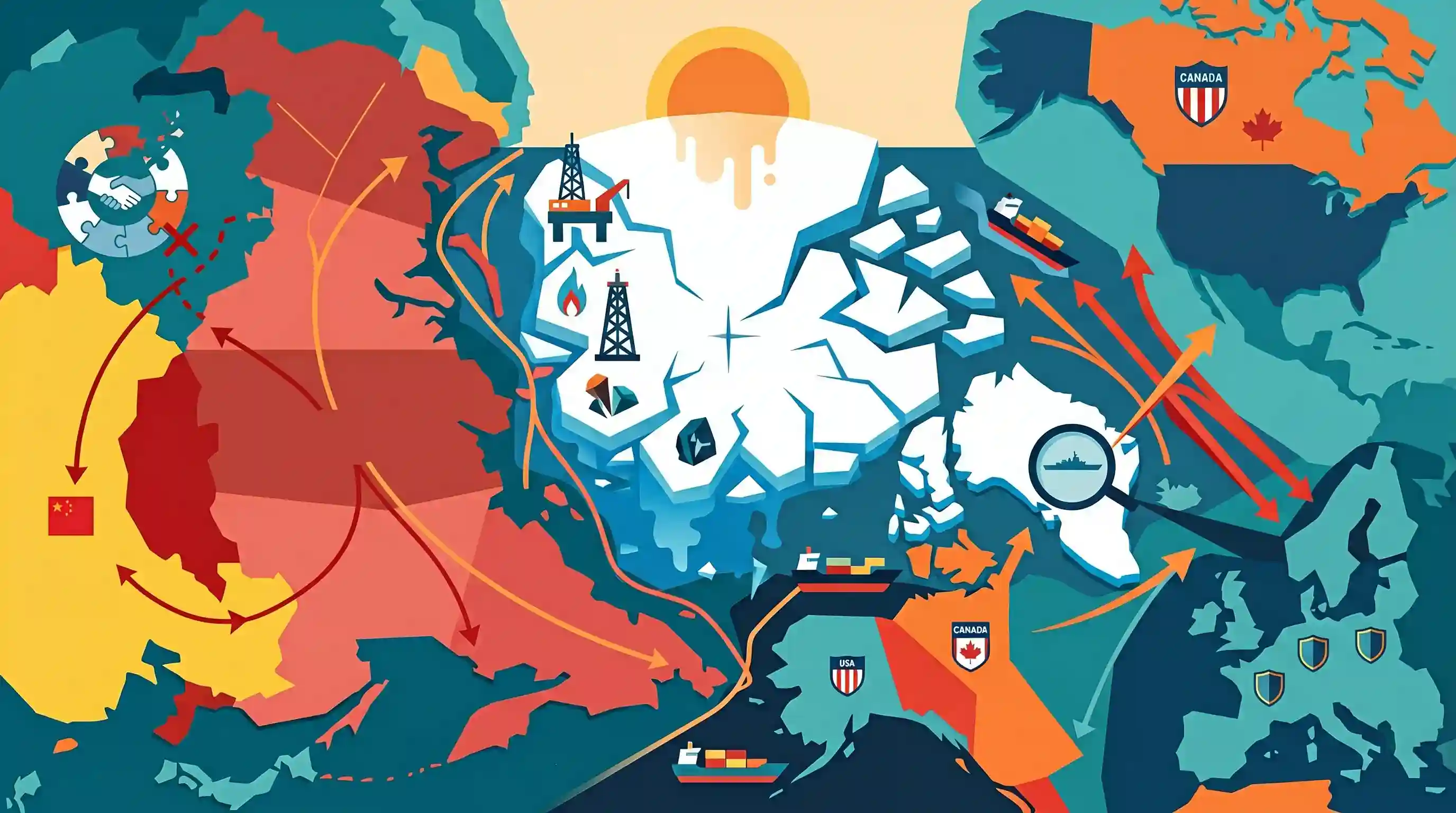
The article highlights the intensifying geopolitical competition in the Arctic, catalyzed by the accelerating effects of climate change and melting ice. As new maritime routes like the Northern Sea Route become navigable and vast natural resources become accessible, the region is transforming into a major strategic arena. Russia, facing isolation from the West, is deepening its partnership with China, which seeks to establish a 'Polar Silk Road' to expand its global influence. This burgeoning Sino-Russian axis has raised significant concerns in the United States—exemplified by past discussions regarding the strategic value of Greenland—and among NATO allies. Furthermore, the fallout from the Ukraine conflict has severely disrupted the functioning of the Arctic Council, effectively turning the once-cooperative region into a new flashpoint of global power rivalry.
Key Points
- The melting of Arctic ice is opening up the Northern Sea Route (NSR), creating a faster maritime trade corridor between Europe and Asia and unlocking vast, untapped energy and mineral resources.
- Isolated by Western sanctions, Russia is heavily leaning on China to help develop its Arctic infrastructure, facilitating China's ambitions as a self-declared 'near-Arctic state' and its 'Polar Silk Road'.
- The growing Sino-Russian footprint in the Arctic has triggered alarm in the US and NATO, reviving strategic anxieties that were highlighted by Donald Trump's past proposal to buy Greenland.
- Geopolitical tensions, particularly stemming from the Ukraine war, have paralyzed the Arctic Council, undermining collective governance, scientific cooperation, and climate mitigation efforts in the fragile region.
Important Terms
Arctic Council

Intergovernmental forum promoting cooperation among eight Arctic nations and indigenous groups on sustainable development and environmental protection. Established by the 1996 Ottawa Declaration, its mandate explicitly excludes military security.
UPSC context
GS II: Important International institutions. Focuses on India’s observer status and scientific interests (Himadri station) versus intensifying regional power competition.
Polar Silk Road
China's strategic initiative to integrate Arctic shipping lanes, primarily the Northern Sea Route, into its Belt and Road Initiative. It aims to diversify trade routes and secure access to Arctic energy and minerals.
UPSC context
GS II: China's global footprint. Tests understanding of China's "Near-Arctic" ambitions and its strategic impact on India's energy and maritime interests.
Northern Sea Route (NSR)
A 5,600 km maritime corridor along Russia's Arctic coast from the Kara Sea to the Bering Strait. It offers a 40% shorter transit between Europe and Asia compared to the Suez Canal.
UPSC context
GS II/III: Infrastructure/Trade. Significant for India-Russia maritime cooperation (Chennai-Vladivostok corridor) and energy security through faster, reliable logistics.
Near-Arctic State
A self-defined geopolitical status claimed by China in its 2018 White Paper to assert its right to participate in Arctic governance and resource extraction despite having no territorial sovereignty.
UPSC context
GS II: International Relations. Analyzes China’s assertive diplomacy and its efforts to expand influence in non-traditional global commons.
NATO (Arctic Role)
Transatlantic military alliance increasingly focused on the "High North" to counter Russian military build-up and Chinese influence. Seven of eight Arctic Council members are now NATO member states.
UPSC context
GS II: Global security groupings. Tests knowledge of the Arctic’s transition from a zone of cooperation to a strategic military flashpoint.
Prelims Trap
China is officially recognized as a 'Near-Arctic State' by the Arctic Council.
China self-declared itself a "Near-Arctic State" in 2018. The Arctic Council does not recognize this category, nor does UNCLOS. China only holds "Observer" status in the Council.
Static Concepts Connected
What is the mandate and membership structure of the Arctic Council?
- Ottawa Declaration: Established in 1996 as an intergovernmental forum promoting cooperation among Arctic states, with a focus on sustainable development and environmental protection.
- Exclusive Membership: Strictly limited to eight states with Arctic territory: Canada, Denmark, Finland, Iceland, Norway, Russia, Sweden, and the US.
- Security Exclusion: The Council's founding mandate explicitly excludes military security issues from its agenda, making its current paralysis unique.
- Observer Status: India (since 2013) holds Observer status, alongside countries like China, Japan, and South Korea, allowing participation without voting rights.
What is the Northern Sea Route (NSR) and its geographic significance?
- Geographic Extent: A shipping lane spanning from the Barents Sea to the Bering Strait, largely within Russia's Exclusive Economic Zone (EEZ).
- Distance Reduction: It reduces the maritime transit distance between Europe and East Asia by 30-40% compared to the traditional Suez Canal route.
- Icebreaker Dependency: Requires specialized icebreaker vessels. Russia maintains the world's largest nuclear-powered icebreaker fleet to keep the route operational.
Cross-Topic Patterns
UNCLOS vs. Internal Waters claims
As the Northern Sea Route opens, Russia's claim over it as internal waters will increasingly clash with US demands for freedom of navigation operations (FONOPs) under UNCLOS.
Polar Silk Road & Malacca Dilemma
China's Polar Silk Road creates an alternative maritime corridor that bypasses the Malacca Strait dilemma, neutralizing traditional maritime choke points and complicating Indo-Pacific containment strategies.
India's Arctic Policy & Energy Security
While India's 2022 Arctic Policy emphasizes scientific research, Russia's isolation pushes it to offer India joint exploration of Arctic oil and gas, linking geopolitics to India's energy security.

Expect a 2026 multi-statement question mixing Arctic Council membership, India's observer status, and UNCLOS aspects of the Northern Route.
Linked PYQs · 5
Linked PYQs · 5
- 2014PrelimsGS1
Consider the following countries : 1. Denmark 2. Japan 3. Russian Federation 4. United Kingdom 5. United States of America Which of the above are the members of the 'Arctic Council'?
- 2018MainsGS1
Why is India taking keen interest in resources of Arctic Region?
- 2015MainsGS1
What are the economic significances of discovery of oil in Arctic Sea and its possible environmental consequences?
- 2011MainsGS2
As regards the increasing rates of melting of Arctic Sea ice, the interests of the Arctic Council nations may not coincide with those of the wider world." Explain.
- 2021MainsGS1
How do the melting of the Arctic ice and glaciers of the Antarctic differently affect the weather patterns and human activities on the Earth? Explain.
