Russia and Ukraine Begin Major Prisoner Exchange Following Talks
Source:The Hindu ↗
Why It Matters
The article highlights the complexities of wartime diplomacy, the role of third-party mediation (Turkiye, US), and the dual reality of humanitarian swaps occurring alongside continued military aggression, which are crucial themes for understanding current global geopolitics.
Summary
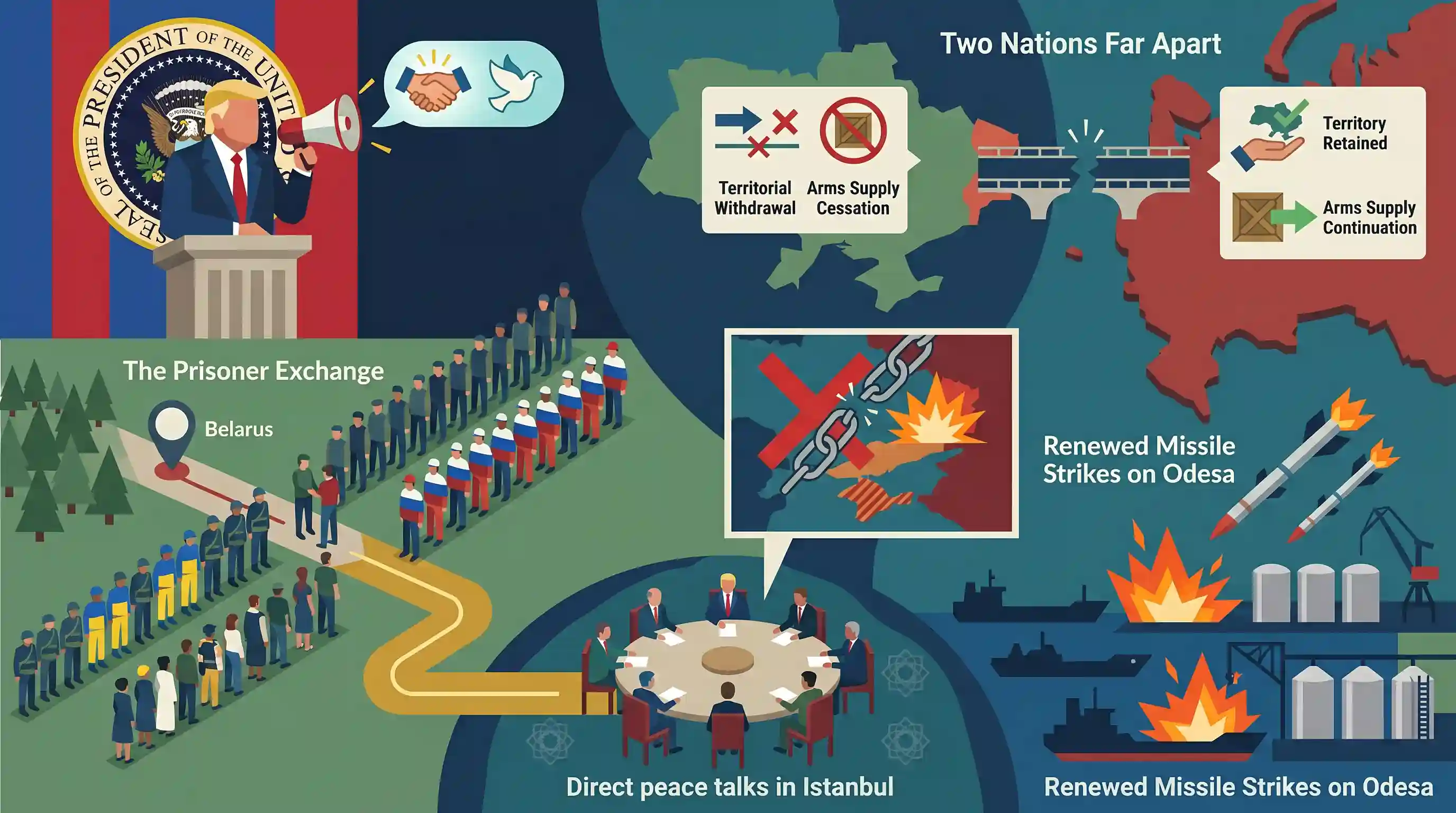
A major prisoner exchange between Russia and Ukraine took place following direct peace talks in Istanbul, Turkiye. The swap, announced by U.S. President Donald Trump, involved the release of hundreds of military personnel and civilians and occurred near the Belarus border. Despite this humanitarian progress, a comprehensive ceasefire remains elusive, as evidenced by renewed Russian missile strikes on the Ukrainian port of Odesa. The two nations remain far apart on key conditions for ending the conflict, including territorial withdrawals and the cessation of Western arms supplies.
Key Points
- Russia and Ukraine commenced a major prisoner swap, involving hundreds of military personnel and civilians from both sides.
- The exchange was facilitated by recent direct peace talks held in Istanbul, Turkiye.
- U.S. President Donald Trump announced the swap on social media, suggesting it could lead to further diplomatic breakthroughs.
- Despite the swap, fighting continues, with Russia launching ballistic missiles at the southern Ukrainian port city of Odesa.
- Both nations remain deadlocked on peace terms: Ukraine demands a temporary ceasefire, while Russia insists on a freeze on Western arms supplies and territorial concessions.
Important Terms
Odesa

A strategic Ukrainian port city on the Black Sea coast. It is Ukraine's primary maritime hub for international trade and is vital for global grain and energy supply chains.
UPSC context
GS Paper 1 & 2 (Geography/International Relations); tests knowledge of maritime security and global food security.
Geneva Convention (Third)
A set of international treaties establishing humanitarian standards for the treatment of prisoners of war. It mandates humane conditions, medical care, and protection from violence for captured combatants.
UPSC context
GS Paper 2 (International Treaties); tests understanding of global humanitarian laws and rules of engagement in modern conflicts.
Prisoner of War (POW)
A combatant captured by a belligerent power during or after an armed conflict. Under international law, they are entitled to legal protections and repatriation following the cessation of hostilities.
UPSC context
GS Paper 2 (International Relations/Human Rights); tests awareness of the legal status and rights of individuals in state-led warfare.
The Kremlin
A fortified complex in Moscow serving as the official residence of the Russian President and the symbolic seat of the Russian government’s executive and political authority.
UPSC context
GS Paper 2 (International Relations); essential for analyzing Russian statecraft and its diplomatic interactions with global powers and India.
Istanbul (Diplomatic Hub)
Turkey's largest city, acting as a neutral ground for Russia-Ukraine negotiations. Its significance stems from Turkey's 'active neutrality' and strategic control over access to the Black Sea.
UPSC context
GS Paper 2 (Bilateral/Multilateral Groupings); examines the role of middle-power mediators in conflict resolution and international diplomacy.
Black Sea
A strategic inland sea bounded by Europe and Asia. It is a critical theater for naval operations, maritime trade routes, and global energy and food logistics.
UPSC context
GS Paper 1 (World Geography/Mapping); focus on strategic chokepoints, maritime borders, and regional geopolitical stability.
Prelims Trap
The United Nations regulates the passage of naval warships into the Black Sea under the Montreux Convention.
The Montreux Convention (1936) grants sovereign control over the Bosporus and Dardanelles straits specifically to Turkiye, not to the United Nations or any collective international body.
Static Concepts Connected
What is the Montreux Convention (1936)?
- Control of Straits: Grants Turkiye control over the Bosporus and Dardanelles straits, which connect the Black Sea to the Mediterranean.
- Wartime Powers: Allows Turkiye to restrict the passage of naval warships of belligerent nations during wartime, a power actively used in the Russia-Ukraine conflict.
- Commercial Ships: Guarantees the free passage of civilian and commercial merchant vessels through the straits during peacetime.
Which countries border Ukraine?
- Northern and Eastern: Belarus to the north; Russia to the east and northeast.
- Western: Poland, Slovakia, and Hungary to the west.
- Southern: Romania and Moldova to the south and southwest, along with a coastline on the Black Sea and Sea of Azov.
Cross-Topic Patterns
Turkiye's mediation + NATO membership
Turkiye balances its NATO membership with strategic ties to Russia, enabling it to host talks and previously broker the Black Sea Grain Initiative, showcasing middle-power diplomatic hedging.
Port of Odesa + Global Food Security
Strikes on Odesa disrupt agricultural exports, demonstrating how regional conflicts directly trigger food insecurity and inflation shocks in developing nations across the Global South.

Map-based questions on Black Sea ports (Odesa), straits (Bosporus, Kerch), and the Montreux Convention are highly probable in 2026.
Linked PYQs · 5
Linked PYQs · 5
- 2025MainsGS2
"The reform process in the United Nations remains unresolved, because of the delicate imbalance of East and West and entanglement of the USA vs. Russo-Chinese alliance.” Examine and critically evaluate the East-West policy confrontations in this regard.
- 2023MainsGS2
‘Virus of Conflict is affecting the functioning of the SCO’ In the light of the above statement point out the role of India in mitigating the problems.
- 2020MainsGS2
What is the significance of Indo-US defence deals over Indo-Russian defence deals? Discuss with reference to stability in the Indo-Pacific region.
- 2014PrelimsGS1
Turkey is located between
- 2019PrelimsGS1
Consider the following pairs: Sea Bordering country 1. Adriatic Sea : Albania 2. Black Sea : Croatia 3. Caspian Sea : Kazakhstan 4. Mediterranean Sea : Morocco 5. Red Sea : Syria Which of the pairs given above are correctly matched?
