Collapse of Arms Control Treaties and Nuclear Escalation
Source:Indian Express ↗
Why It Matters
The collapse of landmark Cold War arms control treaties like the INF Treaty severely undermines global strategic stability. For UPSC aspirants, understanding these developments is crucial as escalating US-Russia nuclear brinkmanship impacts international security architecture, potentially triggering a renewed arms race that affects global peace and regional stability.
Summary
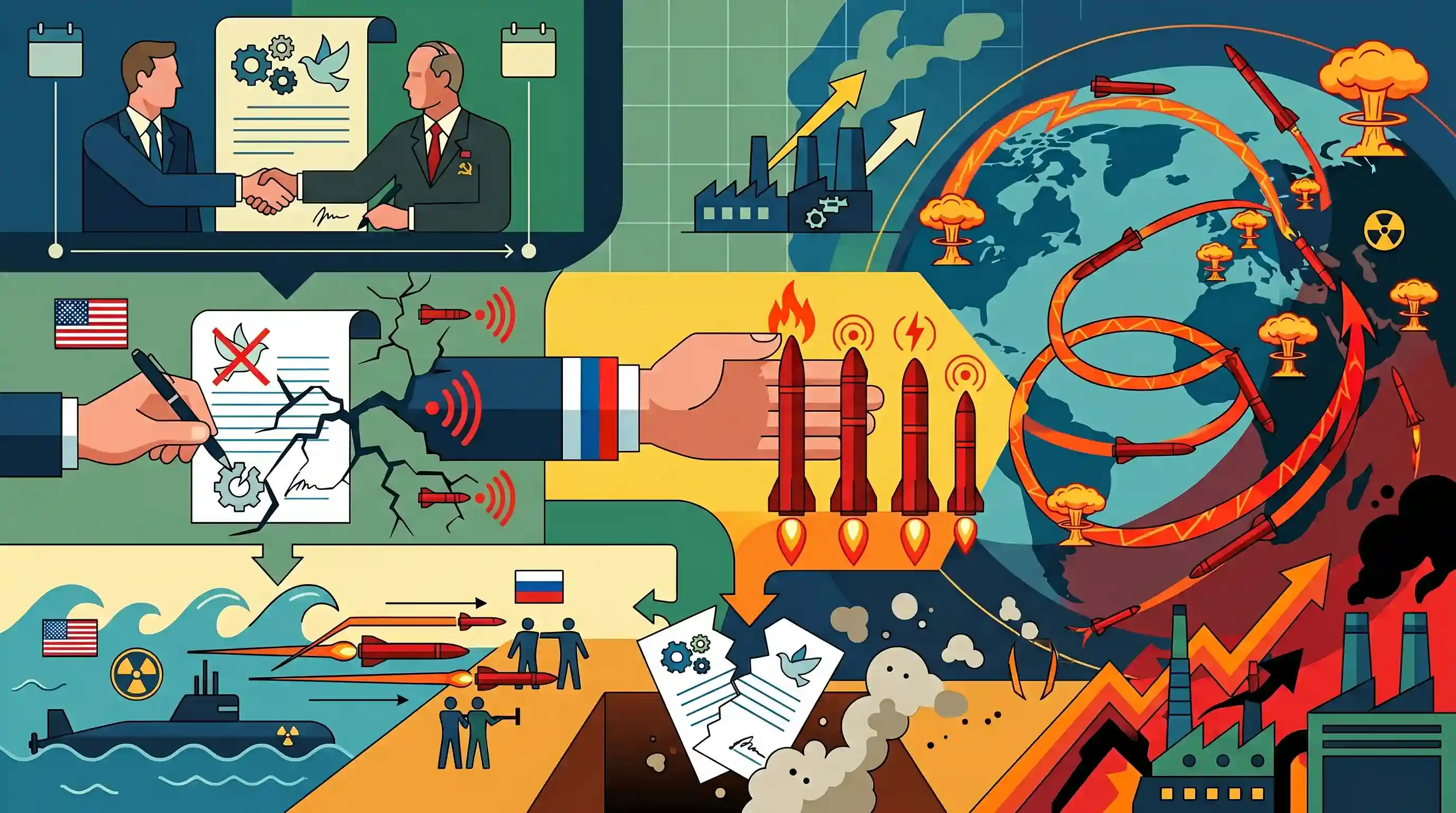
Russia has declared it will no longer observe its self-imposed moratorium on the deployment of intermediate and shorter-range nuclear missiles, effectively abandoning the remnants of the Intermediate-Range Nuclear Forces (INF) Treaty framework. This escalation follows the US deployment of nuclear-capable submarines in response to nuclear rhetoric from Russian officials. The INF Treaty, signed in 1987 by Ronald Reagan and Mikhail Gorbachev, was a cornerstone of Cold War arms control. The US officially withdrew from the pact in 2019, alleging Russian non-compliance. Moscow's current stance signals a further deterioration of US-Russia relations and heightens the risk of a new global nuclear arms race.
Key Points
- Russia has abandoned its self-imposed moratorium on deploying intermediate and shorter-range nuclear missiles.
- The decision is a retaliation against the US deploying nuclear submarines, such as the USS Florida and USS Georgia, amid escalating tensions.
- The INF Treaty was a landmark 1987 Cold War agreement between the US and Soviet Union banning ground-launched missiles with ranges of 500 to 5,500 km.
- The US had formally withdrawn from the INF Treaty in 2019 during the Trump administration, citing Russian violations.
- The complete breakdown of this arms control framework raises serious concerns about a renewed nuclear arms race and global strategic instability.
Important Terms
Intermediate-Range Nuclear Forces (INF) Treaty

A 1987 Cold War-era pact between the US and USSR banning all ground-launched ballistic and cruise missiles with ranges of 500–5,500 km. It was the first treaty to eliminate an entire class of nuclear weapons.
UPSC context
GS-II: Important for international relations, bilateral agreements, and the impact of the collapse of Cold War-era security architecture on India’s interests.
NATO (North Atlantic Treaty Organization)
An intergovernmental military alliance between 32 member states. In the nuclear context, it serves as a collective defense framework, maintaining a nuclear deterrent posture while supporting allied arms control and non-proliferation efforts.
UPSC context
GS-II: Global groupings and agreements; tests understanding of collective security and the changing security dynamics in the Euro-Atlantic region.
New START (Strategic Arms Reduction Treaty)
The final remaining US-Russia strategic arms treaty (signed 2010), capping deployed nuclear warheads at 1,550. Its expiration signals a transition to an era without legally binding limits on the world’s largest nuclear arsenals.
UPSC context
GS-II: Critical current affair regarding global strategic stability and the potential for a renewed nuclear arms race involving Russia, the US, and China.
Arms Control and Disarmament
Arms control focuses on regulating and limiting the development, testing, and deployment of weapons to maintain stability. Disarmament refers to the active reduction or complete elimination of military weapons, particularly nuclear arms.
UPSC context
GS-III: Security challenges; essential for understanding international efforts to prevent conflict escalation and India's stance on universal, non-discriminatory disarmament.
Intermediate-Range Ballistic Missiles (IRBMs)
Ballistic missiles with a range of 3,000–5,500 km. These were a primary focus of the INF Treaty due to their ability to strike targets across continents with minimal warning time.
UPSC context
GS-III: Science and Technology; Defense; relevant to understanding missile classifications (like India's Agni series) and global proliferation trends.
Nuclear Non-proliferation
The international effort to prevent the spread of nuclear weapons and technology. It aims to achieve total nuclear disarmament while promoting peaceful uses of nuclear energy.
UPSC context
GS-II: Global treaties (NPT, CTBT); tests understanding of the international nuclear order and India’s unique position as a non-signatory nuclear state.
Prelims Trap
"The INF Treaty banned all nuclear-capable missiles with ranges between 500 and 5,500 km."
The INF Treaty only banned GROUND-launched ballistic and cruise missiles. Air-launched and sea-launched missiles (like those on submarines) were entirely exempt from the treaty.
Static Concepts Connected
What were the core provisions of the INF Treaty (1987)?
- Range Limits: It explicitly banned all ground-launched ballistic and cruise missiles with ranges between 500 and 5,500 km.
- Launch Platforms: It did not cover sea-launched (e.g., submarine) or air-launched nuclear missiles, focusing entirely on land-based systems.
- Verification Regime: It introduced an unprecedented, highly intrusive on-site inspection regime to verify the destruction of missile stockpiles.
What is the status of other major US-Russia arms control treaties?
- New START: The last remaining bilateral pact capping deployed strategic warheads. Russia suspended participation in 2023; it expires in 2026.
- ABM Treaty: Limited defensive missile systems. The US unilaterally withdrew in 2002 to develop its national missile defense network.
- Open Skies Treaty: Allowed unarmed aerial surveillance flights. The US withdrew in 2020, followed by Russia in 2021.
Cross-Topic Patterns
INF collapse + China's missile build-up
The US withdrawal from INF was partly driven by China (a non-signatory) amassing intermediate-range missiles in the Indo-Pacific, altering the regional security calculus for India and the Quad.
Global arms race + India's NFU
As major powers lower the threshold for deploying tactical nuclear weapons outside treaty frameworks, India's strict "No First Use" and "Credible Minimum Deterrence" postures face renewed debate in security circles.

Expect a 2026 prelims question differentiating the scope of INF (ground-launched), New START (strategic), and TPNW (comprehensive ban).
Linked PYQs · 4
Linked PYQs · 4
- 2011PrelimsGS1
The "New START" treaty was in the news. What is this treaty?
- 2025MainsGS2
"The reform process in the United Nations remains unresolved, because of the delicate imbalance of East and West and entanglement of the USA vs. Russo-Chinese alliance.” Examine and critically evaluate the East-West policy confrontations in this regard.
- 2025MainsGS2
"With the waning of globalization, post-Cold War world is becoming a site of sovereign nationalism.” Elucidate.
- 2023MainsGS2
‘The expansion and strengthening of NATO and a stronger US-Europe strategic partnership works well for India.’ What is your opinion about this statement ? Give reasons and examples to support your answer.
