Periodic Labour Force Survey Highlights Rural Urban Job Trends
Source:The Hindu ↗
Why It Matters
PLFS data is the primary official source for tracking employment trends in India. For UPSC aspirants, these statistics are vital for substantiating arguments in GS Paper 3 regarding job-led growth, structural unemployment, agricultural dependence, and female labor force participation. The methodology of computing unemployment and addressing 'disguised unemployment' in agriculture are recurring themes in both Prelims and Mains.
Summary
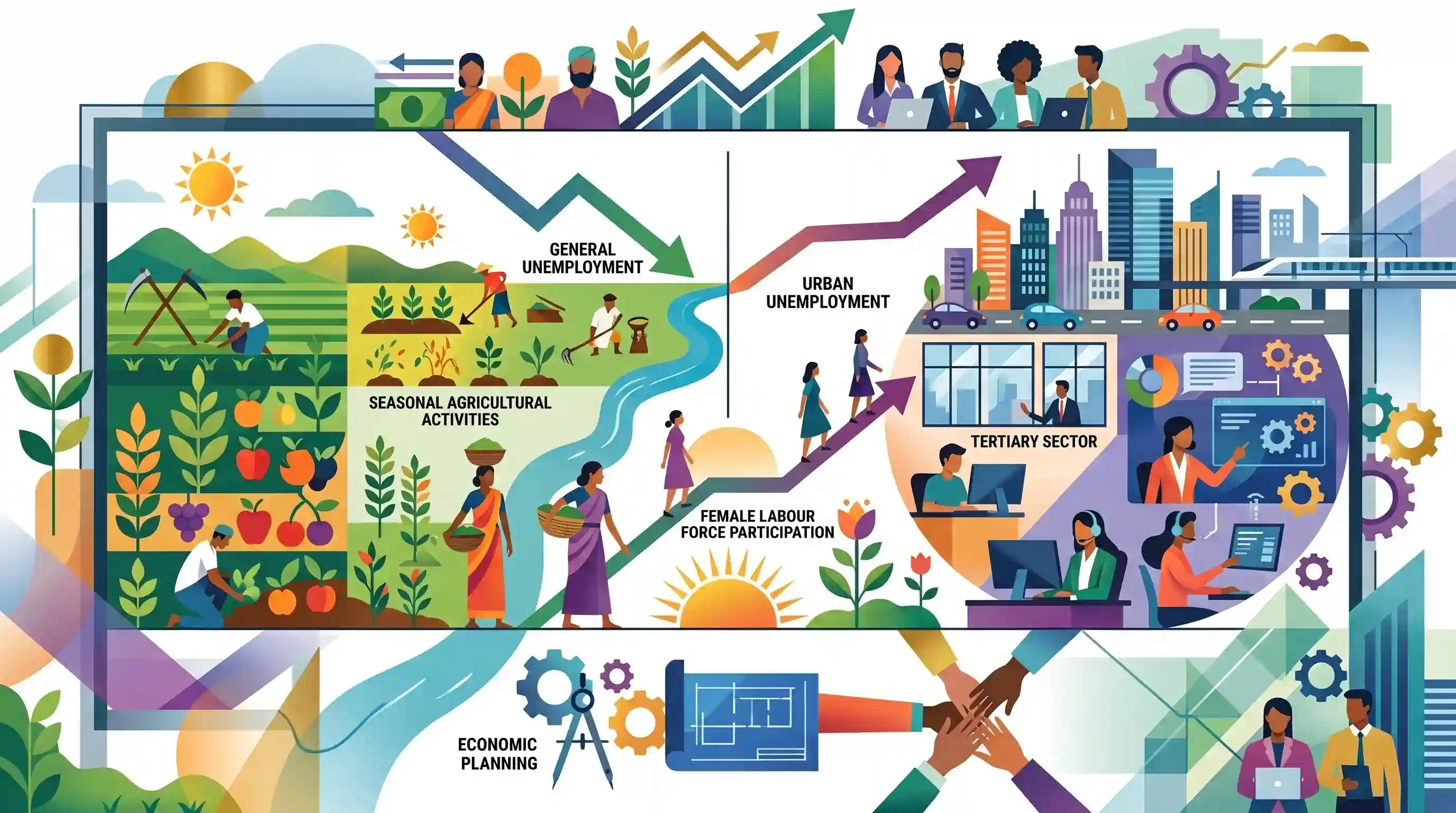
According to the Periodic Labour Force Survey (PLFS) conducted by the Ministry of Statistics and Programme Implementation for the July-September 2025 quarter, India's overall unemployment rate dropped to 5.2%. However, the data highlights a clear rural-urban divide. Rural unemployment declined to 4.4%, largely supported by seasonal agricultural activities that increased the sector's workforce share to 57.7%. Conversely, urban unemployment slightly increased, with the tertiary sector absorbing the majority (62%) of urban workers. The survey also noted an increase in the Female Labour Force Participation Rate to 33.7%, driven predominantly by rural women entering the workforce, underscoring ongoing structural challenges and demographic shifts in the Indian economy.
Key Points
- India's overall unemployment rate for individuals aged 15 and above decreased to 5.2% in the July-September 2025 quarter, down from 5.4% in the previous quarter.
- A rural-urban divergence was noted: rural unemployment declined to 4.4% (from 4.8%), whereas urban unemployment edged up slightly, with female urban unemployment reaching 9.0%.
- Self-employment is the dominant category in rural areas (62.8%), while regular wage or salaried employment is most common in urban areas (49.8%).
- The rural workforce is heavily concentrated in the agriculture sector (57.7%), which saw an increase due to seasonal farming, while 62.0% of the urban workforce is engaged in the tertiary sector.
- The Female Labour Force Participation Rate (LFPR) increased to 33.7%, primarily driven by a rise in rural female participation (37.5%).
Important Terms
Periodic Labour Force Survey (PLFS)

A nationwide survey launched in 2017 to provide frequent, reliable data on employment and unemployment indicators. It releases quarterly reports for urban areas and annual reports covering both rural and urban India.
UPSC context
GS Paper III: Indian Economy/Employment. Tests ability to analyze labour market trends and evaluate official data sources for policy formulation.
Ministry of Statistics and Programme Implementation (MoSPI)
The nodal ministry responsible for collecting, analyzing, and disseminating official statistics in India. It oversees the National Statistical Office (NSO) and monitors the implementation of major central infrastructure projects.
UPSC context
GS Paper II & III: Governance/Planning. Tests knowledge of the institutional framework responsible for India's national accounts and socio-economic data.
National Sample Survey Office (NSSO)
Established in 1950, it was India's premier agency for conducting large-scale socio-economic surveys. In 2019, it was merged with the Central Statistics Office (CSO) to form the National Statistical Office (NSO).
UPSC context
GS Paper III: Economic Planning. Relevant for understanding the historical evolution and current structure of India’s statistical system.
Labour Force Participation Rate (LFPR)
The percentage of the working-age population (15 years and above) that is either employed or actively seeking/available for work. It measures the total labor supply in the economy.
UPSC context
GS Paper III: Inclusive Growth. Tests understanding of demographic dividends and the impact of discouraged workers on economic data.
Unemployment Rate (UR)
The percentage of persons unemployed among those in the labour force (employed plus seeking work). It indicates the economy's inability to provide jobs for those willing to work.
UPSC context
GS Paper III: Indian Economy/Employment. A critical metric for evaluating the success of job-creation schemes and economic stability.
Female Labour Force Participation Rate (FLFPR)
The percentage of the female working-age population that is part of the labour force. It is a key indicator of gender equality and inclusive economic growth.
UPSC context
GS Paper I & III: Society/Economy. Highlight’s structural barriers to women's employment and the socio-economic impact of their participation.
Prelims Trap
"The recent rise in India's Female LFPR is primarily driven by urban women entering regular salaried jobs."
The rise in Female LFPR is actually driven by rural women engaging in unpaid family labor or agricultural self-employment, not formal urban jobs.
Static Concepts Connected
What are the primary types of unemployment characterizing the Indian economy?
- Disguised Unemployment: Marginal productivity of labor is zero; heavily prevalent in Indian agriculture where surplus labor is employed but adds no output.
- Structural Unemployment: A mismatch between available labor skills and market demands, limiting the absorption of workers into formal tertiary or manufacturing sectors.
- Seasonal Unemployment: Occurs during agricultural off-seasons when labor demand drops, leading to cyclical joblessness in rural areas.
What are the key metrics and statuses measured by the Periodic Labour Force Survey (PLFS)?
- LFPR: Percentage of persons in the labor force (both working and actively seeking work) among the total population.
- Unemployment Rate (UR): Percentage of persons genuinely unemployed among those ALREADY in the labor force, not the entire population.
- Reference Periods: Usual Status (US) uses a 365-day reference period, capturing long-term employment, while Current Weekly Status (CWS) uses a 7-day period.
Cross-Topic Patterns
Female LFPR and Unpaid Family Labor
The statistical rise in rural female employment often masks distress-driven participation, largely absorbing women into unpaid family helper roles in agriculture rather than monetized, formal empowerment.
Lewis Model Failure and the Missing Middle
India's structural shift bypasses manufacturing, moving directly from agriculture (rural) to services (urban). This violates the Lewis Model of economic transformation and leaves low-skilled labor trapped in disguised unemployment.

Expect a multi-statement Prelims question contrasting rising rural female LFPR (often unpaid) against persistently high urban joblessness.
Linked PYQs · 4
Linked PYQs · 4
- 2023MainsGS3
Most of the unemployment in India is structural in nature. Examine the methodology adopted to compute unemployment in the country and suggest improvements.
- 2023MainsGS3
Distinguish between 'care economy' and 'monetized economy'. How can care economy be brought into monetized economy through women empowerment?
- 2022MainsGS3
Economic growth in the recent past has been led by increase in labour productivity." Explain this statement. Suggest the growth pattern that will lead to creation of more jobs without compromising labour productivity.
- 2013PrelimsGS1
Disguised unemployment generally means
