Bela Bag Cluster Empowers Jeevika Didis in Rural Bihar
Source:uni ↗
Why It Matters
The JEEViKA model in Bihar is a prime case study for rural entrepreneurship, women's empowerment, and poverty alleviation. For BPSC Prelims and Mains, understanding the impact of SHGs, PPP models in rural development, and state-specific schemes like JEEViKA is highly crucial for questions on social justice, economy, and governance.
Summary
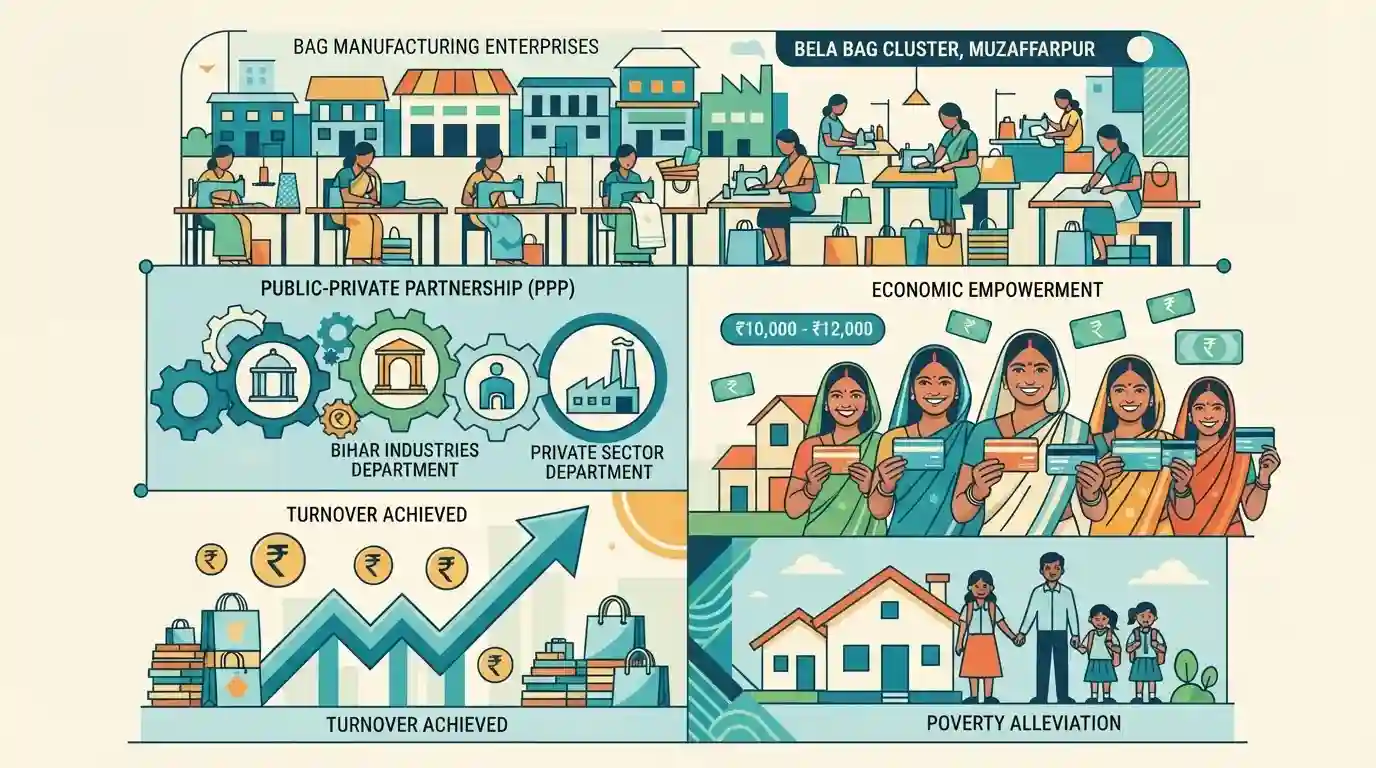
The article highlights the success of Bihar's JEEViKA programme at the Bela Bag Cluster in Muzaffarpur, where women belonging to Self-Help Groups (SHGs) are spearheading rural entrepreneurship. Operating on a Public-Private Partnership (PPP) model supported by the Bihar Industries Department, the cluster has established 42 bag manufacturing enterprises, achieving a turnover of Rs 19 crore. By providing women with steady monthly incomes of Rs 10,000 to Rs 12,000 and supportive infrastructure, the initiative exemplifies successful poverty attenuation and women's economic empowerment in rural Bihar.
Key Points
- Women from Self-Help Groups (SHGs), known as JEEViKA Didis, are driving rural entrepreneurship at the Bela Bag Cluster in Muzaffarpur, Bihar.
- Operating under a Public-Private Partnership (PPP) model, the initiative receives infrastructural support from the Bihar Industries Department and community mobilization from JEEViKA.
- The cluster currently houses 42 bag manufacturing enterprises, producing over 3.6 million bags and generating a total turnover of Rs 19.03 crore.
- The project has enabled economic independence for rural women, providing them with a steady monthly income of Rs 10,000 to Rs 12,000 and supporting facilities like a creche and a common facility centre.
Important Terms
Self-Help Groups (SHGs)

Voluntary, informal associations of 10–20 individuals (predominantly rural women) from similar backgrounds who pool savings, access collateral-free credit, and initiate collective livelihood activities to achieve economic self-reliance and empowerment.
UPSC context
GS Paper 2 (Development processes and role of SHGs) and GS Paper 3 (Financial inclusion). Evaluates grassroots governance models.
JEEViKA (Bihar Rural Livelihoods Promotion Society)
An autonomous body under Bihar's Department of Rural Development acting as the State Rural Livelihoods Mission. It mobilizes rural women into self-managed community institutions to promote social empowerment and sustainable livelihoods.
UPSC context
GS Paper 2 (Welfare schemes) and GS Paper 3 (Inclusive growth). Tests understanding of community-led livelihood programs.
Bihar Rural Livelihoods Project (BRLP)
A World Bank-assisted socio-economic initiative launched in Bihar (locally known as JEEViKA). It aims to reduce rural poverty by building community-run institutions, enhancing household incomes, and fostering financial inclusion.
UPSC context
GS Paper 2 (Poverty alleviation) and GS Paper 3 (Rural development). Examines World Bank-funded socio-economic development frameworks in India.
Public-Private Partnership (PPP)
A long-term collaborative arrangement between government agencies and private sector entities to leverage private finance, technology, and management expertise to design, construct, and operate public infrastructure or developmental services.
UPSC context
GS Paper 3 (Investment models and infrastructure). Assesses policy frameworks for collaborative public service delivery.
Cluster Development
A developmental strategy grouping enterprises or producer collectives in a specific geographic area to leverage shared infrastructure, common facilities, and collaboration, thereby improving productivity, technology, and market access.
UPSC context
GS Paper 3 (MSMEs and industrial growth). Tests strategies for enhancing regional economic competitiveness and rural enterprise scaling.
Prelims Trap
Self-Help Groups and their federations are legally restricted from entering into Public-Private Partnerships or formal industrial manufacturing.
UPSC tests functional limits of institutions. SHG federations are fully permitted to enter into PPPs, handle industrial manufacturing, and execute formal commercial/state contracts.
Static Concepts Connected
What is the SHG-Bank Linkage Programme (SBLP)?
- Genesis: Launched by NABARD in 1992 to integrate informal self-help groups with India's formal banking system.
- Collateral-free credit: Enables SHGs to access bank credit without collateral, leveraging peer pressure and collective responsibility as social collateral.
- NABARD support: NABARD provides refinance support to participating banks to encourage micro-lending to the rural poor.
What is the three-tier federated structure of SHGs under DAY-NRLM?
- Neighborhood level: Self-Help Groups (SHGs) comprising 10-20 individual members, forming the grassroots foundation.
- Village level: Village Organisations (VOs) federating 10-15 SHGs to provide financial and social solidarity services.
- Block level: Cluster Level Federations (CLFs) aggregating multiple VOs to manage larger economic enterprises and value chains.
Cross-Topic Patterns
Social infrastructure and FLFP
Integrating crèches and common facility centres in rural economic hubs directly addresses women's unpaid care burden, boosting India's Female Labor Force Participation (FLFP).
Micro-credit to micro-enterprise
Shifting focus from consumption-led micro-credit to production-led Self-Help Enterprises (SHEs) accelerates rural industrialisation and diversifies the non-farm economy.

Mains 2026 may evaluate the role of Self-Help Enterprises (SHEs) and PPPs in solving rural underemployment and low FLFP.
Linked PYQs · 3
Linked PYQs · 3
- 2016BPSC_PRELIMSGS1
'JEEVIKA' is an initiative of Bihar Govt for:
- 2025BPSC_PRELIMSGS1
According to PLFS 2023-24, which of the following statements best describe the nature of employment among women in Bihar?
- 2022BPSC_PRELIMSGS1
The new ministry proposed in the Bihar Budget for the year 2021-22 focuses on
