Indian Rupee Appreciates Against US Dollar Amid Falling Crude Prices
Source:The Hindu ↗
কেন এটি গুরুত্বপূর্ণ
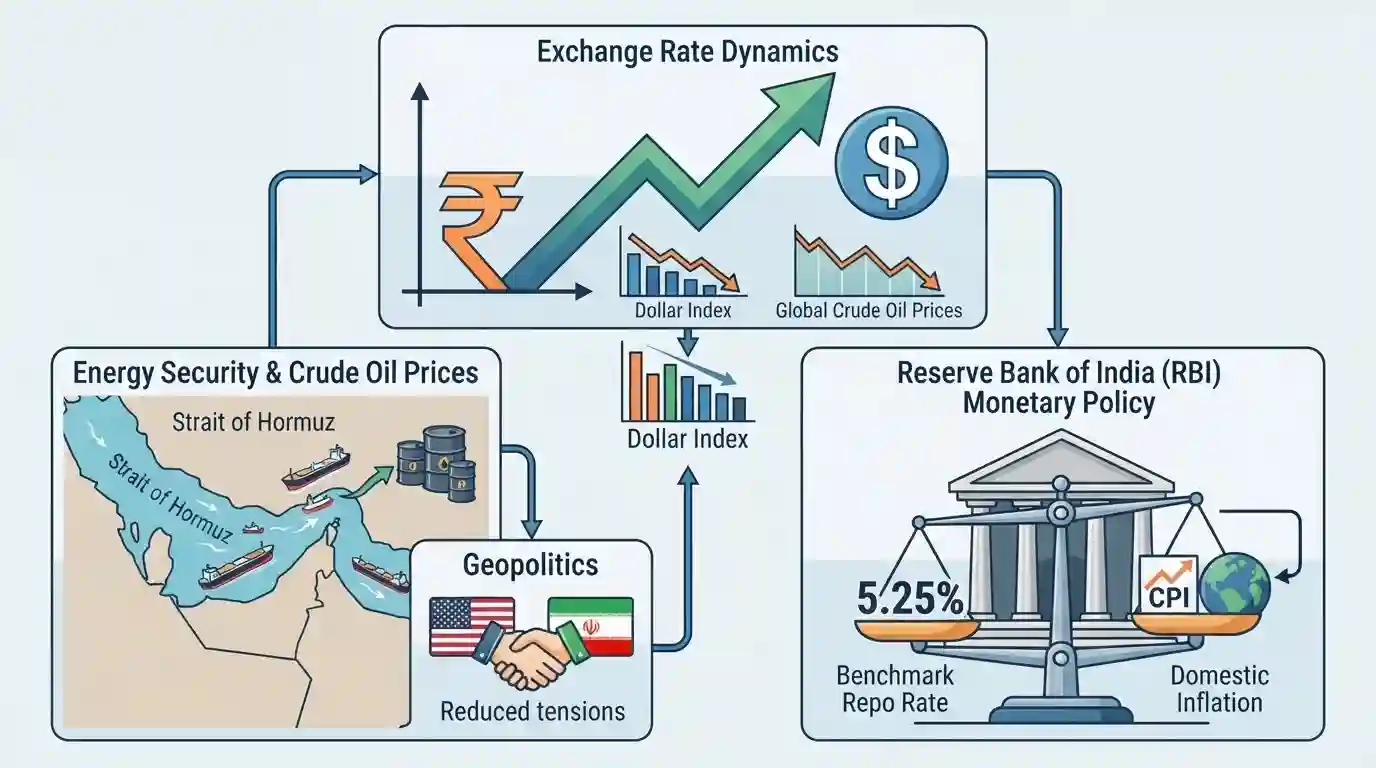
The article highlights the intricate linkages between international geopolitics (US-Iran relations, Strait of Hormuz), global commodity markets (crude oil), and India's domestic macroeconomic indicators (exchange rate, inflation). Understanding how external shocks influence the RBI's monetary policy stance is a recurring theme in UPSC GS3 Economy and GS2 International Relations.
সারসংক্ষেপ
The Indian Rupee appreciated significantly against the US Dollar, closing at 94.89, aided by a drop in the dollar index and a decline in global crude oil prices. The easing of crude prices is directly linked to positive developments in US-Iran negotiations and a reduction in geopolitical tensions around the strategic Strait of Hormuz. Domestically, market participants are anticipating the Reserve Bank of India's Monetary Policy Committee to maintain a status quo on the benchmark repo rate at 5.25%, balancing the dual challenges of managing domestic inflation and navigating global macroeconomic uncertainties.
মূল বিষয়
- The Indian Rupee appreciated by 39 paise to 94.89 against the US Dollar, supported by a weakening dollar index and falling crude prices.
- Global crude oil prices declined due to progress in US-Iran talks concerning the Strait of Hormuz, easing supply disruption fears.
- The RBI's Monetary Policy Committee (MPC) is expected to keep the benchmark repo rate unchanged at 5.25% in its August 5, 2026 meeting.
- Foreign institutional flows and the RBI's inflation management remain critical factors influencing India's currency and bond markets.
গুরুত্বপূর্ণ শব্দ
Reserve Bank of India (RBI)

The central bank and apex monetary authority of India, established in 1935, responsible for regulating the banking system, issuing currency, managing foreign exchange reserves, and maintaining monetary and financial stability.
UPSC context
GS Paper III (Indian Economy); tests understanding of central banking functions, monetary policy tools, and financial system regulation.
Monetary Policy Committee (MPC)
A statutory six-member body under the RBI Act, 1934, chaired by the RBI Governor, responsible for fixing the benchmark interest rate (repo rate) to maintain price stability while supporting economic growth.
UPSC context
GS Paper III (Indian Economy); crucial for questions on inflation-targeting frameworks, monetary policy transmission, and institutional governance.
Foreign Institutional Investors (FIIs)
Large overseas entities like mutual funds, pension funds, or insurance companies that invest pooled capital into India's financial markets, now regulated under the unified Foreign Portfolio Investor (FPI) framework.
UPSC context
GS Paper III (Indian Economy); tests knowledge of external sector dynamics, capital flows, exchange rates, and market liquidity regulation.
প্রিলিমস ফাঁদ
An appreciation of the Rupee (increase in NEER) automatically indicates an improvement in India's global trade competitiveness.
Trade competitiveness is measured by REER, not NEER. If India's inflation is higher than its trading partners, an appreciating NEER overvalues the currency, making exports more expensive and less competitive.
সংযুক্ত স্থির ধারণা
What is the difference between NEER and REER in exchange rate dynamics?
- NEER (Nominal): The unadjusted, weighted average rate at which the Rupee exchanges for a basket of foreign currencies.
- REER (Real): The NEER adjusted for inflation differentials between India and its trading partners.
- Trade Indicator: A REER above 100 indicates the currency is overvalued (hurting exports), while below 100 implies undervaluation.
What is the geographical and strategic significance of the Strait of Hormuz?
- Water Bodies Connected: It serves as the exclusive maritime chokepoint connecting the Persian Gulf to the Gulf of Oman and the Arabian Sea.
- Bordering Nations: It is bordered by Iran to the north, and the UAE and Oman (Musandam exclave) to the south.
- Strategic Chokepoint: Nearly 40% of India's crude oil imports transit through this narrow strait, making it vital for energy security.
আন্তঃবিষয় প্যাটার্ন
Geopolitics dictating domestic monetary policy
Global crude price drops via Strait of Hormuz easing reduce India's imported inflation risk, giving the RBI MPC more headroom to maintain a status quo on the repo rate.
US Dollar Index and FII Flows
A weakening US Dollar index typically triggers foreign portfolio investments into emerging markets like India, which structurally drives Rupee appreciation and shifts domestic bond yields.

Expect a multi-statement Prelims question blending REER/NEER dynamics with RBI's forex interventions and imported inflation in 2026.
সংযুক্ত PYQ · 4
সংযুক্ত PYQ · 4
- 2022PrelimsGS1
With reference to the Indian economy, consider the following statements: 1. If the inflation is too high, Reserve Bank of India (RBI) is likely to buy government securities. 2. If the rupee is rapidly depreciating, RBI is likely to sell dollars in the market. 3. If interest rates in the USA or European Union were to fall, that is likely to induce RBI to buy dollars. Which of the statements given above are correct?
- 2025PrelimsGS1
Which of the following are the sources of income for the Reserve Bank of India? I. Buying and selling Government bonds II. Buying and selling foreign currency III. Pension fund management IV. Lending to private companies V. Printing and distributing currency notes Select the correct answer using the code given below.
- 2022PrelimsGS1
In India, which one of the following is responsible for maintaining price stability by controlling inflation?
- 2026PrelimsGS1
Ships from which of the following countries have to cross the Strait of Hormuz to reach out to the Indian Ocean ? 1. Bahrain 2. Syria 3. Qatar 4. Egypt Select the answer using the code given below :
