RBI evaluates rate hike as rupee plunges to record low
Source:The Hindu ↗
Why It Matters
Currency depreciation impacts India's macroeconomic stability by inflating the import bill (especially for crude oil) and stoking imported inflation. For UPSC aspirants, understanding the RBI's toolkit—such as adjusting interest rates and conducting open market operations in the forex market—is essential for the GS-3 Economy syllabus. Additionally, it highlights the intersection of international relations (GS-2) and economic outcomes.
Summary
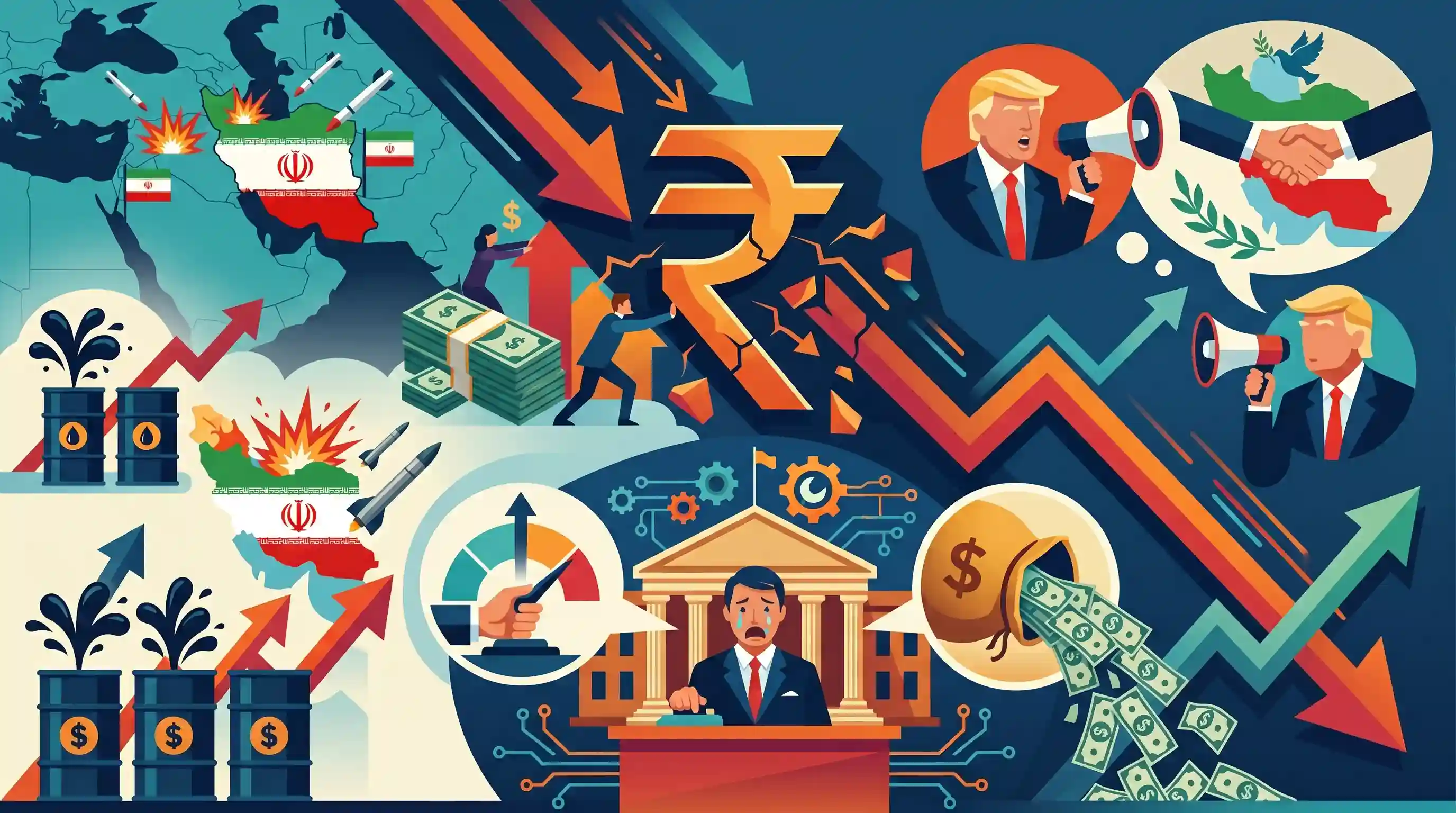
The Indian rupee depreciated to a new record low of 96.95 against the US dollar, pressured by high dollar demand, surging global crude oil prices, and geopolitical uncertainties in West Asia involving Iran. In response to the severe currency slump, the Reserve Bank of India (RBI) is actively evaluating intervention strategies, including a potential interest rate hike and selling dollars from its forex reserves, to stabilize the exchange rate. The currency saw a marginal recovery following remarks from US President Donald Trump regarding the advanced stages of negotiations with Iran, underscoring the vulnerability of the Indian economy to external geopolitical shifts.
Key Points
- The Indian rupee plunged to a record low of 96.95 against the US dollar due to robust dollar demand and rising crude oil prices.
- Geopolitical tensions in West Asia, particularly involving Iran, have contributed significantly to the currency's weakness and market volatility.
- The Reserve Bank of India (RBI) is considering various stabilization measures, notably an interest rate hike and foreign exchange market interventions.
- The rupee experienced a slight recovery after US President Donald Trump indicated that negotiations with Iran were in their final stages, illustrating the direct impact of global geopolitics on India's economy.
Important Terms
Currency Depreciation

A decrease in a currency's value relative to others in a floating exchange rate system, driven by market forces like high demand for foreign currency or weak economic fundamentals.
UPSC context
GS III (Economy); tests understanding of external sector dynamics and impacts on trade competitiveness and inflation.
Foreign Exchange (Forex) Reserves
Assets including foreign currencies, gold, and SDRs held by the RBI to manage currency volatility, fund imports, and ensure the country can meet its external obligations.
UPSC context
GS III (Economy); critical for India's external resilience and management of the Balance of Payments.
Monetary Policy Committee (MPC)
A statutory body under the RBI Act, 1934, mandated to fix the benchmark policy interest rate (repo rate) to maintain price stability while supporting economic growth.
UPSC context
GS III (Economy); central to the institutional framework for inflation targeting and monetary policy in India.
Managed Float Exchange Rate System
India's exchange rate regime where the Rupee's value is primarily market-determined, but the RBI intervenes by buying or selling dollars to curb excessive volatility.
UPSC context
GS III (Economy); tests knowledge of RBI’s intervention strategies and exchange rate mechanisms.
Current Account Deficit (CAD)
A measurement of a country's trade where the value of imported goods and services exceeds the value of exports; rising oil prices often widen this deficit.
UPSC context
GS III (Economy); fundamental indicator of macroeconomic stability and a primary driver of currency pressure.
Reserve Bank of India (RBI)
The central bank of India, acting as the custodian of forex reserves, manager of monetary policy, and regulator of the country's financial stability and currency.
UPSC context
GS III (Economy); foundational knowledge regarding India’s central banking functions and regulatory framework.
Prelims Trap
"The RBI purchases US dollars from the forex market to arrest the depreciation of the rupee."
To arrest rupee depreciation, the RBI actually sells dollars from its forex reserves to increase dollar supply and absorb excess rupee liquidity in the market.
Static Concepts Connected
What are the primary tools used by the RBI to defend a depreciating rupee?
- Forex Sales: The RBI sells US dollars from its foreign exchange reserves, increasing the supply of dollars in the market and soaking up excess rupees.
- Policy Rate Hikes: The RBI hikes the repo rate to attract foreign capital inflows by widening the interest rate differential between India and advanced economies.
- Capital Account Easing: The RBI can ease External Commercial Borrowing (ECB) norms or increase Foreign Portfolio Investment (FPI) limits in debt markets to boost dollar inflows.
How does a depreciating currency impact NEER, REER, and domestic prices?
- Indices Decline: A plunging rupee lowers both the Nominal and Real Effective Exchange Rates, theoretically improving the competitiveness of Indian exports on the global market.
- Imported Inflation: Depreciation makes inelastic imports (like crude oil and edible oils) more expensive in rupee terms, importing inflation into the domestic economy and eroding REER gains.
Cross-Topic Patterns
Geopolitics, Crude Oil, and India's CAD
Geopolitical shocks in West Asia spike inelastic crude oil prices, inflating India's import bill and Current Account Deficit (CAD), which structurally weakens the rupee and drains forex reserves.
US Safe-Haven Appeal and FPI Outflows
Global uncertainties trigger a 'flight to safety' toward US assets, causing Foreign Portfolio Investment (FPI) outflows from India, forcing the RBI to hike domestic rates to maintain attractive yield differentials.

Expect a multi-statement prelims question linking West Asian oil shocks to RBI's forex interventions, NEER/REER, and imported inflation.
Linked PYQs · 3
Linked PYQs · 3
- 2022PrelimsGS1
With reference to the Indian economy, consider the following statements: 1. If the inflation is too high, Reserve Bank of India (RBI) is likely to buy government securities. 2. If the rupee is rapidly depreciating, RBI is likely to sell dollars in the market. 3. If interest rates in the USA or European Union were to fall, that is likely to induce RBI to buy dollars. Which of the statements given above are correct?
- 2019PrelimsGS1
Which one of the following is not the most likely measure the Government/RBI takes to stop the slide of Indian rupee?
- 2022PrelimsGS1
With reference to the Indian economy, consider the following statements: 1. An increase in Nominal Effective Exchange Rate (NEER) indicates the appreciation of rupee. 2. An increase in the Real Effective Exchange Rate (REER) indicates an improvement in trade competitiveness. 3. An increasing trend in domestic inflation relative to inflation in other countries is likely to cause an increasing divergence between NEER and REER. Which of the above statements are correct?
