Rupee depreciation dynamics and foreign exchange reserve management
Source:The Hindu ↗
Why It Matters
Currency depreciation impacts India's import bill (especially crude oil), inflation, and overall macroeconomic stability. Understanding the mechanics of exchange rate determination and the RBI's role in managing volatility through forex reserves is a core concept for the UPSC GS3 Economy syllabus.
Summary
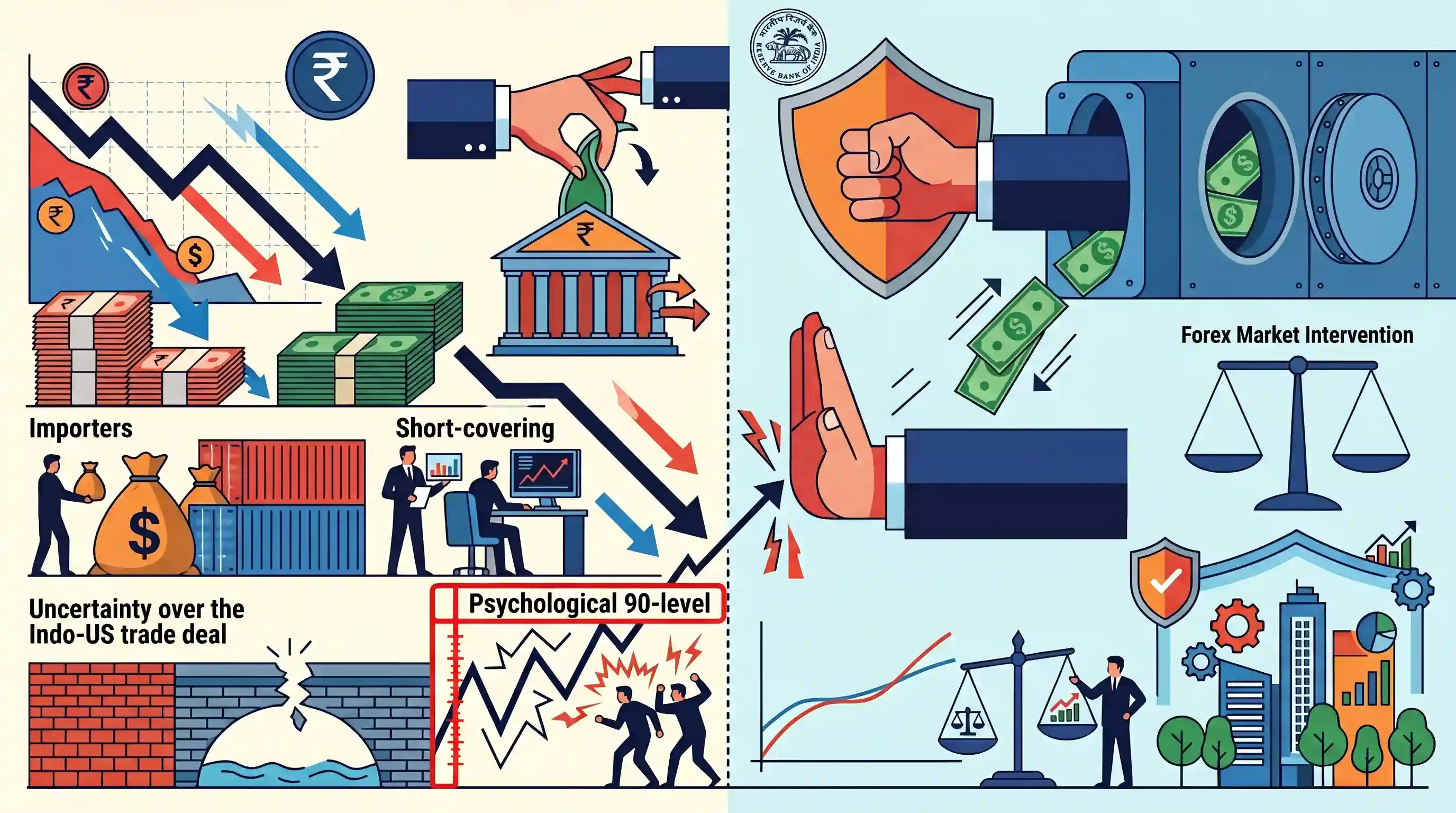
The Indian Rupee has depreciated to an all-time low of 89.95 against the US Dollar, driven by foreign fund outflows, strong importer demand for the greenback, and speculative short-covering. Additionally, uncertainty over an Indo-U.S. trade deal has weighed on the currency. Market analysts highlight the psychological importance of the 90-level, noting that the Reserve Bank of India (RBI) must actively intervene in the forex market to prevent speculators from exploiting a unilateral trend and to maintain macroeconomic stability by avoiding unnecessary volatility in the exchange rate.
Key Points
- The Indian Rupee fell by 42 paise to close at a historic low of 89.95 against the US Dollar.
- Key drivers for the depreciation include short-covering by speculators, sustained demand for dollars from importers, and significant Foreign Institutional Investor (FII) outflows from Indian equities.
- Market uncertainties surrounding the Indo-U.S. trade deal also contributed to the negative sentiment.
- Experts emphasize the necessity of Reserve Bank of India (RBI) intervention below the psychological 90 mark to curb speculative one-way trending and prevent excessive volatility in the USD-INR pair.
Important Terms
Currency Depreciation

A market-driven decrease in the value of the Indian Rupee against foreign currencies, particularly the US Dollar, due to high import demand or capital outflows.
UPSC context
GS Paper III (Economy); tests understanding of exchange rate dynamics, balance of payments, and impacts on inflation and exports.
Foreign Institutional Investors (FII)
Foreign entities (like banks or pension funds) that invest in Indian financial markets. Their mass exits often trigger capital outflows and rupee weakening.
UPSC context
GS Paper III (Economy); relevant for resource mobilization, stock market volatility, and external sector stability.
Indo-U.S. Trade Deal
A strategic agreement to reduce reciprocal tariffs (from ~50% to 18%) and resolve trade disputes involving energy procurement and market access between India and the USA.
UPSC context
GS Paper II (International Relations); focuses on bilateral agreements and the effect of foreign policies on India's interests.
RBI Forex Market Intervention
The central bank's action of buying or selling foreign currency (dollars) to curb excessive exchange rate volatility and prevent a disorderly fall of the rupee.
UPSC context
GS Paper III (Economy); tests knowledge of monetary policy tools, foreign exchange reserves, and currency management.
Macroeconomic Stability
The state of an economy characterized by low inflation, sustainable debt levels, and stable exchange rates, ensuring resilience against external financial shocks.
UPSC context
GS Paper III (Economy); central to topics on Indian economy, planning, and growth.
Managed Floating Exchange Rate
The exchange rate regime where the currency value is largely market-determined, but the central bank intervenes to manage extreme fluctuations.
UPSC context
GS Paper III (Economy); essential for understanding India’s external sector and RBI’s operational framework.
Prelims Trap
RBI intervenes in the forex market to peg the Rupee at a specific target level against the Dollar.
India operates under a 'managed float'. The RBI does not target a specific exchange rate or peg; it only intervenes to curb excessive volatility and prevent speculative attacks.
Static Concepts Connected
How does the RBI intervene to defend the depreciating Rupee?
- Spot Market Interventions: RBI sells US dollars from its forex reserves in the spot market to increase dollar supply, stabilizing the Rupee.
- Forward Market Interventions: RBI intervenes in the forward market to influence future exchange rate expectations and manage speculative positioning without immediate reserve depletion.
- Sterilization: Selling dollars absorbs Rupee liquidity from the system. RBI may use Open Market Operations (buying G-Secs) to replenish this liquidity, known as sterilization.
What are Nominal and Real Effective Exchange Rates (NEER/REER)?
- NEER (Nominal): The weighted average of bilateral nominal exchange rates of the home currency against a basket of foreign trading partners' currencies.
- REER (Real): NEER adjusted for relative inflation differentials. A decreasing REER indicates an improvement in a country's trade competitiveness.
- Exam linkage: UPSC often tests the dynamic: an increasing REER implies the currency is overvalued in real terms, harming export competitiveness even if the nominal rate depreciates.
Cross-Topic Patterns
Rupee depreciation & Imported Inflation
Since India imports over 80% of its crude oil, a weaker rupee directly inflates domestic fuel prices, spilling over into broader CPI inflation and impacting RBI's monetary policy stance.
FII outflows & US Fed rate cycle
Capital flight from Indian equities is heavily correlated with safe-haven demand triggered by US Federal Reserve rate policies or global trade uncertainties, impacting balance of payments.

Expect a multi-statement question interlinking Rupee depreciation, RBI's sterilization efforts, and the impact on NEER/REER in 2026.
Linked PYQs · 4
Linked PYQs · 4
- 2022PrelimsGS1
With reference to the Indian economy, consider the following statements: 1. If the inflation is too high, Reserve Bank of India (RBI) is likely to buy government securities. 2. If the rupee is rapidly depreciating, RBI is likely to sell dollars in the market. 3. If interest rates in the USA or European Union were to fall, that is likely to induce RBI to buy dollars. Which of the statements given above are correct?
- 2021PrelimsGS1
Consider the following statements : The effect of devaluation of a currency is that it necessarily 1. improves the competitiveness of the domestic exports in the foreign markets 2. increases the foreign value of domestic currency 3. improves the trade balance Which of the above statements is/are correct?
- 2018MainsGS3
How would the recent phenomena of protectionism and currency manipulations in world trade affect macroeconomic stability of India?
- 2011PrelimsGS1
Both Foreign Direct Investment (FDI) and Foreign Institutional Investor (FII) are related to investment in a country. Which one of the following statements best represents an important difference between the two?
