Rupee Depreciation And Exchange Rate Management In India
Source:Indian Express ↗
Why It Matters
Provides critical economic perspective on exchange rate dynamics, RBI's role in forex management, and the difference between short-term nominal depreciation and structural macroeconomic health, which is essential for GS3 Indian Economy.
Summary
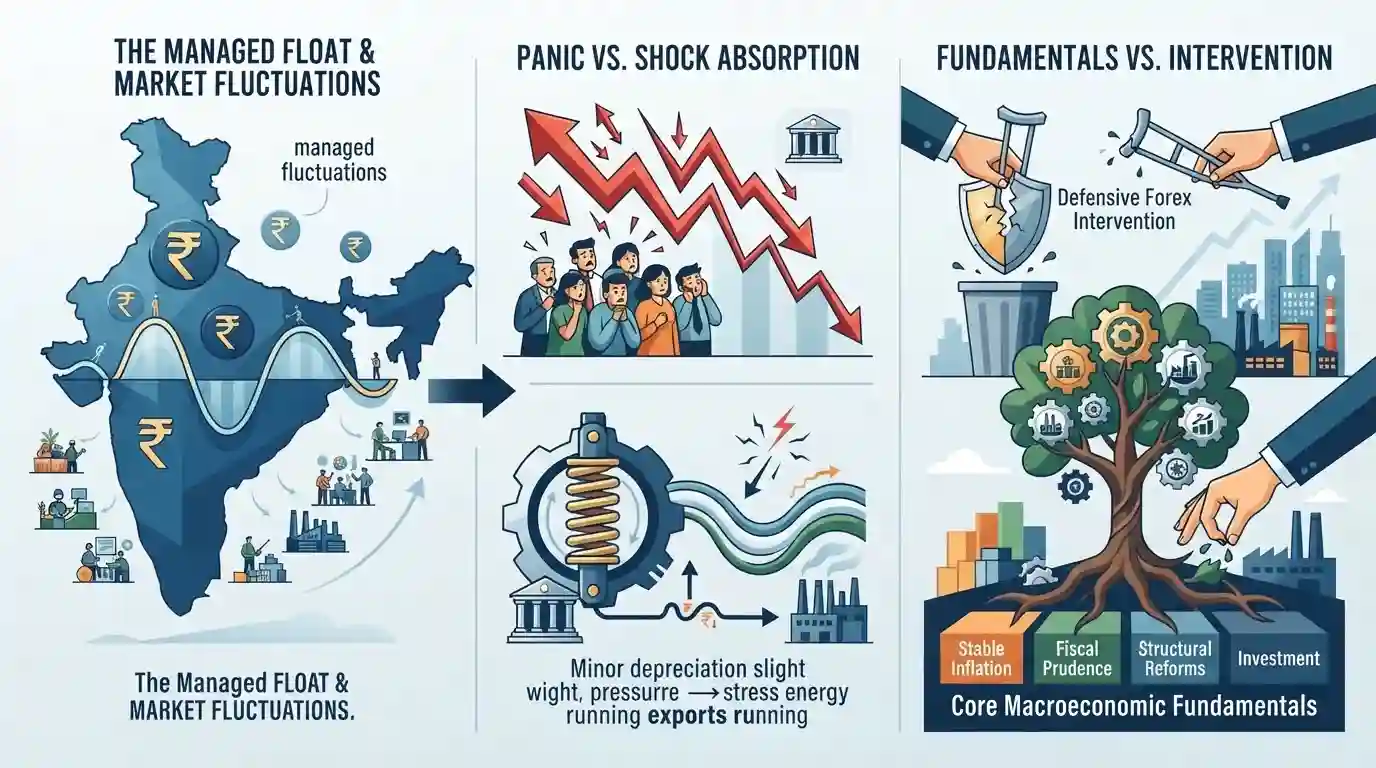
The article examines the common panic surrounding the depreciation of the Indian rupee, arguing that exchange rate fluctuations are a natural part of a managed floating exchange rate regime. It emphasizes that minor currency slides act as economic shock absorbers, and knee-jerk policy interventions or defensive forex interventions to prop up the currency are counterproductive compared to focusing on core macroeconomic fundamentals.
Key Points
- Depreciation of the Indian rupee against the US dollar is often met with unwarranted panic among policymakers and commentators.
- A managed floating exchange rate regime implies that currency fluctuations are a natural shock absorber for trade competitiveness rather than a sign of macroeconomic failure.
- Attempting to artificially defend a specific exchange rate level through aggressive forex reserves depletion can be counterproductive.
- Structural economic fundamentals, inflation differentials, and productivity growth matter far more for long-term currency value than short-term nominal interventions.
Important Terms
Reserve Bank of India

India's central banking institution that controls monetary policy, issues currency, regulates the banking system, and manages the country's foreign exchange reserves and exchange rate.
UPSC context
UPSC GS Paper III (Indian Economy): Essential for questions on monetary policy, central banking functions, and macroeconomic management.
managed floating exchange rate regime
An exchange rate system where market forces determine currency value, but the central bank intervenes periodically to curb excessive volatility rather than target a fixed rate.
UPSC context
UPSC GS Paper III (Indian Economy): Tests understanding of external sector management, exchange rate mechanisms, and forex interventions.
Static Concepts Connected
How does India's managed floating exchange rate regime operate in practice?
- Market Determination: Market Determined: The external value of the rupee is primarily determined by market forces of demand and supply for foreign exchange.
- RBI Role: Volatility Curbing: The RBI intervenes in the forex market only to curb excessive volatility and disruptive movements, without targeting any fixed exchange rate level.
- Shock Absorber: Shock Absorber: Gradual depreciation acts as a natural economic cushion, absorbing external shocks and protecting domestic trade competitiveness during global downturns.
Cross-Topic Patterns
Rupee Depreciation vs. Export Competitiveness and Inflation
A depreciating currency aids export competitiveness while simultaneously raising import bills, creating a complex trade-off between export promotion schemes (like PLIs) and domestic inflation targeting under the Monetary Policy Committee.

Expect a statement-based question distinguishing between a fixed exchange rate and India's managed float, testing RBI intervention objectives.
Linked PYQs · 3
Linked PYQs · 3
- 2018MainsGS3
How would the recent phenomena of protectionism and currency manipulations in world trade affect macroeconomic stability of India?
- 2019PrelimsGS1
Which one of the following is not the most likely measure the Government/RBI takes to stop the slide of Indian rupee?
- 2022PrelimsGS1
With reference to the Indian economy, consider the following statements: 1. If the inflation is too high, Reserve Bank of India (RBI) is likely to buy government securities. 2. If the rupee is rapidly depreciating, RBI is likely to sell dollars in the market. 3. If interest rates in the USA or European Union were to fall, that is likely to induce RBI to buy dollars. Which of the statements given above are correct?
