Indian Rupee Valuation: Macroeconomic Stability and Forex Reserves
Source:The Hindu ↗
Why It Matters
The movement of the Indian Rupee against the U.S. Dollar is a key indicator of India's external sector health. Understanding the interplay between currency valuation, forex reserves, inflation indices (WPI), and trade deficit is crucial for monetary policy formulation and impacts India's macroeconomic stability.
Summary
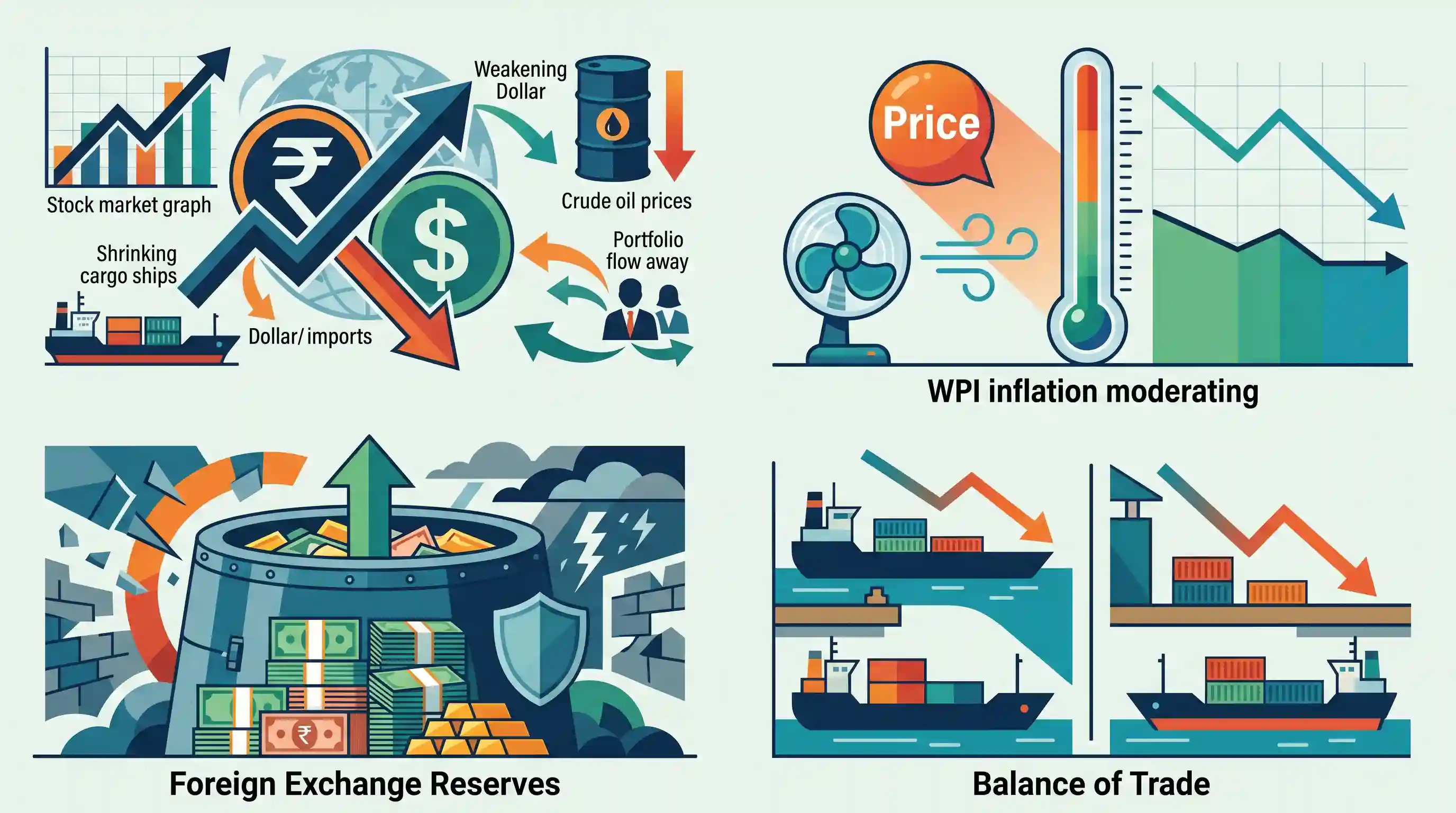
The Indian Rupee recorded a slight appreciation against the U.S. Dollar, closing at 86.03, buoyed by robust domestic equity markets, a weakening greenback, and lower global crude oil prices. This currency gain materialized despite headwinds such as falling exports, declining imports, and continuous foreign portfolio outflows. Concurrently, wholesale price inflation (WPI) moderated to a four-month low of 0.39%, and India's foreign exchange reserves rose to $696.65 billion, signaling resilient macroeconomic buffers amidst Middle Eastern geopolitical uncertainties.
Key Points
- The Indian Rupee appreciated by 8 paise to close at 86.03 against the U.S. Dollar, driven by strong domestic equity markets and a weakening dollar.
- Easing of global Brent crude oil prices supported the Rupee, even amidst ongoing geopolitical tensions in the Middle East.
- The appreciation occurred despite a 2.17% decline in exports, a 1.7% decline in imports, and continued foreign fund outflows.
- India's wholesale price inflation (WPI) eased to a four-month low of 0.39%, indicating softening wholesale price pressures.
- Foreign exchange reserves increased to $696.65 billion, providing a strong buffer against external economic shocks.
Important Terms
Currency Appreciation

An increase in the value of the Rupee relative to foreign currencies (like the Dollar), which typically makes imports cheaper and exports more expensive.
UPSC context
GS-III: External Sector. Tests understanding of exchange rate dynamics and their impact on the Balance of Payments.
Wholesale Price Index (WPI)
An index measuring price changes of goods sold in bulk at the wholesale level, excluding services; compiled by the Ministry of Commerce and Industry.
UPSC context
GS-III: Indian Economy. Tests knowledge of inflation indices and their role in Assessing macroeconomic stability.
Foreign Exchange (Forex) Reserves
External assets (foreign currencies, gold, SDRs) held by the RBI to support the exchange rate, ensure liquidity, and buffer against global economic shocks.
UPSC context
GS-III: External Sector. Tests knowledge of India's external resilience and the central bank's intervention capabilities.
Foreign Portfolio Investment (FPI)
Investment by non-residents in Indian financial assets like stocks and bonds; characterized by high liquidity and potential volatility compared to FDI.
UPSC context
GS-III: Indian Economy. Tests understanding of capital market flows and their influence on currency volatility.
Balance of Trade (BoT)
The difference between the total monetary value of a nation's exported and imported goods; a key indicator of a country's trade health.
UPSC context
GS-III: External Sector. Crucial for analyzing the Current Account Deficit and overall trade competitiveness.
BSE (Bombay Stock Exchange)
Asia's oldest stock exchange, providing a platform for capital formation and reflecting Indian market sentiment through its benchmark index, the SENSEX.
UPSC context
GS-III: Financial Markets. Tests knowledge of capital market infrastructure and its significance to economic growth.
Prelims Trap
Foreign portfolio outflows inevitably cause the depreciation of the Indian Rupee.
The Rupee can appreciate even during FPI outflows if the US Dollar weakens globally or falling crude prices reduce India's dollar demand for imports.
Static Concepts Connected
How does WPI differ from CPI in the Indian context?
- Coverage: WPI covers only goods (Primary Articles, Fuel & Power, Manufactured Products). It completely excludes services, unlike CPI.
- Monetary Policy: The RBI exclusively targets CPI (retail inflation) for its flexible inflation targeting framework, not WPI.
- Publishing Agency: WPI is compiled by the Office of the Economic Adviser (Ministry of Commerce & Industry), whereas CPI is compiled by NSO.
What drives exchange rate movements in India's Managed Floating regime?
- Market Forces: Market forces of demand and supply determine the baseline value, heavily influenced by crude oil import bills and global dollar strength.
- RBI Intervention: The RBI does not target a specific rate but intervenes by buying or selling dollars to smooth out excessive volatility.
Cross-Topic Patterns
Forex reserves and sovereign ratings
Rising forex reserves enhance India's 'import cover' metric, an essential parameter used by agencies for sovereign credit ratings during Middle Eastern geopolitical shocks.
Divergence between WPI and CPI trends
While WPI hits a four-month low, sticky food inflation often keeps CPI high. This divergence frequently creates a dilemma for the RBI's Monetary Policy Committee.

Expect a multi-statement question testing the counter-intuitive link between FPI outflows and Rupee appreciation via crude oil dynamics.
Linked PYQs · 5
Linked PYQs · 5
- 2022PrelimsGS1
With reference to the Indian economy, consider the following statements: 1. An increase in Nominal Effective Exchange Rate (NEER) indicates the appreciation of rupee. 2. An increase in the Real Effective Exchange Rate (REER) indicates an improvement in trade competitiveness. 3. An increasing trend in domestic inflation relative to inflation in other countries is likely to cause an increasing divergence between NEER and REER. Which of the above statements are correct?
- 2022PrelimsGS1
With reference to the Indian economy, consider the following statements: 1. If the inflation is too high, Reserve Bank of India (RBI) is likely to buy government securities. 2. If the rupee is rapidly depreciating, RBI is likely to sell dollars in the market. 3. If interest rates in the USA or European Union were to fall, that is likely to induce RBI to buy dollars. Which of the statements given above are correct?
- 2020PrelimsGS1
Consider the following statements: 1. The weightage of food in Consumer Price Index (CPI) is higher than that in Wholesale Price Index (WPI). 2. The WPI does not capture changes in the prices of services, which CPI does. 3. Reserve Bank of India has now adopted WPI as its key measure of inflation and to decide on changing the key policy rates. Which of the statements given above is/are correct?
- 2015MainsGS3
Craze for gold in Indians has led to a surge in import of gold in recent years and put pressure on balance of payments and external value of rupee. In view of this, examine the merits of the Gold Monetization Scheme.
- 2024MainsGS3
What are the causes of persistent high food inflation in India? Comment on the effectiveness of the monetary policy of the RBI to control this type of inflation.
