Indian Rupee appreciates against US Dollar in early trade
Source:The Hindu ↗
Why It Matters
The volatility of the Indian Rupee impacts inflation, trade competitiveness, and the balance of payments. Understanding the mechanisms of RBI intervention, factors like crude oil prices, and the role of forex reserves is crucial for analyzing India's macroeconomic resilience and exchange rate determination.
Summary
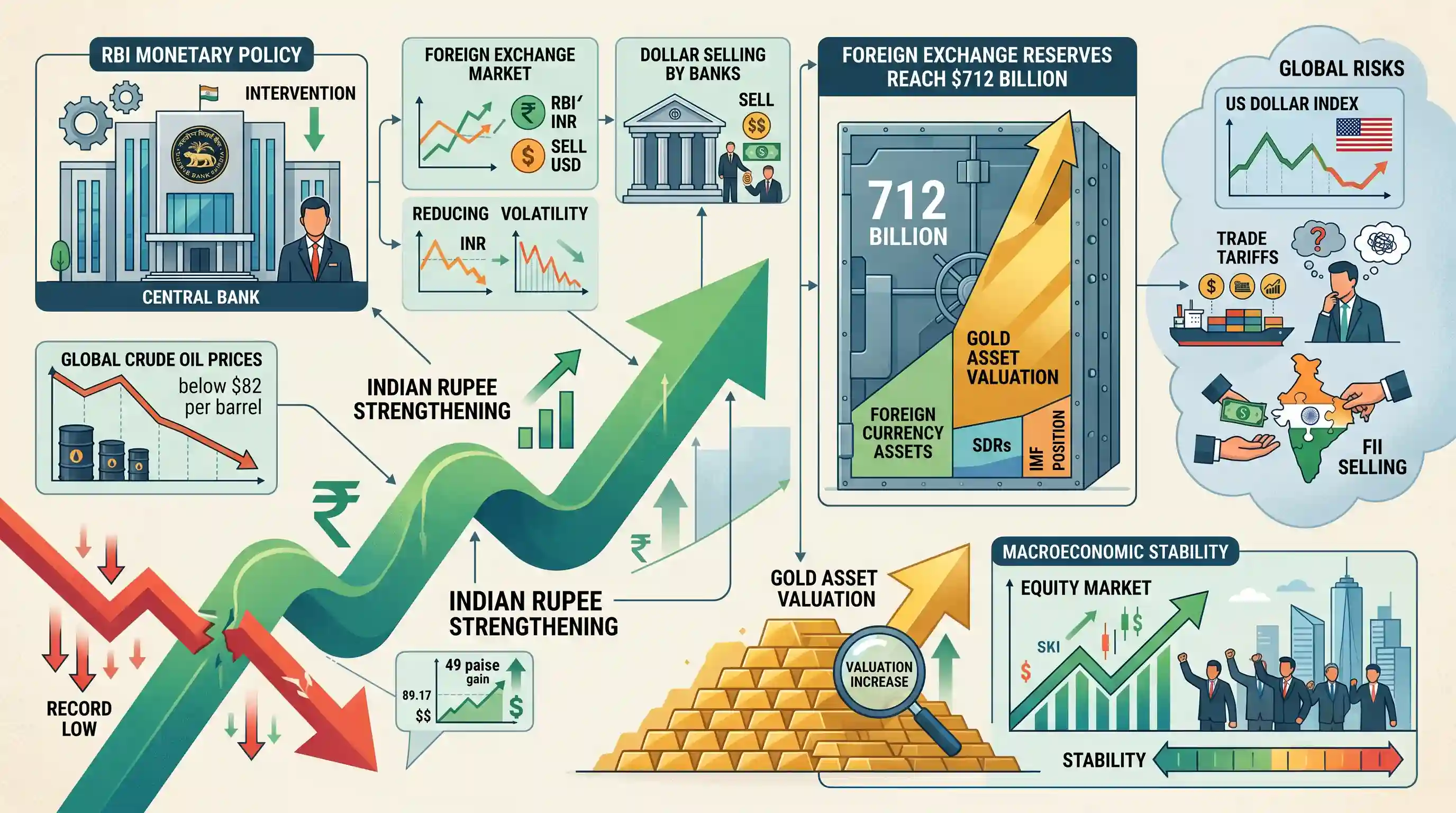
The Indian Rupee strengthened by 49 paise to 89.17 against the US dollar in early trade, recovering from a record low. This appreciation was driven by the Reserve Bank of India's (RBI) likely intervention in the foreign exchange market, dollar selling by banks, and a slight dip in global crude oil prices (Brent crude dropping below $82 per barrel). Furthermore, the broader domestic macroeconomic environment, such as positive openings in equity markets and record-high foreign exchange reserves reaching $712 billion primarily due to gold asset valuation, also supported the recovery. Global factors, including the US Dollar Index, continued to impact currency dynamics amidst uncertainties regarding US trade tariffs and FII selling.
Key Points
- The Indian Rupee rebounded by 49 paise to 89.17 per US Dollar, recovering from recent record lows following suspected RBI intervention and dollar sales by local banks.
- A slight easing of global Brent crude oil prices and a positive start in domestic equity markets contributed to the Rupee's appreciation.
- India's foreign exchange reserves hit a record high of $712.16 billion, a jump largely boosted by the surging value of the RBI's gold reserves.
- Global macroeconomic factors such as the US Dollar index, uncertainties around US trade tariffs, and sustained equity selling by Foreign Institutional Investors (FII) continue to influence the rupee's volatility.
Important Terms
Reserve Bank of India (RBI)

India's central bank and regulatory body responsible for managing monetary policy, issuing currency, and ensuring financial stability by maintaining the country's credit and payment systems.
UPSC context
GS Paper 3: Essential for understanding monetary policy, banking regulation, and external sector stability.
Foreign Institutional Investors (FII)
Large organizations like mutual funds or pension funds based outside India that invest in Indian financial markets, significantly impacting market liquidity and the Rupee's value.
UPSC context
GS Paper 3: Relevant for capital flows, investment trends, and their influence on macroeconomic stability.
Foreign Exchange (Forex) Reserves
Assets held by the RBI in foreign currencies, gold, Special Drawing Rights (SDR), and IMF reserve positions to back liabilities and manage exchange rate volatility.
UPSC context
GS Paper 3: Measures economic resilience, import cover, and the capacity for currency intervention.
US Dollar Index (DXY)
A benchmark measure indicating the value of the US Dollar relative to a weighted basket of six major global currencies including the Euro and Yen.
UPSC context
GS Paper 3: Helps analyze global currency dynamics and their direct impact on the Rupee’s valuation.
Brent Crude
A major global benchmark for oil prices sourced from the North Sea; price shifts significantly affect India's import bill and inflation.
UPSC context
GS Paper 3: Essential for understanding current account deficit and trade-related inflationary pressures.
Exchange Rate Management
Central bank intervention in the foreign exchange market to prevent excessive volatility and stabilize the domestic currency's value against international counterparts.
UPSC context
GS Paper 3: Tests understanding of RBI's role in maintaining external sector stability.
Prelims Trap
"RBI selling dollars from its forex reserves increases rupee liquidity in the domestic market."
When the RBI sells dollars to stabilize the Rupee, it absorbs an equivalent amount of domestic currency from banks, thereby decreasing Rupee liquidity.
Static Concepts Connected
How does the RBI manage the exchange rate under the Managed Float system?
- Managed Float: India does not peg the Rupee. The market determines the rate, but the RBI intervenes to curb extreme volatility.
- Selling Dollars: To arrest Rupee depreciation, the RBI sells US dollars from its reserves, absorbing Rupee liquidity from the system.
- Buying Dollars: To curb excessive appreciation, the RBI buys US dollars, which injects Rupee liquidity into the domestic market.
What are the four components of India's Foreign Exchange Reserves?
- FCAs: Foreign Currency Assets (FCAs) form the largest chunk, held in major currencies like USD, Euro, Yen, and Pound.
- Gold Reserves: The second largest component. It acts as a critical hedge; India's total reserve value fluctuates with global gold prices.
- SDRs and RTP: Special Drawing Rights (SDRs) and the Reserve Tranche Position (RTP) with the IMF make up the remaining fraction.
Cross-Topic Patterns
US Tariffs + FII Flight + Currency
Uncertainties around US trade tariffs drive safe-haven demand for the Dollar, triggering FII outflows from India and forcing the RBI to deplete forex reserves to defend the Rupee.
Forex Interventions + Monetary Policy
RBI's forex operations directly impact domestic liquidity. Heavy dollar selling absorbs Rupees, which can inadvertently tighten domestic monetary conditions even if the repo rate remains unchanged.

Expect a multi-statement Prelims question linking RBI's forex interventions (dollar selling) to domestic money supply and imported inflation.
Linked PYQs · 5
Linked PYQs · 5
- 2022PrelimsGS1
With reference to the Indian economy, consider the following statements: 1. If the inflation is too high, Reserve Bank of India (RBI) is likely to buy government securities. 2. If the rupee is rapidly depreciating, RBI is likely to sell dollars in the market. 3. If interest rates in the USA or European Union were to fall, that is likely to induce RBI to buy dollars. Which of the statements given above are correct?
- 2019PrelimsGS1
Which one of the following is not the most likely measure the Government/RBI takes to stop the slide of Indian rupee?
- 2022PrelimsGS1
With reference to the Indian economy, consider the following statements: 1. An increase in Nominal Effective Exchange Rate (NEER) indicates the appreciation of rupee. 2. An increase in the Real Effective Exchange Rate (REER) indicates an improvement in trade competitiveness. 3. An increasing trend in domestic inflation relative to inflation in other countries is likely to cause an increasing divergence between NEER and REER. Which of the above statements are correct?
- 2011PrelimsGS1
In the context of global oil prices, “Brent crude oil” is frequently referred to in the news. What does this term imply? 1. It is a major classification of crude oil. 2. It is sourced from North Sea. 3. It does not contain sulphur. Which of the statements given above is/are correct?
- 2018MainsGS3
How would the recent phenomena of protectionism and currency manipulations in world trade affect macroeconomic stability of India?
