Indian Rupee Settles Marginally Higher Against US Dollar
Source:The Hindu ↗
Why It Matters
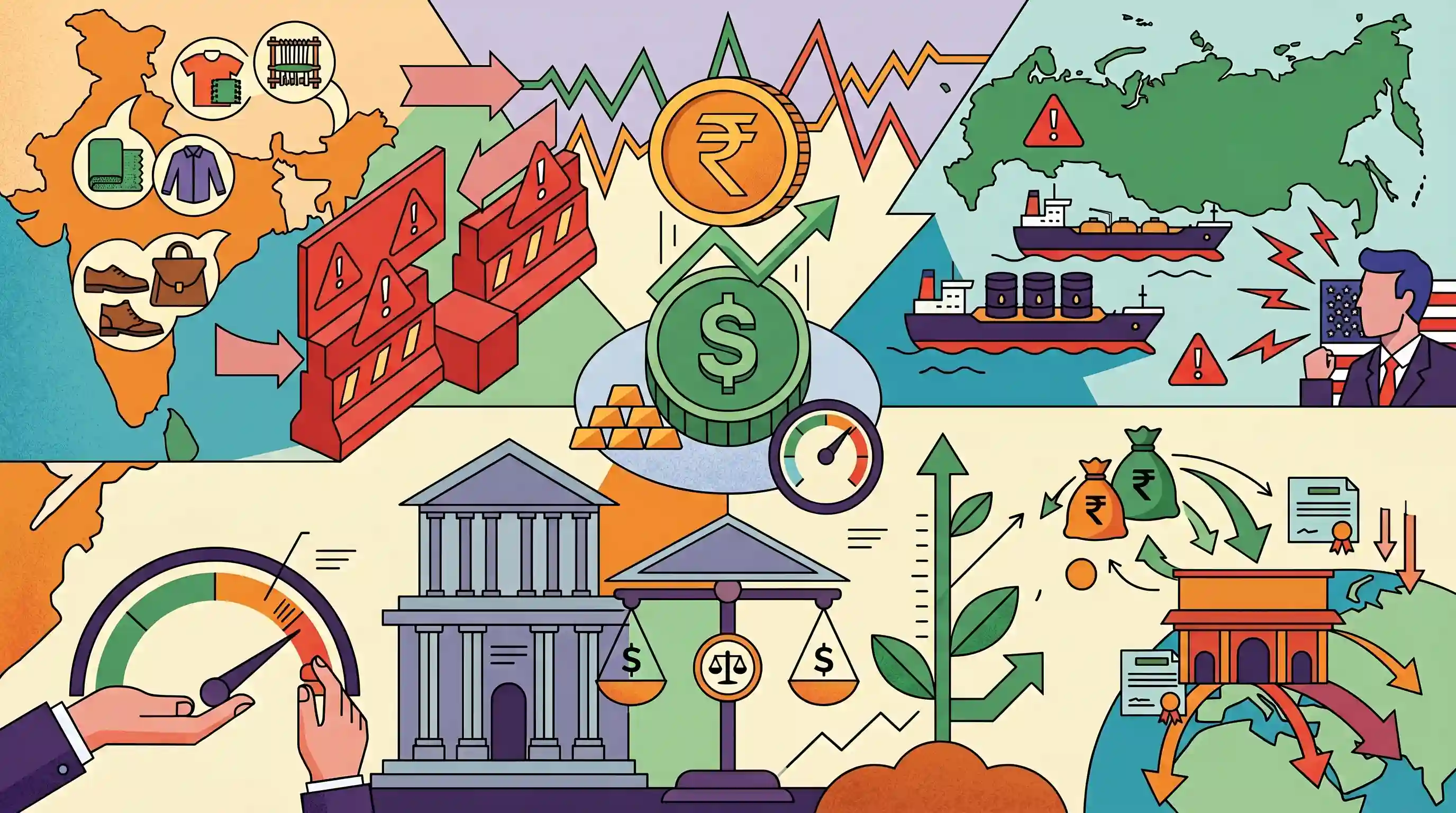
The article lies at the intersection of international trade, geopolitics, and domestic monetary policy. It highlights how India's strategic autonomy in energy procurement (buying Russian oil) faces severe pushback through US tariffs, directly impacting India's export economy. Additionally, it shows how the RBI balances these external shocks through its monetary policy stance to stabilize the rupee and manage inflation.
Summary
The Indian rupee appreciated slightly to close at 87.69 against the US dollar, navigating a volatile environment triggered by new protectionist measures from the US. The US administration imposed an additional 25% duty on Indian imports, raising the total tariff to 50% as a retaliatory measure against India's continued purchases of Russian crude oil. This move threatens key Indian export sectors like textiles and leather. Amidst these geopolitical and trade uncertainties, the Reserve Bank of India (RBI) kept the policy repo rate unchanged at 5.5%, maintaining a neutral stance while retaining a 6.5% economic growth projection for FY26. Concurrently, foreign institutional investors continued to offload Indian equities.
Key Points
- The Indian rupee rose by 3 paise to close at 87.69 against the US dollar.
- The RBI kept the policy repo rate unchanged at 5.5% and maintained a neutral monetary stance amid tariff-related uncertainties.
- US President Donald Trump imposed a 50% total tariff on Indian goods (an additional 25%) as a penalty for India's continued imports of Russian oil.
- The increased US tariffs will negatively impact Indian export sectors such as textiles, marine products, and leather.
- India and Brazil face the highest tariffs at 50%, while China (30%) and Turkey (15%) face comparatively lower rates.
- RBI Governor Sanjay Malhotra retained India's growth rate projection for FY26 at 6.5%.
- Foreign Institutional Investors (FIIs) remained net sellers in the domestic capital market, offloading substantial equities.
Important Terms
Repo Rate

The interest rate at which the RBI lends money to commercial banks against government securities. It is the central bank's primary tool for controlling inflation and managing liquidity.
UPSC context
GS Paper 3 (Economy); essential for understanding monetary policy transmission and inflation targeting.
Neutral Stance
A monetary policy position where the RBI maintains flexibility to either raise or lower interest rates depending on evolving economic data, indicating no immediate bias toward easing or tightening.
UPSC context
GS Paper 3 (Economy); tests knowledge of Monetary Policy Committee (MPC) frameworks and decision-making.
Protectionism
Economic policies, such as tariffs or quotas, designed to restrict imports and protect domestic industries from foreign competition. Retaliatory protectionism often triggers trade wars.
UPSC context
GS Paper 3 (Economy) and GS Paper 2 (International Relations); key for trade-related and WTO themes.
Currency Appreciation
An increase in the value of a currency relative to others in a floating exchange rate system. It makes imports cheaper but reduces the competitiveness of a country's exports.
UPSC context
GS Paper 3 (Economy); vital for understanding the external sector and its impact on trade balance.
Foreign Institutional Investors (FIIs)
International organizations like mutual funds or pension funds that invest in a country's financial markets. They are categorized under Foreign Portfolio Investment (FPI) and are sensitive to global market sentiment.
UPSC context
GS Paper 3 (Economy); relates to capital markets, liquidity, and differences between FDI and FPI.
Reserve Bank of India (RBI)
India's central bank and regulatory body. It manages monetary policy, issues currency, and supervises the banking system to ensure economic and financial stability.
UPSC context
GS Paper 3 (Economy); the foundational body for banking, monetary tools, and external sector management.
Prelims Trap
Continuous FII offloading guarantees the depreciation of the Indian Rupee in daily trading.
While FII outflows structurally exert depreciating pressure, daily rates depend on RBI forex interventions, global dollar index, and trade flows. The Rupee can still appreciate on a given day despite FII selling.
Static Concepts Connected
What do the primary RBI monetary policy stances signify?
- Accommodative: Central bank is prepared to expand the money supply and cut interest rates to boost economic growth.
- Neutral: The RBI retains flexibility to either hike or cut rates based on incoming macroeconomic data, without committing to a specific direction.
- Hawkish (Withdrawal): The central bank focuses on controlling inflation, typically signaling an inclination to hike interest rates and reduce market liquidity.
How does the WTO classify trade barriers and retaliatory tariffs?
- Most-Favored-Nation (MFN): The core WTO principle requiring a country to treat all other WTO members equally regarding tariffs; unilateral punitive tariffs often violate this.
- Bound Rates: The absolute maximum tariff rate a WTO member has legally committed not to exceed for a specific product line.
- Trade Remedies: WTO permits specific duties (Anti-dumping, Countervailing, Safeguard) only under strict, evidence-based investigative conditions, not for geopolitical retaliation.
Cross-Topic Patterns
Energy security vs. Export competitiveness
India's insistence on buying discounted Russian crude to check domestic inflation is now directly inviting Western unilateral trade tariffs, penalizing labor-intensive export sectors like textiles and leather.
Currency defence amid FII flight
Continuous FII equity sell-offs exert structural depreciating pressure, mandating active RBI interventions in the spot and forward forex markets to prevent wild rupee swings, irrespective of the repo rate stance.

Expect a 2026 prelims question linking RBI's neutral stance, FII-driven currency depreciation pressures, and WTO MFN rule violations.
Linked PYQs · 5
Linked PYQs · 5
- 2020PrelimsGS1
If the RBI decides to adopt an expansionist monetary policy, which of the following would it not do ? 1. Cut and optimize the Statutory Liquidity Ratio 2. Increase the Marginal Standing Facility Rate 3. Cut the Bank Rate and Repo Rate Select the correct answer using the code given below:
- 2022PrelimsGS1
With reference to the Indian economy, consider the following statements: 1. An increase in Nominal Effective Exchange Rate (NEER) indicates the appreciation of rupee. 2. An increase in the Real Effective Exchange Rate (REER) indicates an improvement in trade competitiveness. 3. An increasing trend in domestic inflation relative to inflation in other countries is likely to cause an increasing divergence between NEER and REER. Which of the above statements are correct?
- 2022PrelimsGS1
With reference to the Indian economy, consider the following statements: 1. If the inflation is too high, Reserve Bank of India (RBI) is likely to buy government securities. 2. If the rupee is rapidly depreciating, RBI is likely to sell dollars in the market. 3. If interest rates in the USA or European Union were to fall, that is likely to induce RBI to buy dollars. Which of the statements given above are correct?
- 2012MainsGS2
Discuss the likely negative impact of the protectionist measures proposed by the US on India's software industry.
- 2018MainsGS2
What are the key areas of reform if the WTO has to survive in the present context of "Trade War', especially keeping in mind the interest of India?
