व्यापार समझौते की उम्मीद से अमेरिकी डॉलर के मुकाबले भारतीय रुपया मजबूत हुआ
स्रोत:द हिंदू ↗
क्यों मायने रखता है
The article intertwines core macroeconomic concepts (exchange rate dynamics, RBI intervention, forex reserves) with a significant geopolitical and economic development (India-US trade pact). It is highly relevant for GS-3 (Economy) concerning currency management and for GS-2 (IR) regarding bilateral relations.
सारांश
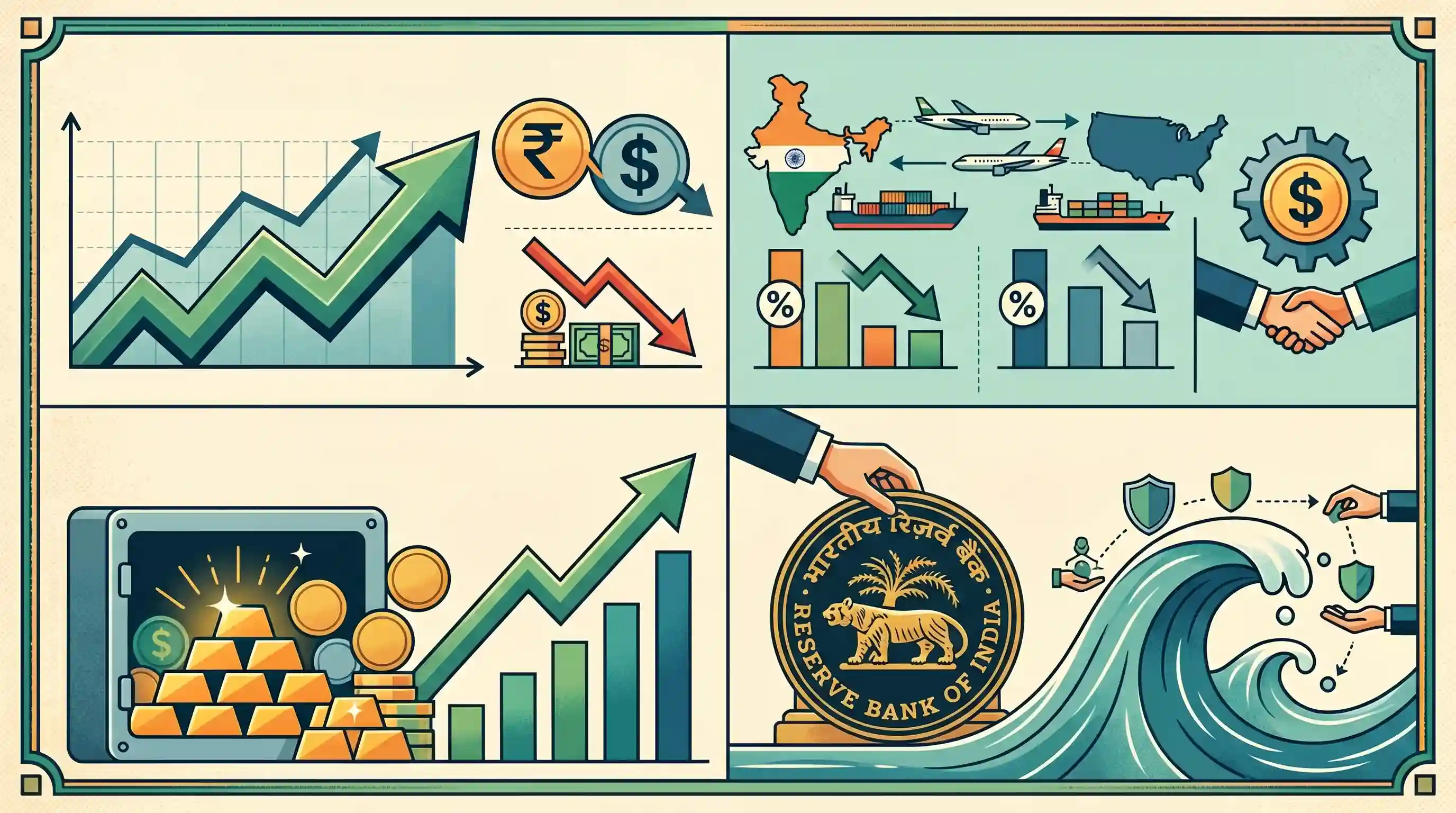
The Indian rupee rebounded by 21 paise to close at 90.44 against the US dollar, buoyed by the framework for an interim India-US trade pact that promises substantial mutual tariff reductions. This agreement involves the US slashing tariffs on Indian goods from 50% to 18%, and India reciprocating by reducing duties on American industrial and agricultural goods, along with a commitment to purchase $500 billion in US products over five years. The currency was further supported by a softening dollar index, robust domestic equities, active RBI interventions to stabilize excessive volatility, and India's record-high foreign exchange reserves.
मुख्य बिंदु
- The Indian Rupee appreciated by 21 paise to settle at 90.44 against the US dollar, reversing a recent slide.
- A major driver of the appreciation was the announcement of a framework for an India-US interim trade pact, aiming to sharply reduce mutual import duties.
- Under the pact, US tariffs on key Indian exports (textiles, jewelry, marine products) would fall from 50% to 18%, while India will eliminate or reduce duties on US industrial and agricultural goods.
- India also pledged to purchase $500 billion worth of US energy, aircraft, precious metals, and technology over the next five years.
- RBI's active intervention in the forex market—buying dollars around the 90.05 mark and selling on upticks—alongside a retreating dollar index and record high forex reserves of $723.774 billion supported the rupee.
महत्वपूर्ण शब्द
India-US Interim Trade Pact (2026)

A framework agreement (2026) where the US lowered tariffs on Indian goods to 18% in exchange for India's $500 billion purchase commitment and duty reductions.
UPSC context
GS Paper III (Economy). Illustrates bilateral trade relations, tariff diplomacy, and India's strategy to boost exports and secure energy/tech imports.
Managed Floating Exchange Rate System
A regime where the rupee's value is market-determined but the RBI intervenes to curb excessive volatility without targeting a specific exchange rate level.
UPSC context
GS Paper III (Economy). Essential for understanding RBI’s monetary policy and its role in maintaining external stability.
Foreign Exchange (Forex) Reserves
Assets held by the central bank in foreign currencies, gold, and SDRs to provide a buffer against external shocks and maintain currency stability.
UPSC context
GS Paper III. Tests knowledge of Balance of Payments (BoP), import cover, and the components of India’s external wealth.
Real Effective Exchange Rate (REER)
A weighted average of the rupee's value relative to a basket of major currencies, adjusted for inflation, used to assess trade competitiveness.
UPSC context
GS पेपर III। एक तकनीकी संकेतक जिसका उपयोग यह आंकने के लिए किया जाता है कि क्या रुपया अपने व्यापारिक साझेदारों की तुलना में अधिमूल्यित (overvalued) है या अवमूल्यित (undervalued)।
Dollar Index (DXY)
A measure of the value of the United States dollar relative to a basket of six major foreign currencies, influencing global capital flows.
UPSC context
GS Paper III. High index values often lead to capital outflows from emerging markets like India, impacting the rupee’s strength.
Reserve Bank of India (RBI)
The primary regulator of India's financial system, responsible for managing the rupee's value and maintaining price stability through its Monetary Policy Committee.
UPSC context
GS Paper III. Central to topics on banking, inflation, and external sector management.
प्रारंभिक ट्रैप
The Indian Rupee is part of the six-currency basket that determines the US Dollar Index.
The Dollar Index (DXY) tracks only six major developed-market currencies (Euro, Yen, Pound, CAD, Krona, Swiss Franc). Neither the INR nor the Chinese Yuan are included.
संबंधित अवधारणाएँ
How does RBI intervention in the forex market impact domestic liquidity?
- Selling Dollars: Sucks domestic Rupee liquidity out of the banking system, often used to arrest steep Rupee depreciation against foreign currencies.
- Buying Dollars: Injects Rupee liquidity into the system, done to absorb excess foreign inflows and prevent sharp currency appreciation.
- Sterilization: RBI conducts open market operations or issues MSS bonds to neutralize the inflationary impact of massive dollar-buying (absorbing the excess Rupee liquidity).
What is an Early Harvest Scheme (Interim Trade Agreement)?
- Precursor Step: A confidence-building measure where negotiating nations lower tariffs on a limited list of goods before finalizing a comprehensive Free Trade Agreement (FTA).
- WTO अनुपालन: Under GATT Article XXIV, such interim agreements are permitted only if they include a definitive plan and timeline to eventually cover "substantially all trade."
अंतर-विषय पैटर्न
Strategic trade + Import substitution
The $500 billion US purchase pledge reflects India's geopolitical balancing act—securing preferential Western market access while strategically decoupling its critical supply chains from Chinese imports.
Currency dynamics + Imported inflation
Rupee appreciation makes imported crude oil and electronics cheaper, creating a disinflationary effect that gives the Monetary Policy Committee (MPC) more room to potentially lower interest rates.

Expect a multi-statement Prelims 2026 question testing WTO criteria for 'Interim Pacts' alongside RBI's sterilization of forex inflows.
संबद्ध PYQ · 5
संबद्ध PYQ · 5
- 2022PrelimsGS1
With reference to the Indian economy, consider the following statements: 1. If the inflation is too high, Reserve Bank of India (RBI) is likely to buy government securities. 2. If the rupee is rapidly depreciating, RBI is likely to sell dollars in the market. 3. If interest rates in the USA or European Union were to fall, that is likely to induce RBI to buy dollars. Which of the statements given above are correct?
- 2022PrelimsGS1
With reference to the Indian economy, consider the following statements: 1. An increase in Nominal Effective Exchange Rate (NEER) indicates the appreciation of rupee. 2. An increase in the Real Effective Exchange Rate (REER) indicates an improvement in trade competitiveness. 3. An increasing trend in domestic inflation relative to inflation in other countries is likely to cause an increasing divergence between NEER and REER. Which of the above statements are correct?
- 2021PrelimsGS1
Consider the following statements : The effect of devaluation of a currency is that it necessarily 1. improves the competitiveness of the domestic exports in the foreign markets 2. increases the foreign value of domestic currency 3. improves the trade balance Which of the above statements is/are correct?
- 2013PrelimsGS1
Which one of the following groups of items is included in India's foreign-exchange reserves?
- 2014MainsGS2
The aim of Information Technology Agreements (ITAs) is to lower all taxes and tariffs on information technology products by signatories to zero. What impact would such agreements have on India's interests?
