Rupee Appreciation and India US Trade Deal Negotiations
Source:The Hindu ↗
Why It Matters
Fluctuations in the rupee-dollar exchange rate directly affect India's macroeconomic stability, import costs, and export competitiveness. Furthermore, the nuances of the India-US trade negotiations highlight the core UPSC theme of balancing international trade liberalization with the protection of vulnerable domestic sectors like agriculture and MSMEs.
Summary
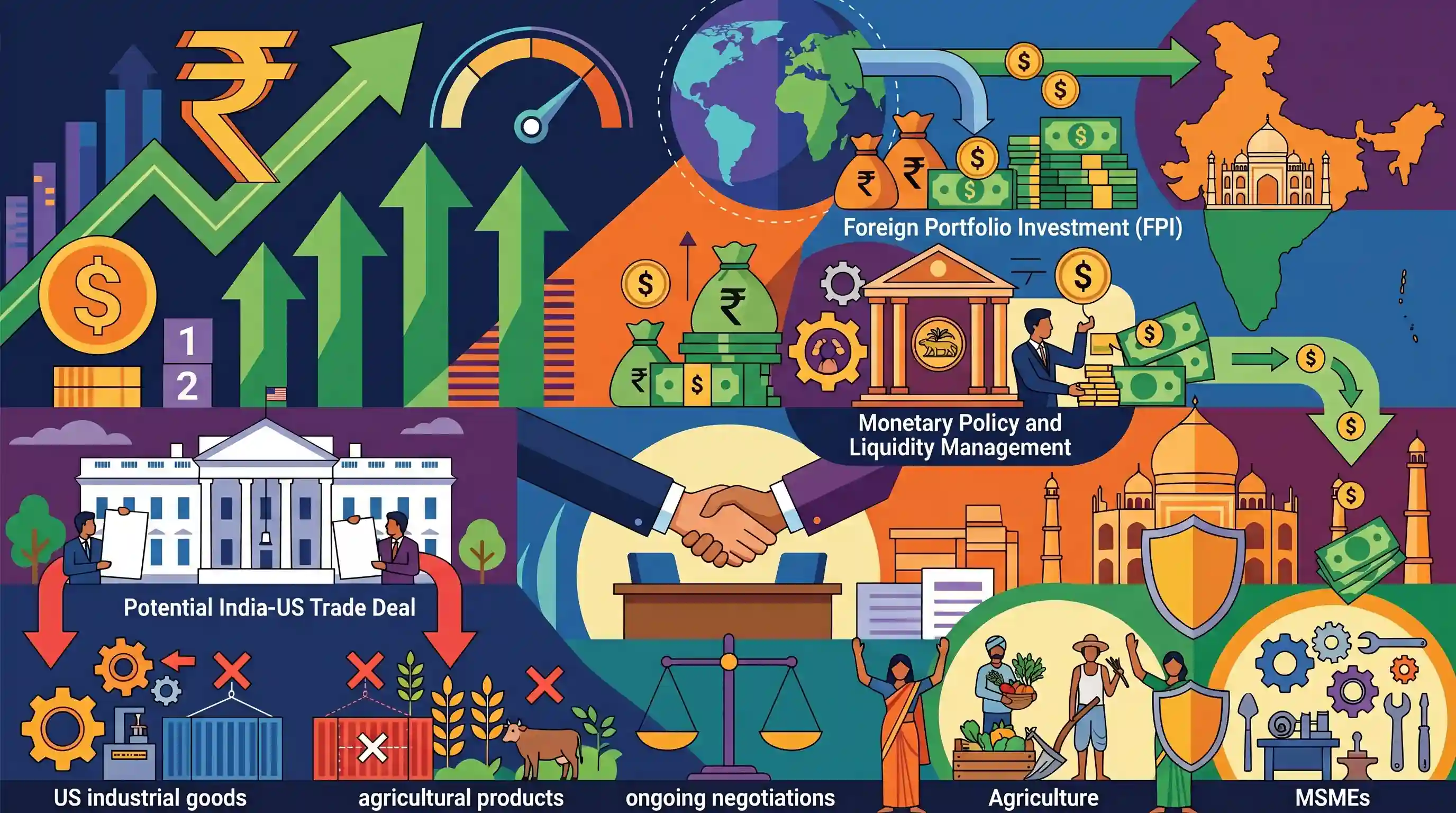
The Indian rupee saw a significant rise of 17 paise to settle at 90.61 against the US dollar, primarily driven by strong foreign fund inflows and the RBI's efforts to ensure ample liquidity in the system. Alongside currency movements, the article highlights emerging details of a potential India-US trade deal. A White House document indicated expectations for India to eliminate tariffs on US industrial goods and reduce them on agricultural products. However, India's Commerce Secretary reiterated the government's stance to safeguard sensitive domestic sectors like agriculture and MSMEs, underscoring the ongoing negotiations surrounding market access and protectionism.
Key Points
- The Indian rupee appreciated by 17 paise to close at 90.61 against the US dollar, bolstered by foreign fund inflows and abundant liquidity managed by the RBI.
- A White House fact sheet revealed that a proposed US-India trade deal involves India eliminating tariffs on US industrial goods and significantly reducing them on food and agricultural products.
- Commerce Secretary Sunil Barthwal emphasized that India will protect its sensitive sectors, such as agriculture, dairy, and MSMEs, amid these tariff reduction pressures.
- Broader market indicators supporting the rupee included a weaker dollar index, stable crude oil prices, and continuous net buying by foreign institutional investors.
Important Terms
Foreign Portfolio Investment (FPI)

Investment by non-residents in Indian financial assets like stocks and bonds. Managed by SEBI, it provides liquidity but is volatile, often called 'hot money.'
UPSC context
GS Paper III: Indian Economy. Tests understanding of capital inflows, market volatility, and exchange rate impact.
Tariffs
A tax or duty imposed by a government on imported goods. It is a tool for protectionism, making foreign products costlier to shield domestic industries.
UPSC context
GS Paper III: External Sector. Tests knowledge of trade barriers, WTO compliance, and impact on domestic manufacturing.
Micro, Small and Medium Enterprises (MSMEs)
Enterprises defined by specific investment and turnover limits. They are vital for employment and exports, often requiring protection in international trade negotiations.
UPSC context
GS Paper III: Industrial Policy. Tests awareness of the 'backbone' of the Indian economy and its vulnerabilities in trade.
Exchange Rate Determination
The value of the Indian Rupee against foreign currencies, determined by market demand, foreign fund flows (FII/FPI), and RBI's liquidity interventions.
UPSC context
GS Paper III: Economy. Tests understanding of currency appreciation/depreciation and central bank's role in monetary stability.
India-US Trade Deal
Evolving negotiations for a 'mini' or interim agreement aimed at reducing reciprocal tariffs and enhancing market access while protecting sensitive sectors like agriculture.
UPSC context
GS Paper II: International Relations. Tests knowledge of bilateral ties, strategic partnerships, and trade diplomacy with major partners.
Prelims Trap
To manage the liquidity from FPI-driven Rupee appreciation, the RBI primarily sells dollars in the forex market.
FPI inflows naturally appreciate the Rupee. To prevent extreme appreciation, the RBI BUYS dollars (it does not sell them) and injects Rupees. It then uses sterilization to absorb excess Rupees.
Static Concepts Connected
What is 'sterilization' in the context of RBI's foreign exchange operations?
- Definition: The central bank's action to neutralize the impact of its foreign exchange interventions on the domestic money supply.
- Mechanism: If RBI buys USD to curb Rupee appreciation, it injects Rupees. It then sells government bonds via Open Market Operations (OMO) to absorb this excess Rupee liquidity.
- Objective: To prevent excess domestic liquidity from fueling inflation while simultaneously managing excessive exchange rate volatility.
What trade policy tools does India use to shield sensitive sectors during FTA negotiations?
- Negative List: Keeping highly sensitive items (like dairy and agriculture) completely out of the tariff reduction commitments.
- Tariff Rate Quotas: Allowing a predetermined, limited quantity of imports at a lower tariff, beyond which higher baseline tariffs apply.
- Rules of Origin: Strict criteria to ensure goods genuinely originate in the partner country, preventing third countries from dumping goods via the FTA route.
Cross-Topic Patterns
Forex rates + MSME Export Competitiveness
A stronger Rupee makes Indian exports pricier. This compounds the challenge for domestic MSMEs already facing pressure from proposed tariff eliminations in the impending US-India trade pact.
Bilateral FTAs + WTO Agriculture Debates
US pressure to slash Indian food tariffs bilaterally runs parallel to the WTO Agreement on Agriculture debates, where India consistently defends its public stockholding and smallholder farmers.

Expect a multi-statement Prelims question linking FPI-driven Rupee appreciation to RBI's sterilization operations and domestic bond yields.
Linked PYQs · 4
Linked PYQs · 4
- 2022PrelimsGS1
With reference to the Indian economy, consider the following statements: 1. If the inflation is too high, Reserve Bank of India (RBI) is likely to buy government securities. 2. If the rupee is rapidly depreciating, RBI is likely to sell dollars in the market. 3. If interest rates in the USA or European Union were to fall, that is likely to induce RBI to buy dollars. Which of the statements given above are correct?
- 2019PrelimsGS1
Which one of the following is not the most likely measure the Government/RBI takes to stop the slide of Indian rupee?
- 2024PrelimsGS1
Consider the following statements : 1. In India, Non-Banking Financial Companies can access the Liquidity Adjustment Facility window of the Reserve Bank of India. 2. In India, Foreign Institutional Investors can hold the Government Securities (G-Secs). 3. In India, Stock Exchanges can offer separate trading platforms for debts. Which of the statements given above is/are correct?
- 2023MainsGS3
What are the direct and indirect subsidies provided to farm sector in India? Discuss the issues raised by the World Trade Organization (WTO) in relation to agricultural subsidies.
