Indian rupee appreciates against US dollar on equity inflows
Source:The Hindu ↗
Why It Matters
Understanding the factors driving the rupee's value (such as equity markets, FII inflows, crude oil prices, and central bank actions) is a core component of the GS3 macroeconomic syllabus. These elements frequently feature in UPSC Prelims questions regarding exchange rate determination and balance of payments.
Summary
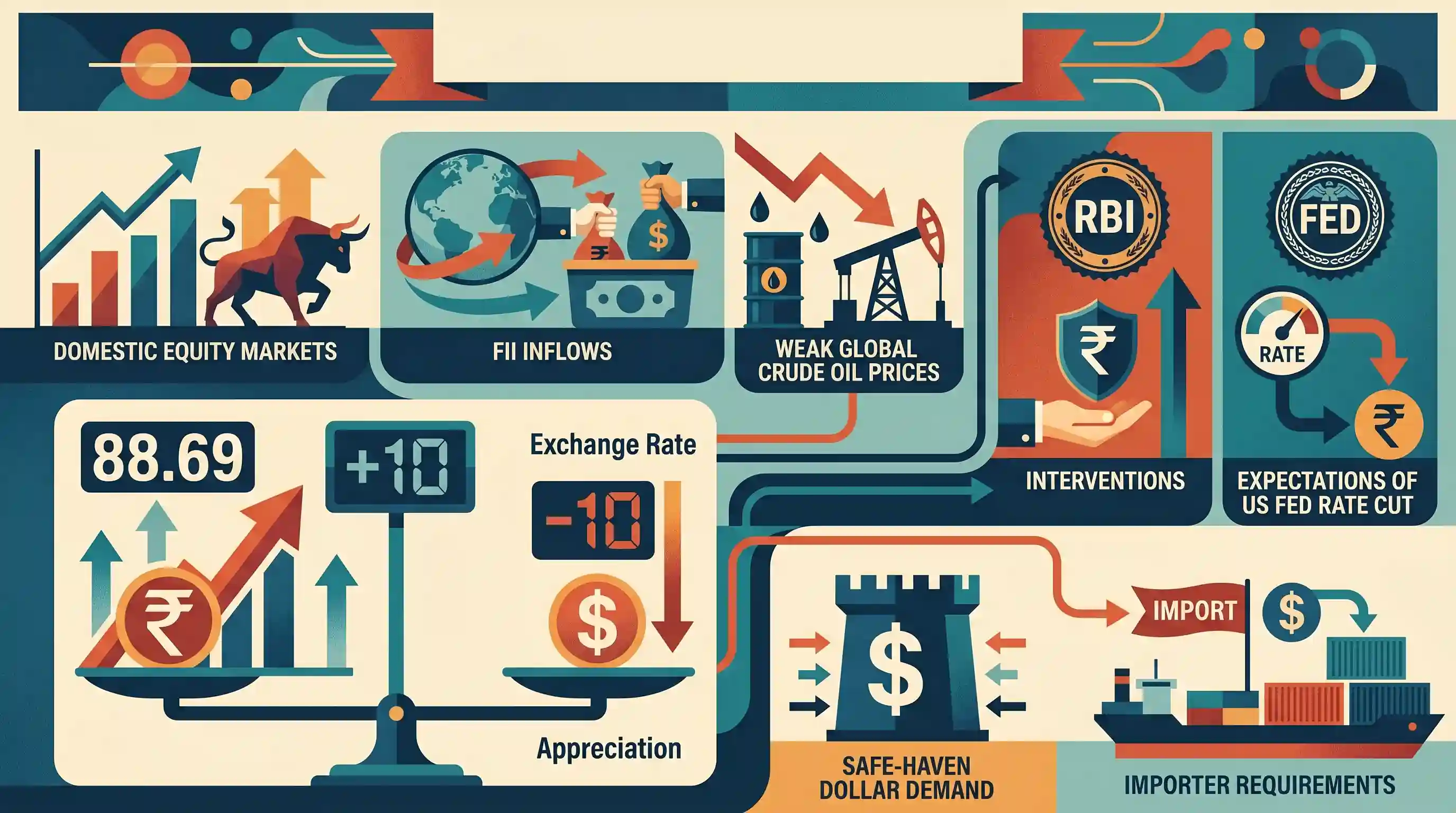
The Indian rupee appreciated by 10 paise to close at 88.69 against the US dollar, driven by strong domestic equity markets, foreign institutional inflows, and weak global crude oil prices. Interventions by the Reserve Bank of India (RBI) and expectations of a US Federal Reserve rate cut further supported the currency, though safe-haven demand for the dollar and importer requirements capped sharper gains.
Key Points
- The Indian rupee appreciated by 10 paise to close at 88.69 against the US dollar, supported by a rally in domestic equities (Sensex and Nifty).
- A decline in global crude oil prices (Brent crude) and net buying by Foreign Institutional Investors (FIIs) contributed to the rupee's upward momentum.
- Expectations of an interest rate cut by the US Federal Reserve and the US government shutdown added a positive bias to the Indian currency.
- Gains were partially capped by safe-haven demand for the strong US dollar and dollar-buying by domestic importers.
- The Reserve Bank of India (RBI) is believed to have intervened to manage the currency's volatility.
Important Terms
Foreign Institutional Investors (FIIs)

Large foreign entities like pension or mutual funds investing in India's financial markets. Known as "hot money," their entry/exit significantly impacts market liquidity and the rupee's value.
UPSC context
GS Paper 3 (Economy); tests understanding of capital flows, resource mobilization, and their impact on domestic market volatility.
Exchange Rate Appreciation
The increase in the value of the rupee against a foreign currency (like the USD) driven by market demand. It makes imports cheaper but reduces export competitiveness.
UPSC context
GS Paper 3 (Economy); essential for topics on the External Sector and Balance of Payments (BoP).
Reserve Bank of India (RBI)
India's central bank and custodian of foreign exchange reserves. It intervenes in the forex market (buying/selling dollars) to contain excessive volatility of the rupee.
UPSC context
GS Paper 3 (Economy); focus on monetary policy, regulatory roles, and management of forex reserves.
US Federal Reserve (Fed)
The central bank of the United States. Its interest rate decisions (e.g., rate cuts) influence global liquidity and the attractiveness of emerging markets like India to investors.
UPSC context
GS Paper 3 (Economy); tests the impact of global macroeconomic policies on the Indian economy and currency.
Safe-haven Asset
An investment, such as the US Dollar or Gold, expected to retain or increase in value during periods of global economic downturn or geopolitical uncertainty.
UPSC context
GS Paper 3 (Economy); relevant for understanding currency demand patterns during global crises.
Crude Oil Import Bill
The total expenditure on importing crude oil. Since India imports ~85% of its oil, price fluctuations directly affect the trade deficit and demand for the US dollar.
UPSC context
GS Paper 3 (Economy); crucial for analyzing inflation, trade balance, and current account deficit (CAD).
Prelims Trap
"A US Federal Reserve interest rate cut triggers capital flight from India, depreciating the Rupee."
Lower US rates reduce yields on US assets, driving foreign capital into emerging markets like India for higher returns, thereby *appreciating* the Rupee.
Static Concepts Connected
How does the RBI manage exchange rate volatility?
- Forex transactions: RBI sells dollars from reserves to arrest rupee depreciation, and buys dollars to prevent excessive appreciation.
- Sterilization: Uses Open Market Operations (OMO) to absorb or inject rupee liquidity caused by its forex interventions, maintaining domestic money supply.
- Managed Float: India follows a market-determined rate; RBI intervenes only to smooth extreme fluctuations, not to fix a specific rate.
What macroeconomic factors drive Rupee appreciation?
- FII Inflows: Net buying by foreign investors increases dollar supply in domestic markets, strengthening the domestic currency.
- Crude Oil Prices: Falling global oil prices lower India's massive import bill and Current Account Deficit (CAD), reducing dollar demand.
- US Monetary Policy: Dovish US monetary policy (rate cuts) pushes global capital toward emerging markets in search of higher yields.
Cross-Topic Patterns
Currency valuation + Imported Inflation
Rupee fluctuations directly impact the cost of inelastic imports like crude oil, transmitting global price shocks into domestic CPI/WPI and affecting RBI's inflation targeting framework.
US Fed Rates + Taper Tantrum
The inverse relationship between US interest rates and emerging market equity inflows remains a recurring Prelims theme, frequently tested by UPSC since the 2013 taper tantrum.

Expect a multi-statement Prelims question interlinking US Fed rates, FII flows, RBI sterilization, and imported inflation.
Linked PYQs · 4
Linked PYQs · 4
- 2022PrelimsGS1
With reference to the Indian economy, consider the following statements: 1. If the inflation is too high, Reserve Bank of India (RBI) is likely to buy government securities. 2. If the rupee is rapidly depreciating, RBI is likely to sell dollars in the market. 3. If interest rates in the USA or European Union were to fall, that is likely to induce RBI to buy dollars. Which of the statements given above are correct?
- 2019PrelimsGS1
Which one of the following is not the most likely measure the Government/RBI takes to stop the slide of Indian rupee?
- 2011PrelimsGS1
Both Foreign Direct Investment (FDI) and Foreign Institutional Investor (FII) are related to investment in a country. Which one of the following statements best represents an important difference between the two?
- 2018MainsGS3
How would the recent phenomena of protectionism and currency manipulations in world trade affect macroeconomic stability of India?
