Rupee Recovers from Record Lows Amid RBI Intervention Signs
Source:The Hindu ↗
Why It Matters
Understanding exchange rate movements is fundamental to UPSC economics. This event perfectly illustrates the difference between domestic economic weakness and external shocks causing currency depreciation, while highlighting the RBI's 'managed float' exchange rate policy and the impact of global trade protectionism on emerging markets.
Summary
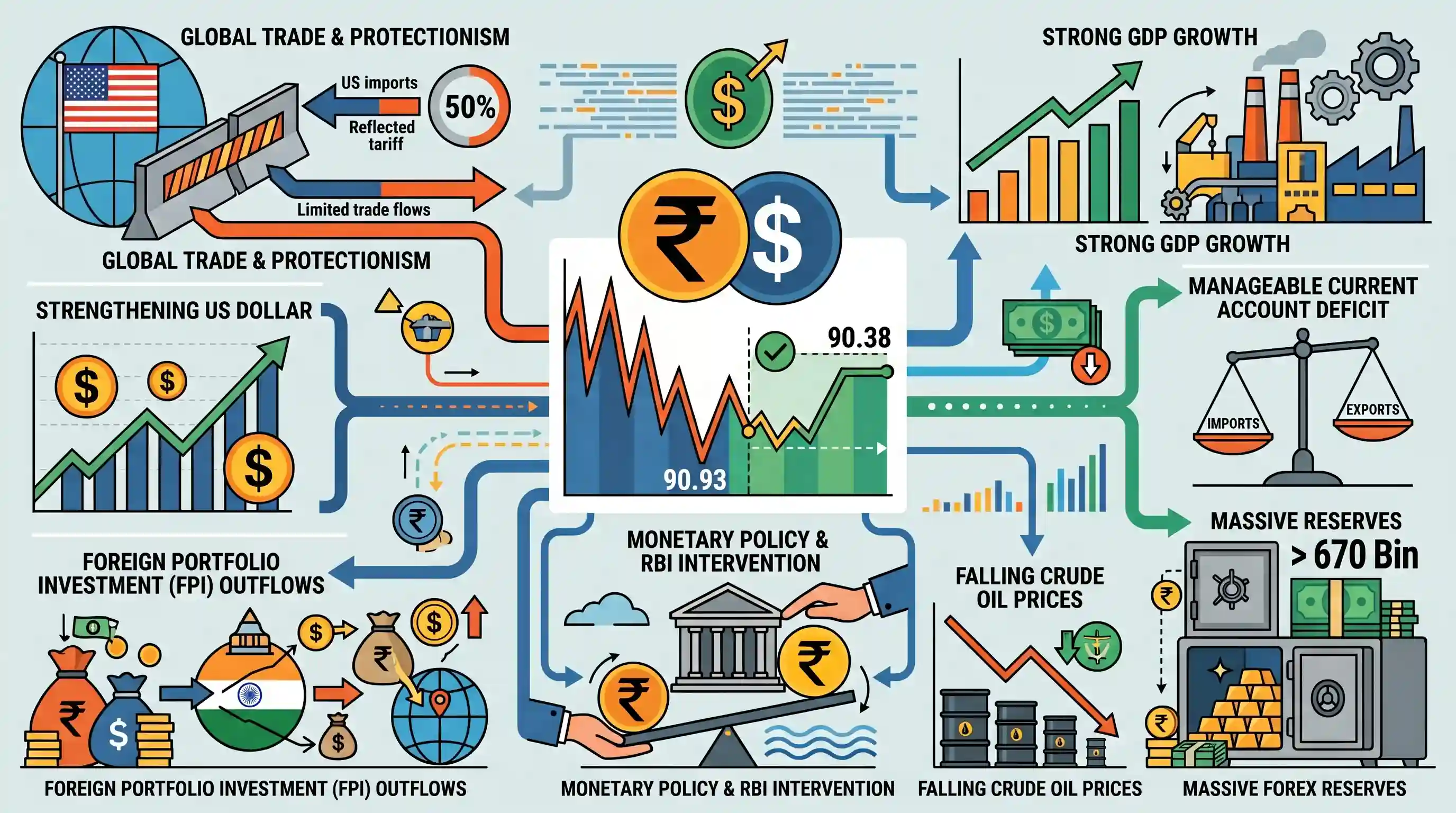
The Indian rupee recently witnessed a steep depreciation to a historic low of 90.93 against the US dollar before rebounding to 90.38, supported by suspected interventions from the Reserve Bank of India (RBI). The downward pressure on the currency stems entirely from external headwinds, including significant capital outflows by Foreign Portfolio Investors (FPIs), a strengthening US dollar, and the immediate shock of 50% tariffs imposed by the US on Indian exports. However, India's internal macroeconomic fundamentals remain robust, backed by strong GDP growth, a manageable current account deficit, and massive forex reserves exceeding $670 billion. The RBI's actions underscore its policy of managing volatility rather than pegging the rupee, while falling global crude oil prices offer an additional buffer for India's external sector.
Key Points
- The Indian rupee recovered 55 paise to close at 90.38 against the US dollar, largely attributed to suspected interventions by the Reserve Bank of India after the currency hit an all-time low of 90.93.
- The currency's depreciation is driven by external factors such as persistent capital outflows by Foreign Portfolio Investors (FPIs), broad strength in the US dollar, and newly announced 50% US tariffs on Indian exports.
- The RBI's intervention strategy focuses on curbing excessive market volatility rather than defending a specific exchange rate level.
- India's domestic economic fundamentals remain strong, with robust forex reserves (over $670 billion), healthy GDP growth, and a manageable current account deficit.
- Lower global crude oil prices (Brent crude below $60 per barrel) provide a structural cushion to the Indian economy by reducing the import bill, which helps limit severe currency depreciation.
Important Terms
Reserve Bank of India (RBI)

India's central bank and regulatory body responsible for monetary policy and managing foreign exchange reserves. It intervenes in the forex market to curb excessive rupee volatility through a 'managed float' approach.
UPSC context
GS Paper III (Economy). Essential for questions on monetary policy, exchange rate management, and banking regulation.
Foreign Portfolio Investors (FPIs)
Foreign entities investing in Indian financial assets like stocks and bonds without taking managerial control. Often termed 'hot money', these flows are highly volatile and significantly impact the rupee’s value.
UPSC context
GS Paper III (External Sector). Tests understanding of capital account volatility and its impact on the rupee.
Managed Float Exchange Rate
An exchange rate regime where the currency's value is determined by market forces, but the central bank (RBI) intervenes to prevent extreme volatility. It is also referred to as 'dirty floating'.
UPSC context
GS Paper III (Economy). Key concept for exchange rate dynamics and RBI’s policy framework.
Forex Reserves
Reserve assets held by the central bank, comprising Foreign Currency Assets (FCA), Gold, Special Drawing Rights (SDRs), and Reserve Tranche Position with the IMF. They serve as a buffer against external shocks.
UPSC context
GS Paper III (External Sector). Vital for Balance of Payments (BoP) stability and currency management.
Current Account Deficit (CAD)
A situation where a country's total imports of goods, services, and transfers exceed its total exports. It indicates the nation is a net borrower of foreign exchange from the rest of the world.
UPSC context
GS Paper III (Economy). A core indicator for assessing India's external sector health and macroeconomic stability.
Tariffs
Taxes imposed by a government on imported goods to protect domestic industries from foreign competition or as a retaliatory measure. They increase import costs and can influence the domestic currency's value.
UPSC context
GS Paper II (IR) & III (Economy). Relevant for trade wars, protectionism, and global trade dynamics.
Prelims Trap
The RBI intervenes in the forex market to peg the value of the Rupee at a specific target rate.
India follows a 'managed float' system. The RBI intervenes in the forex market solely to curb excessive volatility, never to defend a specific target exchange rate.
Static Concepts Connected
What is a 'Managed Float' exchange rate regime?
- Market-determined: The exchange rate is broadly determined by market forces of demand and supply, rather than government mandate.
- Central Bank Intervention: The central bank buys or sells foreign currency to smooth out excessive volatility, often termed a 'dirty float'.
- No Target Rate: Unlike a fixed exchange rate regime, the central bank does not guarantee or peg the currency to a specific numerical value.
How does Rupee depreciation theoretically affect the Indian economy?
- Costlier Imports: Increases the domestic cost of buying foreign goods (like crude oil), which can trigger 'imported inflation'.
- Export Competitiveness: Depreciation traditionally makes Indian goods cheaper abroad, boosting export competitiveness (though currently offset by US tariffs).
- External Debt Burden: Increases the rupee burden for the government and corporates servicing dollar-denominated external debt.
Cross-Topic Patterns
US Protectionism & Exchange Rates
The 50% US tariff shock reduces forex earnings, demonstrating how geopolitical trade wars immediately transmit into domestic monetary challenges, worsening the Current Account Deficit.
Hot Money Flight vs. FDI
FPI outflows driven by a strong dollar highlight the volatility of 'hot money' compared to stable FDI, a recurring theme in UPSC Balance of Payments questions.
Brent Crude as a Macro Buffer
Falling global crude prices structurally offset the depreciating rupee's imported inflation risk, linking international commodity super-cycles to India's domestic inflation targeting.

Expect a 2026 multi-statement question linking US protectionist tariffs, RBI's managed float interventions, and FPI withdrawal impacts.
Linked PYQs · 4
Linked PYQs · 4
- 2022PrelimsGS1
With reference to the Indian economy, consider the following statements: 1. If the inflation is too high, Reserve Bank of India (RBI) is likely to buy government securities. 2. If the rupee is rapidly depreciating, RBI is likely to sell dollars in the market. 3. If interest rates in the USA or European Union were to fall, that is likely to induce RBI to buy dollars. Which of the statements given above are correct?
- 2022PrelimsGS1
Consider the following statements: 1. Tight monetary policy of US Federal Reserve could lead to capital flight. 2. Capital flight may increase the interest cost of firms with existing External Commercial Borrowings (ECBs). 3. Devaluation of domestic currency decreases the currency risk associated with ECBs. Which of the statements given above are correct?
- 2019PrelimsGS1
Which one of the following is not the most likely measure the Government/RBI takes to stop the slide of Indian rupee?
- 2018MainsGS3
How would the recent phenomena of protectionism and currency manipulations in world trade affect macroeconomic stability of India?
