Indian Rupee Recovers Marginally from All-Time Low Against US Dollar
Source:The Hindu ↗
Why It Matters
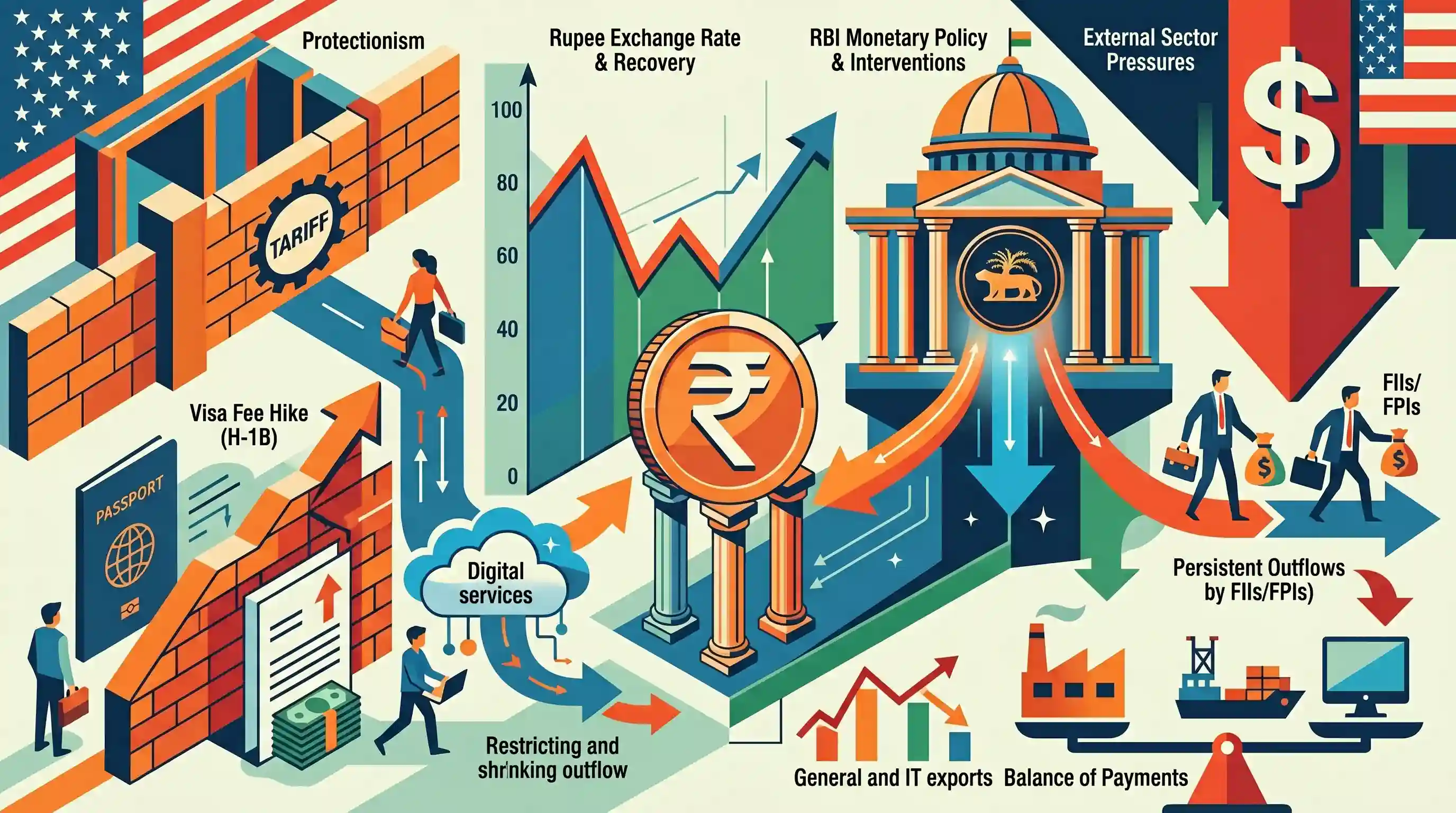
The article provides a real-world illustration of how external protectionist measures (tariffs, visa fee hikes) and capital flight directly impact India's exchange rate and macroeconomic stability, testing core GS3 concepts related to the balance of payments, currency depreciation, and RBI's market operations.
Summary
The Indian rupee has staged a marginal recovery from its all-time low to 88.60 against the US dollar, primarily supported by expected interventions from the Reserve Bank of India (RBI). Despite this slight uptick, the currency faces severe downward pressure from multiple external factors. Persistent outflows by Foreign Institutional Investors (FIIs), a broadly stronger US dollar, and looming trade uncertainties—particularly proposed US tariffs and a hike in H-1B visa fees—are straining the external sector. The visa fee hike is specifically detrimental to India's IT services export revenues, further impacting the balance of payments. These developments underscore the vulnerability of the domestic currency to global protectionist policies and the critical role of central bank intervention in managing exchange rate volatility.
Key Points
- The Indian rupee recovered 15 paise from an all-time low to trade at 88.60 against the US dollar, aided by interventions from the Reserve Bank of India (RBI).
- The domestic currency has been under severe pressure due to persistent foreign fund (FII) outflows and a stronger dollar overseas.
- Global trade uncertainties, specifically the anticipated tariff hikes under the Trump administration, are exacerbating pressure on emerging market currencies.
- A recent hike in US H-1B visa fees is expected to hit India's IT services exports, worsening the external sector's outlook.
Important Terms
H-1B visa policy

A US non-immigrant visa allowing employers to hire foreign workers in 'specialty occupations' requiring technical expertise (IT, STEM); critical for Indian IT firms and remittances.
UPSC context
GS Paper 2: Effect of policies of developed countries on India’s interests and Indian diaspora.
Reserve Bank of India (RBI)
India's central bank that manages the rupee's exchange rate under a 'managed float' system, intervening in the forex market to curb excessive volatility.
UPSC context
GS Paper 3: Indian Economy, Monetary Policy, and management of the External Sector.
Foreign Institutional Investors (FIIs)
Foreign entities (e.g., pension funds) investing in Indian financial markets; their 'hot money' status makes them a major driver of rupee volatility during outflows.
UPSC context
GS Paper 3: Capital markets, resource mobilization, and impact on currency stability.
Prelims Trap
The recent fall of the Indian Rupee is a deliberate devaluation by the RBI.
India uses a managed float system. The Rupee "depreciates" via market forces. "Devaluation" implies a fixed exchange rate regime, which India abandoned in 1993.
Static Concepts Connected
How does the RBI intervene to manage exchange rate volatility under a managed float?
- Selling Dollars: The RBI sells USD from its forex reserves to increase dollar supply in the market, absorbing excess rupee liquidity and arresting steep depreciation.
- Sterilization: The RBI conducts Open Market Operations (OMO) to neutralize or 'sterilize' the domestic money supply impacts caused by its large-scale foreign exchange interventions.
- Volatility Targeting: India does not target a specific exchange rate; the central bank intervenes solely to curb excessive intraday or systemic volatility.
How do IT exports and visa constraints reflect in India's Balance of Payments (BoP)?
- Invisibles Account: Software and IT services exports are recorded under 'Invisibles' in the Current Account, not the Capital Account.
- Deficit Cushion: A robust surplus in IT service exports plays a critical role in offsetting India's structural merchandise (goods) trade deficit.
- Remittances: Indians working abroad under H-1B visas send money back home, recorded as 'Transfers' (remittances) under the Current Account.
Cross-Topic Patterns
Currency depreciation + Imported Inflation
A weaker rupee makes inelastic imports like crude oil more expensive, forcing the MPC to balance domestic inflation targeting with currency management priorities.
BoP vulnerabilities + US Protectionism
Restrictive visa regimes and rising US tariffs highlight the risks of India's heavy reliance on IT services exports to bridge its structural current account deficit.

Expect a 2026 prelims question linking FII outflows (Capital Account) with IT export shocks (Current Account) and RBI sterilization steps.
Linked PYQs · 5
Linked PYQs · 5
- 2022PrelimsGS1
With reference to the Indian economy, consider the following statements: 1. If the inflation is too high, Reserve Bank of India (RBI) is likely to buy government securities. 2. If the rupee is rapidly depreciating, RBI is likely to sell dollars in the market. 3. If interest rates in the USA or European Union were to fall, that is likely to induce RBI to buy dollars. Which of the statements given above are correct?
- 2019PrelimsGS1
Which one of the following is not the most likely measure the Government/RBI takes to stop the slide of Indian rupee?
- 2022PrelimsGS1
Consider the following statements: 1. Tight monetary policy of US Federal Reserve could lead to capital flight. 2. Capital flight may increase the interest cost of firms with existing External Commercial Borrowings (ECBs). 3. Devaluation of domestic currency decreases the currency risk associated with ECBs. Which of the statements given above are correct?
- 2025MainsGS3
What are the challenges before the Indian economy when the world is moving away from free trade and multilateralism to protectionism and bilateralism? How can these challenges be met?
- 2018MainsGS3
How would the recent phenomena of protectionism and currency manipulations in world trade affect macroeconomic stability of India?
