Bilateral Trade Agreement Effects on Foreign Exchange Dynamics
Source:The Hindu ↗
Why It Matters
Currency exchange dynamics, current account deficits, and the role of the RBI in forex intervention are core components of the UPSC Economics syllabus. The implications of bilateral trade deals (moving from multilateralism to bilateralism) directly connect with Mains GS2/GS3 themes on international trade and India's macroeconomic stability.
Summary
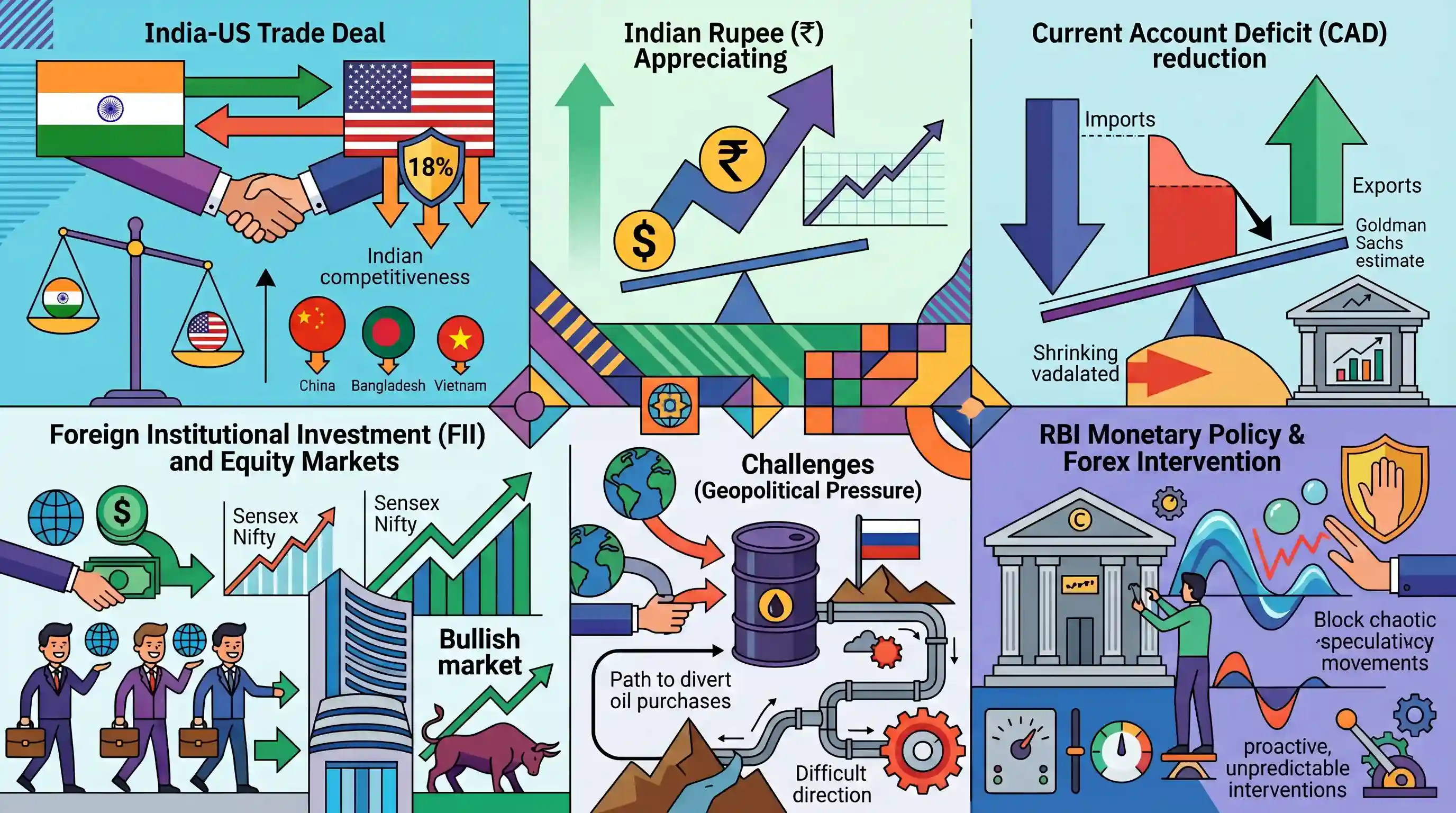
The Indian rupee witnessed a sharp rally, surging 122 paise against the US dollar to close at 90.27, driven by positive market sentiment following a newly established India-US trade deal. Under this agreement, the US has capped reciprocal tariffs on Indian goods at 18%, offering Indian exporters a distinct advantage over competitors from China, Bangladesh, and Vietnam. The development triggered a broader domestic market rally, with key equity indices also surging. Economists predict this bilateral agreement will help narrow India's Current Account Deficit (CAD) and boost foreign inflows. However, concerns remain regarding India's ability to swiftly pivot away from discounted Russian oil imports without disrupting energy security, alongside the need for continuous RBI intervention to manage foreign exchange volatility and speculative positioning.
Key Points
- The Indian rupee appreciated significantly by 122 paise to close at 90.27 against the US dollar following the announcement of an India-US trade deal.
- The agreement lowers reciprocal US tariffs on Indian goods to a maximum of 18%, providing India with a competitive export advantage over nations like China, Bangladesh, and Vietnam.
- This development is expected to narrow India's Current Account Deficit (CAD) by approximately 0.25% of GDP in CY26, thereby easing fundamental pressure on the rupee.
- Despite the positive sentiment, challenges persist regarding India's reliance on Russian oil imports and how it might align with the new US trade expectations.
- The RBI is expected to continue its active intervention in the foreign exchange (FX) market to maintain stability and prevent one-sided speculative positioning in the INR.
Important Terms
India-US Trade Deal

A bilateral agreement to lower trade barriers. In the 2026 context, it specifically refers to the deal capping reciprocal tariffs at 18% to boost Indian exports and stabilize the Rupee.
UPSC context
GS-II IR & GS-III Economy; tests impact of trade diplomacy on national growth and bilateral strategic partnerships.
Current Account Deficit (CAD)
The shortfall between a country's total export earnings and its total import payments. It includes the trade balance, net factor income, and transfer payments like remittances.
UPSC context
GS-III Economy; essential for analyzing the Balance of Payments (BoP) and overall macroeconomic health.
Reciprocal Tariffs
Trade duties imposed by a nation to match the tax rates its trading partner charges on its exports, aiming to ensure level-playing fields and address trade imbalances.
UPSC context
GS-III Economy & GS-II IR; evaluates knowledge of protectionism, trade wars, and global trade policy shifts.
RBI Intervention
Actions by the central bank—buying or selling foreign currency—to maintain orderly market conditions and curb excessive Rupee fluctuations without targeting a specific exchange rate level.
UPSC context
GS-III Economy; tested under monetary policy and exchange rate management (managed float regime).
External Sector
The portion of the national economy that encompasses all international transactions, including merchandise trade, services, foreign investment (FDI/FPI), and external debt.
UPSC context
GS-III Economy; a fundamental pillar covering India's global economic integration and BoP management.
Exchange Rate Volatility
The magnitude and frequency of changes in a currency's value. High volatility creates uncertainty for importers, exporters, and foreign investors, often requiring central bank action.
UPSC context
GS-III Economy; impacts inflation and investment attractiveness; tested in the context of currency risk.
Prelims Trap
An increase in the numerical value of INR per USD signifies an appreciation of the domestic currency.
A numerically higher exchange rate (e.g., 90 to 91) means it costs more Rupees to buy a Dollar—this is depreciation. Appreciation means the numerical value drops (e.g., to 90.27).
Static Concepts Connected
How does a shrinking Current Account Deficit (CAD) impact the Indian Rupee?
- Reduced USD outflow: Lower CAD means fewer dollars are needed to pay for net imports, directly reducing the selling pressure on the Indian Rupee.
- Appreciation bias: Higher export earnings relative to imports boost demand for the domestic currency, fundamentally driving its appreciation against foreign currencies.
What tools does the RBI use to manage Rupee volatility under a managed float?
- Forex intervention: The RBI buys or sells US dollars in the spot and forward markets to curb excessive volatility without targeting a specific exchange rate.
- Sterilization: The RBI uses Open Market Operations (OMO) to absorb or inject rupee liquidity, neutralizing the domestic money supply impact of its forex market interventions.
Cross-Topic Patterns
Energy Security vs US Trade Diplomacy
India's strategic import of discounted Russian crude often conflicts with US geopolitical interests, testing the boundaries of secondary sanctions and strategic trade pacts.
Bilateral Trade vs WTO Multilateralism
Preferential tariff caps bypass stalled WTO frameworks, mirroring a broader shift where nations favor strategic bilateral Free Trade Agreements to secure localized supply chains.

Expect a 2026 question linking targeted bilateral tariff caps, their impact on India's CAD, and RBI's sterilization of forex interventions.
Linked PYQs · 4
Linked PYQs · 4
- 2022PrelimsGS1
With reference to the Indian economy, consider the following statements: 1. If the inflation is too high, Reserve Bank of India (RBI) is likely to buy government securities. 2. If the rupee is rapidly depreciating, RBI is likely to sell dollars in the market. 3. If interest rates in the USA or European Union were to fall, that is likely to induce RBI to buy dollars. Which of the statements given above are correct?
- 2022PrelimsGS1
With reference to the Indian economy, consider the following statements: 1. An increase in Nominal Effective Exchange Rate (NEER) indicates the appreciation of rupee. 2. An increase in the Real Effective Exchange Rate (REER) indicates an improvement in trade competitiveness. 3. An increasing trend in domestic inflation relative to inflation in other countries is likely to cause an increasing divergence between NEER and REER. Which of the above statements are correct?
- 2019PrelimsGS1
Which one of the following is not the most likely measure the Government/RBI takes to stop the slide of Indian rupee?
- 2025MainsGS3
What are the challenges before the Indian economy when the world is moving away from free trade and multilateralism to protectionism and bilateralism? How can these challenges be met?
