Rupee strengthens against dollar following trade agreement
Source:The Hindu ↗
Why It Matters
The event offers a live case study of macroeconomic principles frequently tested by UPSC, interlinking bilateral trade tariffs, current account deficit, capital flows (FII), and the RBI's role in managing currency volatility. It is highly relevant for GS3 Economy (external sector) and GS2 International Relations (India-US ties).
Summary
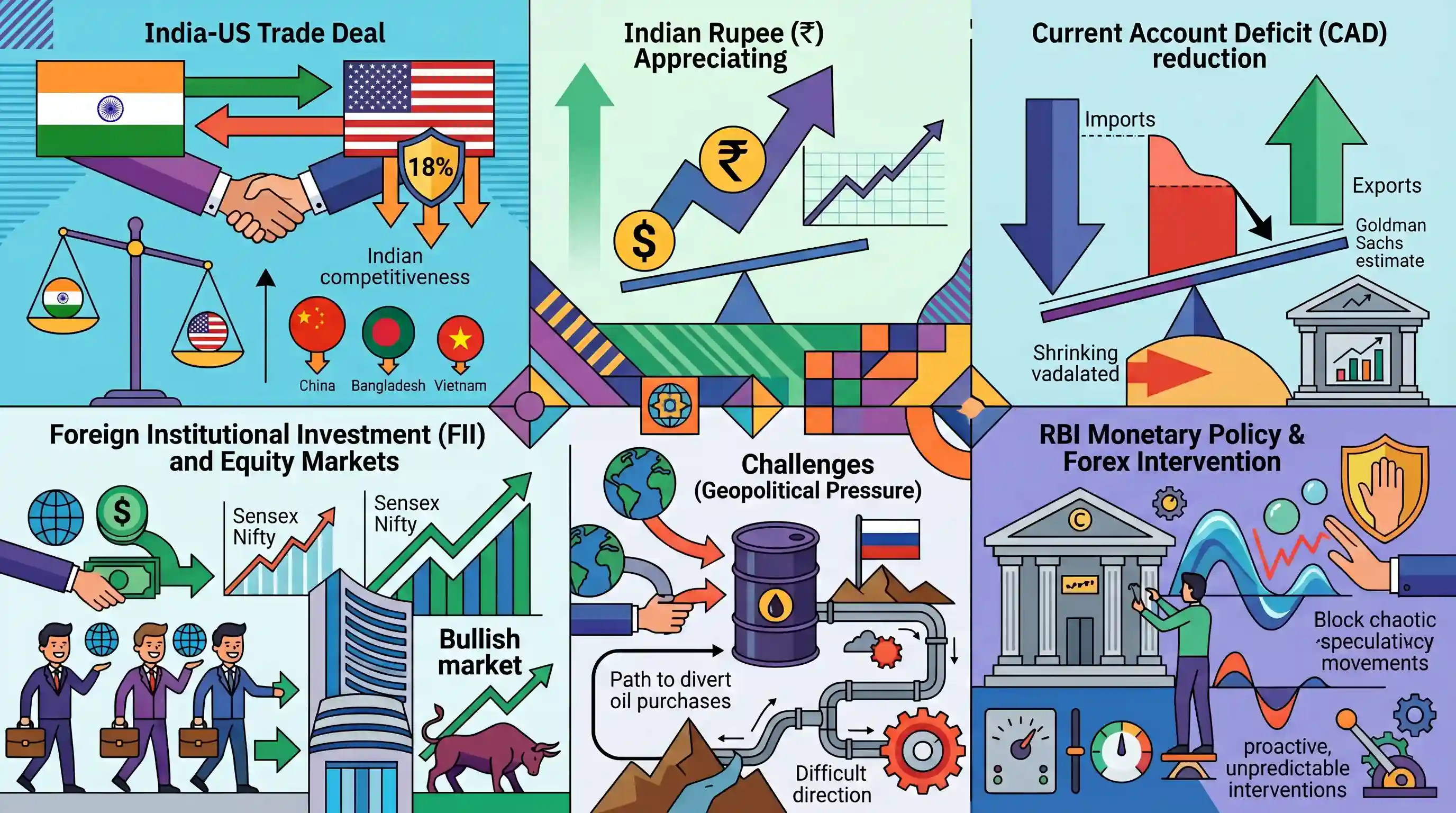
The Indian rupee appreciated significantly, jumping 122 paise to close at 90.27 against the US dollar, buoyed by the announcement of a new India-US trade deal. Under the agreement, Washington will cap reciprocal tariffs on Indian goods at 18%, significantly enhancing India's export competitiveness against manufacturing rivals like China, Bangladesh, and Vietnam. Economists anticipate this improved trade dynamic will narrow India's current account deficit (CAD), with Goldman Sachs estimating a 0.25% of GDP reduction. The positive economic outlook has also reversed recent capital outflows, drawing Foreign Institutional Investors (FIIs) back to Indian equity markets and lifting the Sensex and Nifty indices. However, institutions like HSBC caution that challenges remain, notably the geopolitical pressure to swiftly divert Russian oil purchases and the likelihood of proactive, unpredictable interventions by the Reserve Bank of India (RBI) to manage exchange rate volatility and deter currency speculation.
Key Points
- The Indian rupee surged by 122 paise, closing at 90.27 against the US dollar, driven by positive market sentiment following an India-US trade agreement.
- The trade pact establishes an 18% reciprocal tariff on Indian goods by the US, providing India with a competitive export advantage over nations like China, Bangladesh, and Vietnam.
- This structural improvement in trade is projected to narrow India's Current Account Deficit (CAD) by an estimated 0.25% of GDP and has already spurred Foreign Institutional Investor (FII) inflows into domestic equities.
- Experts warn of potential headwinds, including the necessary rapid diversion of India's Russian oil imports and the possibility of unpredictable RBI interventions in the forex market to curb speculative positioning.
Important Terms
India-U.S. Trade Deal

A bilateral pact to reduce trade barriers and tariffs between two nations. This specific deal involves capping reciprocal tariffs at 18% to enhance Indian export competitiveness.
UPSC context
GS Paper 2 (International Relations) and GS Paper 3 (Economy); tests knowledge of bilateral diplomacy and trade policy impact.
Current Account Deficit (CAD)
The shortfall where a country's total imports of goods, services, and transfers exceed its total exports. It reflects a nation's status as a net borrower from the world.
UPSC context
GS Paper 3 (Economy); core macro-indicator for Balance of Payments (BoP) and external sector stability.
Foreign Institutional Investment (FII)
Investment by foreign entities (like pension or mutual funds) in a country's financial assets. Often called 'hot money' because it can quickly enter or exit markets.
UPSC context
GS Paper 3 (Economy); covers capital markets, investment models, and causes of market volatility.
RBI Forex Intervention
Actions by the central bank to buy or sell foreign currency (typically USD) to curb excessive rupee volatility rather than fixing a specific exchange rate.
UPSC context
GS Paper 3 (Economy); tests understanding of monetary policy tools and exchange rate management.
Sensex and Nifty
Sensex (BSE) and Nifty (NSE) are benchmark indices tracking the performance of the top 30 and 50 liquid, large-cap companies in India, respectively.
UPSC context
GS Paper 3 (Economy); indicators used to gauge domestic economic health and capital market sentiment.
Prelims Trap
The Rupee's appreciation directly enhances India's export competitiveness against manufacturing rivals.
Normally, currency appreciation makes exports costlier. Here, export competitiveness improves because of the 18% tariff cap, not the currency surge. Aspirants often wrongly attribute trade pact benefits to the currency movement.
Static Concepts Connected
What characterizes India's 'Managed Float' exchange rate system?
- Market-determined: The exchange rate is primarily driven by the market forces of demand and supply of foreign exchange, not pegged by the government.
- RBI intervention: The central bank buys or sells foreign currency to contain excessive volatility, without targeting a specific exchange rate level.
How do heavy FII inflows impact the domestic currency and trigger RBI actions?
- Currency appreciation: Surging FII inflows increase the supply of US dollars in the domestic market, leading to the appreciation of the Indian Rupee.
- Sterilization: To prevent steep appreciation, the RBI buys dollars. This injects rupees into the market, which the RBI may then absorb via Open Market Operations.
Cross-Topic Patterns
Energy Security + Exchange Rate Volatility
Pressure to limit discounted Russian oil increases India's dollar-denominated import bill. This offsets the trade deal's CAD benefits and pressures the Rupee, linking energy diplomacy directly to forex stability.
Trade Pacts + Capital Account Surpluses
Structural trade improvements (Current Account) often trigger massive FII equity inflows (Capital Account). This creates a twin-surplus environment that forces the RBI to intervene to prevent excessive currency appreciation.

Expect a multi-statement question in 2026 linking RBI’s 'managed float' interventions, FII capital flows, and the macro impact of FTAs.
Linked PYQs · 4
Linked PYQs · 4
- 2022PrelimsGS1
With reference to the Indian economy, consider the following statements: 1. If the inflation is too high, Reserve Bank of India (RBI) is likely to buy government securities. 2. If the rupee is rapidly depreciating, RBI is likely to sell dollars in the market. 3. If interest rates in the USA or European Union were to fall, that is likely to induce RBI to buy dollars. Which of the statements given above are correct?
- 2022PrelimsGS1
With reference to the Indian economy, consider the following statements: 1. An increase in Nominal Effective Exchange Rate (NEER) indicates the appreciation of rupee. 2. An increase in the Real Effective Exchange Rate (REER) indicates an improvement in trade competitiveness. 3. An increasing trend in domestic inflation relative to inflation in other countries is likely to cause an increasing divergence between NEER and REER. Which of the above statements are correct?
- 2022PrelimsGS1
Consider the following statements: 1. Tight monetary policy of US Federal Reserve could lead to capital flight. 2. Capital flight may increase the interest cost of firms with existing External Commercial Borrowings (ECBs). 3. Devaluation of domestic currency decreases the currency risk associated with ECBs. Which of the statements given above are correct?
- 2024PrelimsGS1
Consider the following statements : 1. In India, Non-Banking Financial Companies can access the Liquidity Adjustment Facility window of the Reserve Bank of India. 2. In India, Foreign Institutional Investors can hold the Government Securities (G-Secs). 3. In India, Stock Exchanges can offer separate trading platforms for debts. Which of the statements given above is/are correct?
