Rupee Appreciation and Forex Dynamics After Trade Pact
Source:The Hindu ↗
Why It Matters
The event serves as an excellent case study of how bilateral trade policies directly impact domestic macroeconomic indicators such as exchange rates, foreign capital flows, and the Current Account Deficit. It also illustrates the critical role of the RBI in forex market intervention to prevent extreme currency volatility, a frequent topic in GS Paper 3. Additionally, it ties into GS Paper 2 by highlighting the geopolitical balancing act India must maintain between US trade interests and its own energy security needs (Russian oil).
Summary
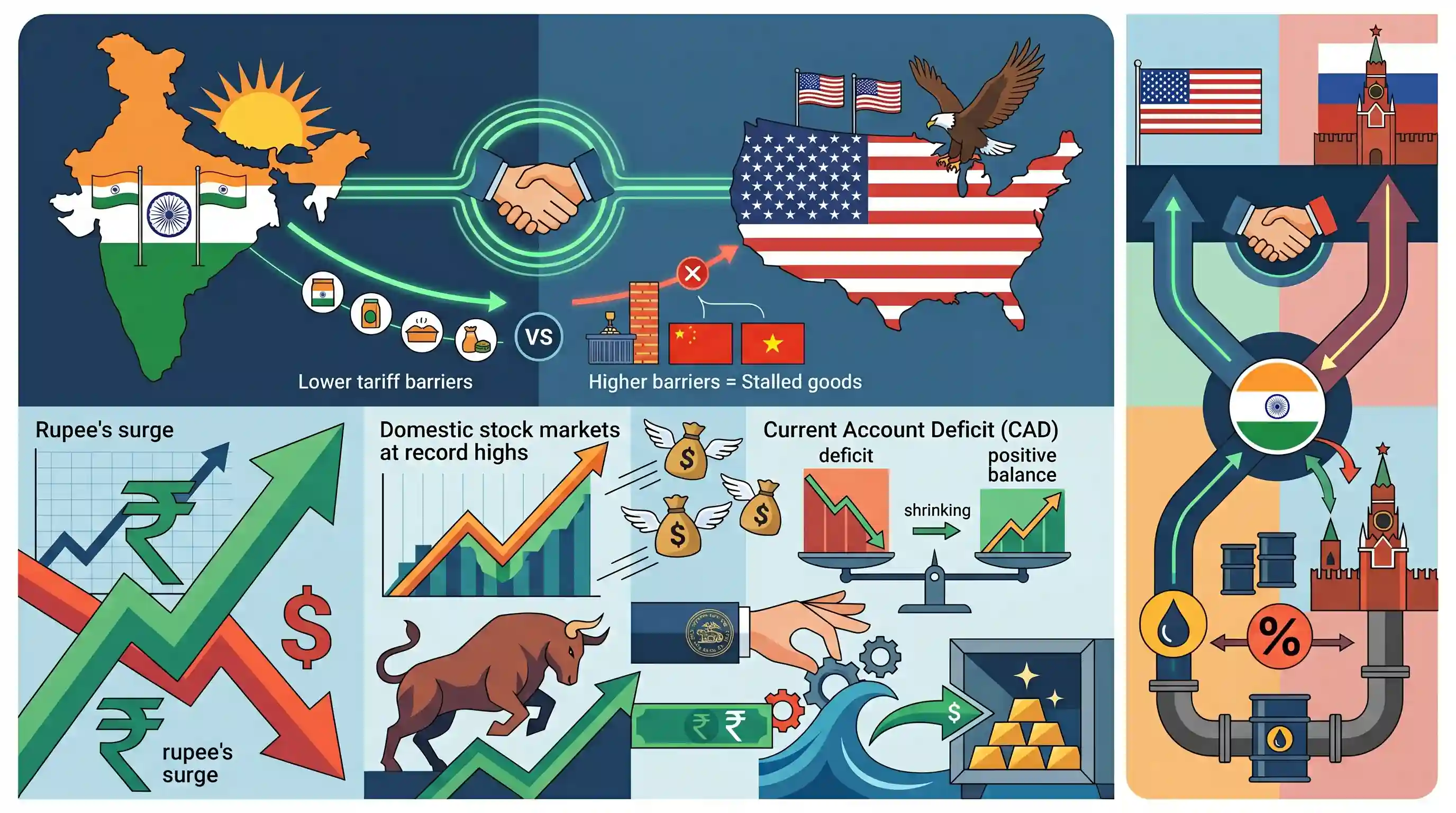
Following the announcement of a major trade deal between India and the United States, the Indian Rupee surged by 122 paise to close at 90.27 against the dollar. The deal, which lowers reciprocal US tariffs on Indian goods to 18%, provides a competitive edge over regional rivals like China and Vietnam. Consequently, domestic stock markets hit record highs on expectations of robust foreign inflows. Economists forecast a positive impact on India's macroeconomic fundamentals, particularly a narrowing of the Current Account Deficit (CAD). Meanwhile, the RBI actively managed the currency's sudden appreciation through forex interventions. However, the deal also surfaces geopolitical complexities, particularly concerning India's continued procurement of discounted Russian oil amidst growing alignment with Washington.
Key Points
- The Indian Rupee appreciated sharply by 122 paise to close at 90.27 against the US dollar, driven by the announcement of a landmark India-US trade deal.
- Under the deal, the US lowered reciprocal tariffs on Indian goods to 18%, making Indian exports more competitive than those from China, Bangladesh, and Vietnam.
- The agreement is expected to trigger significant foreign capital inflows, leading to a surge in domestic equity markets (Sensex and Nifty hit record highs).
- Economists project the trade pact will boost exports and narrow India's Current Account Deficit (CAD) by an estimated 0.25% of GDP in CY26, bringing it to 0.8%.
- The Reserve Bank of India (RBI) actively intervened in the foreign exchange market to absorb excess dollar inflows, ensuring orderly currency movement and curbing speculative trading.
- A potential geopolitical challenge involves India's heavy reliance on discounted Russian oil, which the US may pressure India to reduce as a reciprocal gesture for the trade concessions.
Important Terms
Current Account Deficit (CAD)

A component of the Balance of Payments (BoP) representing the net difference between a country's total imports and exports of goods, services, and transfers.
UPSC context
GS Paper III (Economy). Tests understanding of external sector stability and its impact on the Rupee's value.
Foreign Portfolio Investment (FPI)
Passive investment by foreign entities in a country's financial assets like stocks and bonds without acquiring managerial control or ownership.
UPSC context
GS Paper III (Economy). Important for understanding capital inflows, market volatility, and the distinction from FDI.
Exchange Rate Management
A 'managed float' system where the central bank intervenes in the forex market to curb excessive volatility while letting market forces largely determine value.
UPSC context
GS Paper III (Economy). Tests knowledge of RBI's monetary policy tools and currency stability mechanisms.
Reserve Bank of India (RBI)
India's central bank and monetary authority responsible for regulating the banking system, managing forex reserves, and controlling inflation through monetary policy.
UPSC context
GS Paper III (Economy). Fundamental for questions on banking regulation, liquidity management, and economic stability.
India-US Strategic Partnership
The multifaceted strategic partnership between India and the USA, covering trade, defense, technology (iCET), and energy cooperation.
UPSC context
GS Paper II (International Relations). Analyzes bilateral trade agreements, strategic autonomy, and geopolitical alignments.
Forex Intervention
A central bank's active buying or selling of foreign currency to influence the exchange rate and ensure financial market stability.
UPSC context
GS Paper III (Economy). Evaluates the RBI's role in defending the currency against global shocks.
Prelims Trap
"To control Rupee appreciation from heavy foreign inflows, the RBI sells dollars in the forex market."
To prevent excessive Rupee appreciation during heavy capital inflows, the RBI actually *buys* excess dollars from the market. Selling dollars is done to stop Rupee *depreciation*.
Static Concepts Connected
How does the RBI intervene in India's 'managed float' exchange rate regime?
- Market Determined: The Rupee's fundamental value is primarily driven by open market forces of global demand and supply.
- Volatility Control: The RBI steps in only to curb sudden, excessive volatility, without targeting a specific exchange rate band.
- Buying Dollars: During massive foreign inflows, the RBI buys excess dollars to prevent sharp Rupee appreciation, injecting domestic liquidity.
- Selling Dollars: During periods of capital flight, the RBI sells dollars from its forex reserves to arrest severe depreciation.
What are the primary components determining India's Current Account Deficit (CAD)?
- Trade Deficit: The net difference between the total value of exported and imported merchandise (physical goods).
- Net Services: Income generated from the export of services like software, tourism, and consulting, minus service imports.
- Net Income: Investment incomes such as interest and dividends earned abroad versus those paid out to foreign investors.
- Net Transfers: Unilateral transfers including inward worker remittances and foreign grants that require no reciprocal economic provision.
Cross-Topic Patterns
Multi-alignment in Energy & Trade
Balancing the new US trade pact while retaining discounted Russian oil highlights India's pragmatic multi-alignment, prioritizing domestic inflation control and energy security over geopolitical bloc pressures.
Tariffs accelerating China Plus One
Lowered reciprocal US tariffs directly elevate India's export competitiveness over regional rivals like Vietnam and Bangladesh, capturing and accelerating the global supply chain shift away from China.

RBI forex intervention (managed float) + Rupee appreciation dynamics + FPI surges will likely form a multi-statement Economy question.
Linked PYQs · 4
Linked PYQs · 4
- 2022PrelimsGS1
With reference to the Indian economy, consider the following statements: 1. If the inflation is too high, Reserve Bank of India (RBI) is likely to buy government securities. 2. If the rupee is rapidly depreciating, RBI is likely to sell dollars in the market. 3. If interest rates in the USA or European Union were to fall, that is likely to induce RBI to buy dollars. Which of the statements given above are correct?
- 2019PrelimsGS1
Which one of the following is not the most likely measure the Government/RBI takes to stop the slide of Indian rupee?
- 2024PrelimsGS1
Consider the following statements : 1. In India, Non-Banking Financial Companies can access the Liquidity Adjustment Facility window of the Reserve Bank of India. 2. In India, Foreign Institutional Investors can hold the Government Securities (G-Secs). 3. In India, Stock Exchanges can offer separate trading platforms for debts. Which of the statements given above is/are correct?
- 2025MainsGS2
"Energy security constitutes the dominant kingpin of India's foreign policy, and is linked with India's overarching influence in Middle Eastern countries.” How would you integrate energy security with India's foreign policy trajectories in the coming years?
