Indian Rupee Hits Record Low Against US Dollar
Source:The Hindu ↗
Why It Matters
Provides a practical case study of how external shocks (like foreign tariffs and FPI outflows) influence the domestic currency's exchange rate, and tests an aspirant's understanding of central bank interventions and the macroeconomic impacts of global protectionism.
Summary
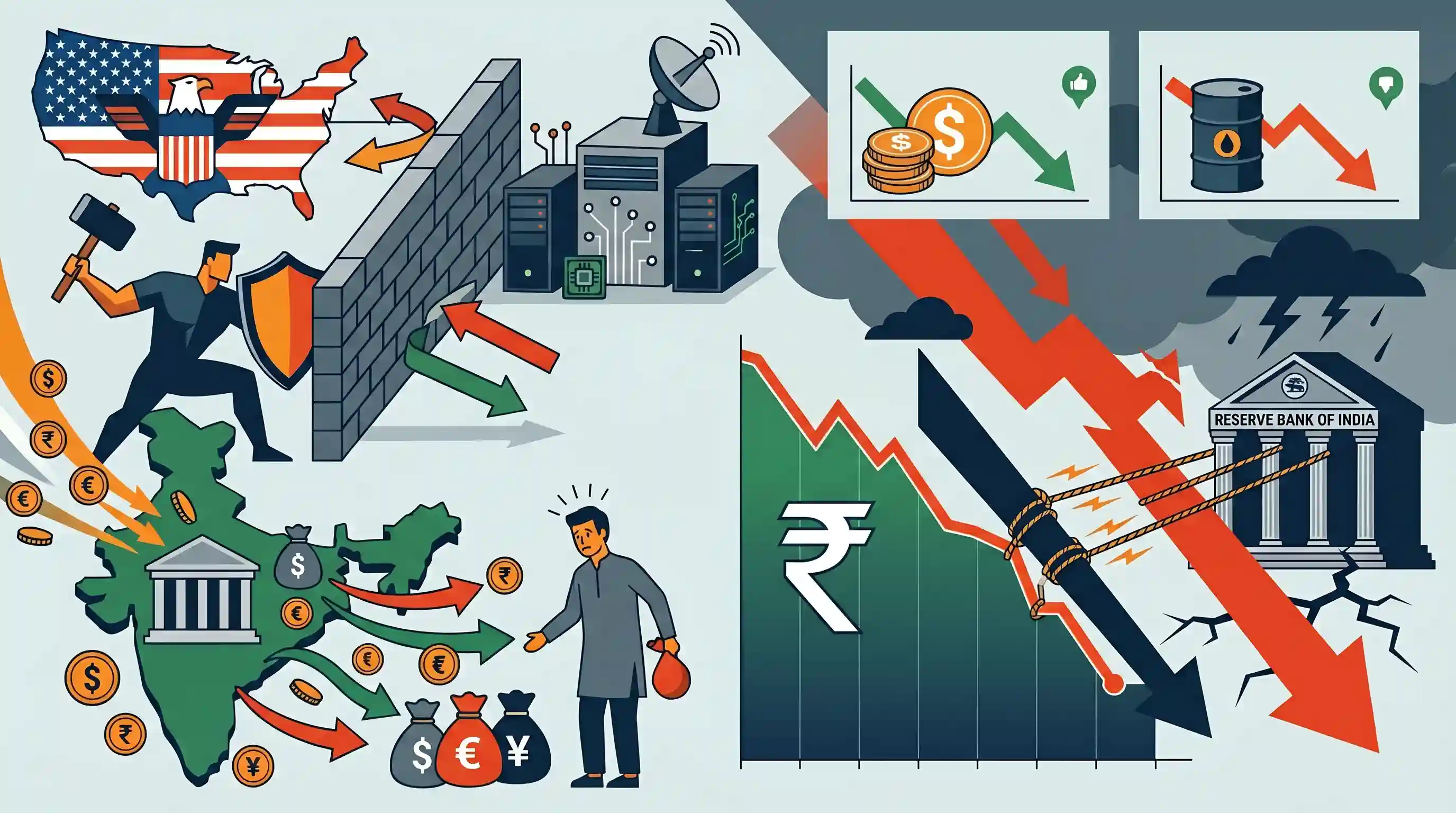
The Indian rupee hit a record low of 88.27 against the US dollar, driven by persistent foreign fund outflows and heightened concerns over potential US tariffs on India's IT sector under Donald Trump's administration. The domestic currency's depreciation occurred despite favorable global factors like a weakening US dollar index and declining Brent crude oil prices. Anticipated interventions by the Reserve Bank of India (RBI) could not offset the negative market sentiment, illustrating the significant impact of global protectionism and capital flight on India's macroeconomic stability.
Key Points
- The Indian rupee depreciated to an all-time low of 88.27 against the US Dollar.
- Continuous outflows of Foreign Portfolio Investments (FPIs) significantly pressured the domestic currency.
- Fears over proposed US tariffs by the Trump administration on India's IT sector worsened market sentiments.
- Despite a softer US dollar index globally and falling Brent crude oil prices, the rupee failed to recover.
- The situation highlights India's vulnerability to global protectionist policies and external economic shocks.
Important Terms
Reserve Bank of India (RBI)

India's central bank responsible for monetary stability, regulating the banking system, and managing foreign exchange reserves to curb excessive currency volatility.
UPSC context
GS Paper III (Economy); tests knowledge of monetary policy tools and the central bank's role in exchange rate management.
Foreign Portfolio Investors (FPIs)
Investment by foreign entities in Indian financial assets like stocks and bonds. It is 'hot money' characterized by high liquidity and volatility.
UPSC context
GS Paper III (Economy); crucial for understanding capital account dynamics and its impact on rupee stability.
US Dollar Index (DXY)
A measure of the US dollar's value against a basket of six major world currencies. A rising index indicates a strengthening dollar globally.
UPSC context
GS Paper III (External Sector); tests understanding of global macro-economic indicators affecting the Indian economy.
Tariffs
Taxes imposed by a government on imported goods, used as a tool for protectionism to make domestic products more competitive against foreign imports.
UPSC context
GS Paper II (International Relations) and III (Economy); relevant for trade wars and bilateral relations.
Brent Crude Oil
The global benchmark for oil prices. As a major importer, India's trade deficit and rupee value are highly sensitive to its price fluctuations.
UPSC context
GS Paper III (Economic Development); tests knowledge of import dependency and its inflationary impact on India.
Managed Float System
A regime where the exchange rate is primarily market-determined but the central bank intervenes occasionally to prevent extreme fluctuations.
UPSC context
GS Paper III (Economy); fundamental concept for exchange rate determination and RBI's operational framework.
Prelims Trap
A decline in the US Dollar Index (DXY) inevitably leads to the appreciation of the Indian Rupee.
A weaker DXY generally supports emerging currencies, but massive domestic FPI outflows or localized trade shocks can still force the Rupee to depreciate independently.
Static Concepts Connected
How does the RBI defend the Rupee in India's managed float system?
- Forex Sales: The RBI sells US dollars from its foreign exchange reserves to increase dollar supply and absorb excess rupees, curbing rapid depreciation.
- Sterilization: The RBI conducts Open Market Operations (OMOs) to neutralize the liquidity impact of its forex market interventions on the domestic money supply.
- Interest Rate Tweaks: Though less direct, the RBI can manage policy rates to maintain yield differentials, making Indian assets attractive enough to prevent excessive capital flight.
Why does the US Dollar Index (DXY) matter for the Indian economy?
- Global Benchmark: It measures the USD against a basket of six major advanced-economy currencies, with the Euro carrying the highest weightage (over 57%).
- Capital Flight Indicator: A rising DXY usually signals capital flowing back to US safe-haven assets, triggering FPI outflows from emerging markets like India and weakening the INR.
Cross-Topic Patterns
IT sector tariffs and Current Account dynamics
While goods face tariffs often, taxing India's IT services targets our primary export strength, threatening the robust service surplus that traditionally cushions India's persistent merchandise trade deficit.
Hot money vs Forex Reserves adequacy
FPI outflows highlight the volatility of 'hot money', forcing RBI interventions that deplete forex reserves and routinely test India's import cover metrics during external geopolitical shocks.

Expect a 2026 Prelims question testing the paradox of Rupee depreciation occurring simultaneously with falling crude and a weakening DXY.
Linked PYQs · 4
Linked PYQs · 4
- 2022PrelimsGS1
With reference to the Indian economy, consider the following statements: 1. If the inflation is too high, Reserve Bank of India (RBI) is likely to buy government securities. 2. If the rupee is rapidly depreciating, RBI is likely to sell dollars in the market. 3. If interest rates in the USA or European Union were to fall, that is likely to induce RBI to buy dollars. Which of the statements given above are correct?
- 2019PrelimsGS1
Which one of the following is not the most likely measure the Government/RBI takes to stop the slide of Indian rupee?
- 2018MainsGS3
How would the recent phenomena of protectionism and currency manipulations in world trade affect macroeconomic stability of India?
- 2025MainsGS3
What are the challenges before the Indian economy when the world is moving away from free trade and multilateralism to protectionism and bilateralism? How can these challenges be met?
