Indian Currency Depreciates Against US Dollar Amid Capital Outflows
Source:The Hindu ↗
Why It Matters
Understanding the dynamics of currency depreciation, foreign exchange reserves, and capital flight is crucial for the UPSC syllabus. These factors directly affect India's import bill, inflation levels, and overall macroeconomic stability, highlighting the real-world linkages between international monetary developments and domestic economic health.
Summary
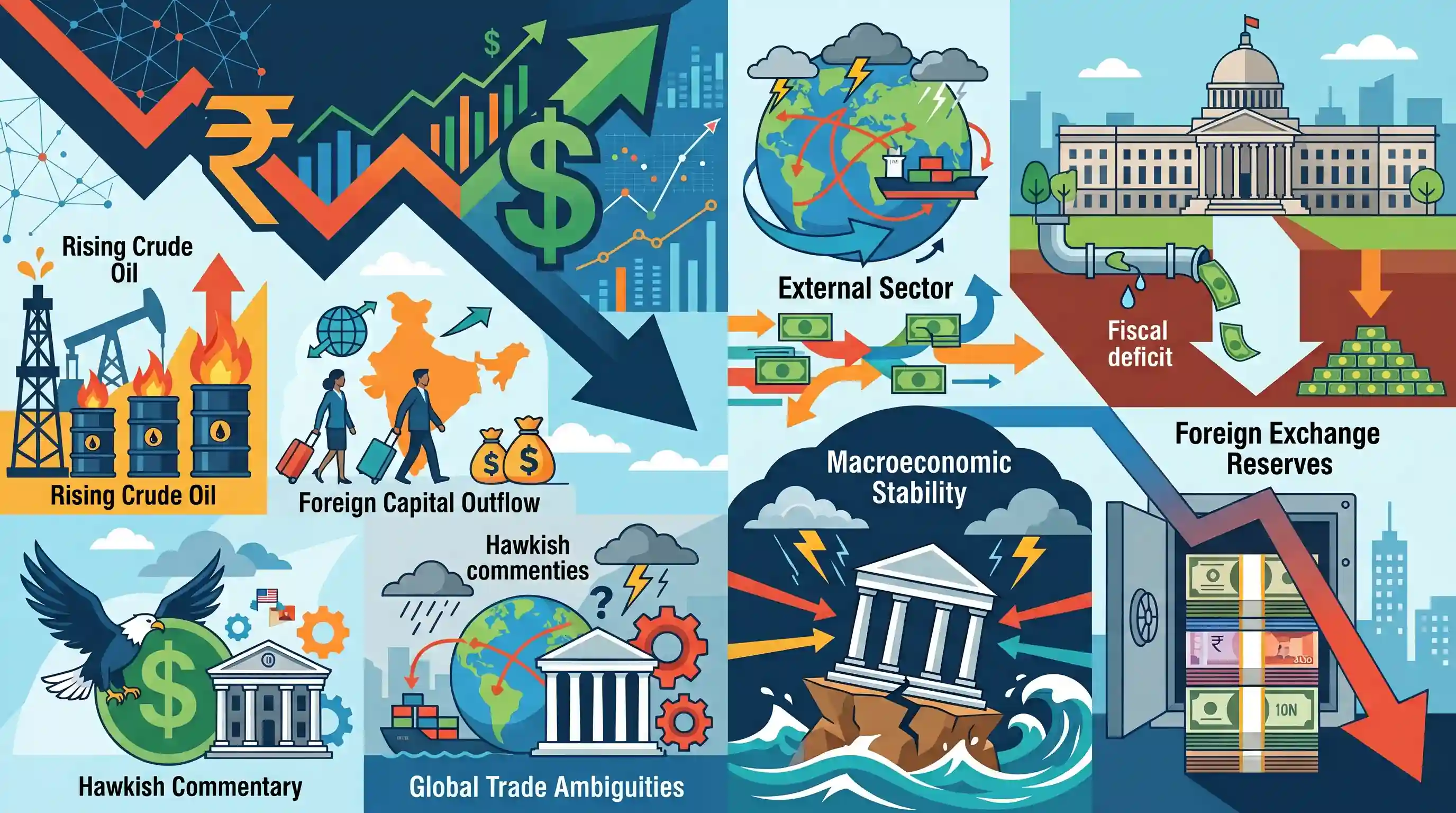
The Indian rupee experienced a depreciation, falling 7 paise to 88.77 against the US dollar in early trading. The domestic currency's slide was influenced by multiple macroeconomic headwinds, such as the rising cost of Brent crude oil, sustained outflow of foreign capital, and overarching global trade ambiguities. The US dollar strengthened broadly following commentary from the US Federal Reserve, exacerbating the rupee's fall. Concurrently, official data indicated a significant $6.925 billion decline in India's foreign exchange reserves and revealed that the Union government's fiscal deficit stood at 36.5% of the annual target at the end of the fiscal first half.
Key Points
- The Indian rupee depreciated by 7 paise, falling to an early trade low of 88.77 against the US dollar.
- This decline was driven by a confluence of factors, including elevated crude oil prices, persistent outflow of foreign portfolio investments, and uncertainties surrounding global trade.
- Comments by US Federal Reserve Chair Jerome Powell caused a strengthening of the US dollar index, further exerting downward pressure on the rupee.
- India's foreign exchange reserves saw a sharp drop of $6.925 billion, bringing the total down to $671.39 billion.
- Additionally, the Union government's fiscal deficit reached 36.5% of its full-year target by the end of the first half of the financial year.
Important Terms
Reserve Bank of India (RBI)

India's central bank, established in 1935, responsible for regulating currency, managing monetary policy, maintaining financial stability, and serving as the banker to the government.
UPSC context
GS Paper III (Economy); tests monetary policy framework, inflation targeting, and the bank’s role in maintaining macroeconomic stability.
Fiscal Deficit
The shortfall in a government's income compared with its spending, representing the total borrowings needed to bridge the revenue-expenditure gap.
UPSC context
GS Paper III (Govt Budgeting); essential for understanding fiscal discipline, FRBM Act targets, and government debt sustainability.
Foreign Exchange Reserves
Assets held by the central bank in foreign currencies, gold, and SDRs to manage exchange rate volatility and ensure external debt repayment.
UPSC context
GS Paper III (External Sector); tests knowledge of Balance of Payments, currency defense, and resilience against external economic shocks.
Exchange Rate
The price at which one currency can be exchanged for another. India follows a 'managed float' system determined primarily by market forces.
UPSC context
GS Paper III (External Sector); relates to export competitiveness, imported inflation, and global currency fluctuation impacts.
US Federal Reserve
The central bank of the United States. Its monetary policy decisions significantly influence global liquidity, interest rates, and capital flows into emerging markets.
UPSC context
GS Paper III (External Sector); tests understanding of global-local linkages and how international monetary shifts affect India’s economy.
Foreign Capital (FPI/FII)
Investment by non-residents in Indian financial assets like stocks and bonds. Persistent outflows often lead to currency depreciation and market volatility.
UPSC context
GS Paper III (Investment/External Sector); crucial for analyzing capital account dynamics and domestic financial market stability.
Prelims Trap
"A depreciating rupee automatically reduces India's external debt burden."
A weaker rupee actually INCREASES the servicing cost of foreign-currency-denominated debt (like ECBs), as more domestic currency is required to purchase dollars for repayment.
Static Concepts Connected
How does US Federal Reserve policy impact the Indian Rupee?
- Interest Differential: Fed rate hikes narrow the yield gap between the US and India, making US assets more attractive.
- Capital Flight: This prompts Foreign Portfolio Investors (FPIs) to pull out of Indian equity and debt markets.
- Currency Depreciation: The resulting high demand for dollars and excess supply of rupees forces the domestic currency to depreciate.
What comprises India's Foreign Exchange Reserves?
- Foreign Currency Assets: The largest component (FCA), maintained in major currencies like the US Dollar, Euro, Pound, and Yen.
- Gold Reserves: Held by the RBI as a secure backup asset to hedge against global currency volatility.
- SDRs & RTP: Special Drawing Rights (SDR) and the Reserve Tranche Position (RTP) held with the International Monetary Fund (IMF).
Cross-Topic Patterns
Depreciation & Imported Inflation
A weaker rupee makes inelastic imports like crude oil costlier, directly feeding into domestic WPI and CPI, complicating the RBI's inflation targeting mandate.
Twin Deficit Vulnerability
Simultaneous reporting of fiscal deficit tracking and forex/rupee drops highlights twin-deficit risks, where domestic fiscal expansion strains the current account balance.

Expect a 2026 Prelims question linking US Fed policy shifts, RBI's forex intervention tools (FCA sales), and imported inflation dynamics.
Linked PYQs · 5
Linked PYQs · 5
- 2022PrelimsGS1
With reference to the Indian economy, consider the following statements: 1. If the inflation is too high, Reserve Bank of India (RBI) is likely to buy government securities. 2. If the rupee is rapidly depreciating, RBI is likely to sell dollars in the market. 3. If interest rates in the USA or European Union were to fall, that is likely to induce RBI to buy dollars. Which of the statements given above are correct?
- 2022PrelimsGS1
With reference to the Indian economy, consider the following statements: 1. An increase in Nominal Effective Exchange Rate (NEER) indicates the appreciation of rupee. 2. An increase in the Real Effective Exchange Rate (REER) indicates an improvement in trade competitiveness. 3. An increasing trend in domestic inflation relative to inflation in other countries is likely to cause an increasing divergence between NEER and REER. Which of the above statements are correct?
- 2018MainsGS3
How would the recent phenomena of protectionism and currency manipulations in world trade affect macroeconomic stability of India?
- 2013PrelimsGS1
Which one of the following groups of items is included in India's foreign-exchange reserves?
- 2025PrelimsGS1
Which of the following are the sources of income for the Reserve Bank of India? I. Buying and selling Government bonds II. Buying and selling foreign currency III. Pension fund management IV. Lending to private companies V. Printing and distributing currency notes Select the correct answer using the code given below.
