Rupee Depreciation Export Mission and Low Inflation Trends
Source:The Hindu ↗
Why It Matters
The article captures key macroeconomic shifts—currency depreciation, export support mechanisms, and inflation trends. Understanding how external factors (US tariffs, FII outflows) and domestic policies (GST cuts, EPM) interact to impact India's macroeconomic stability is essential for GS3.
Summary
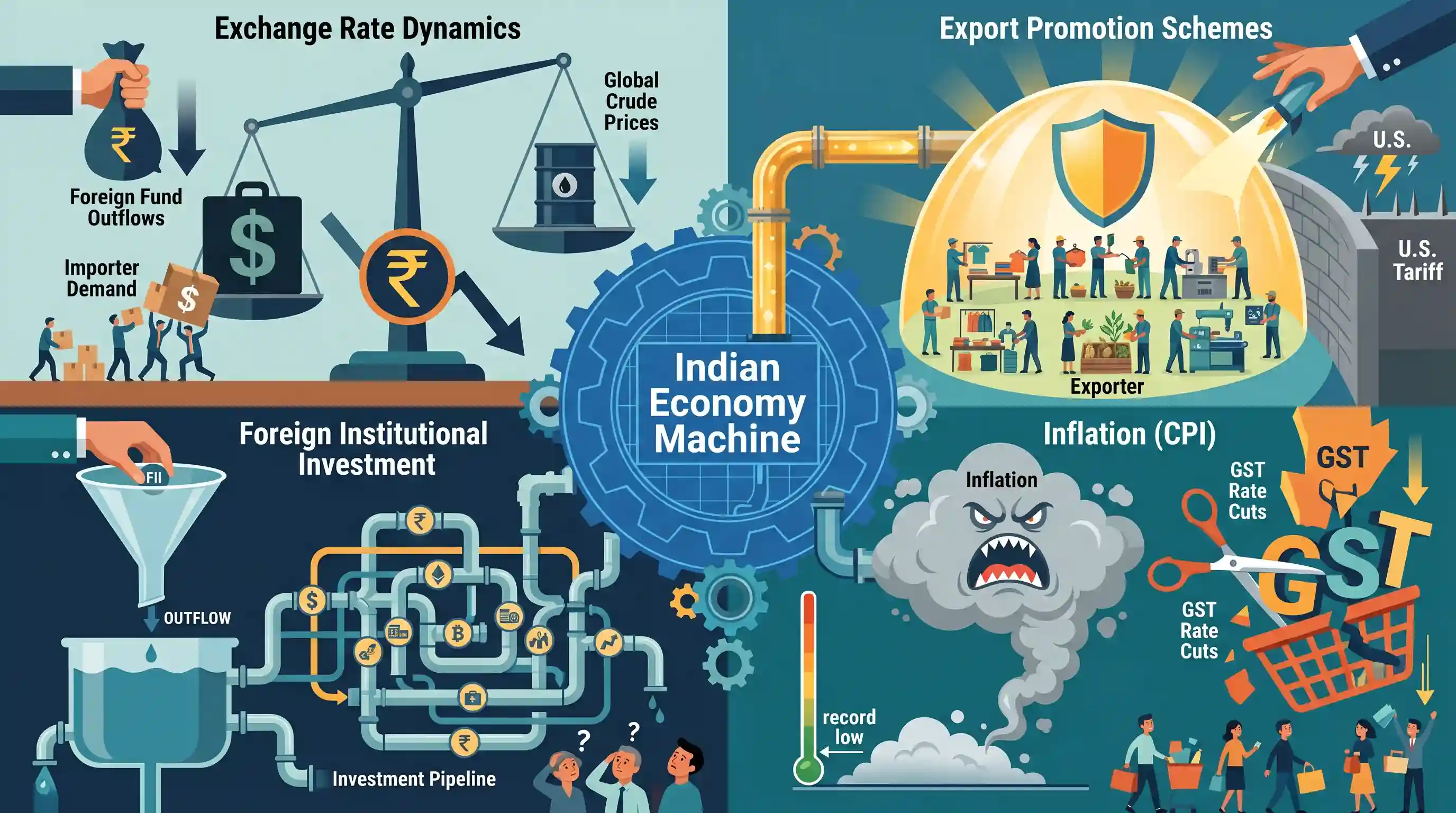
The Indian rupee fell 6 paise to close at 88.68 against the U.S. dollar, pressured by foreign fund outflows and importer demand despite a dip in global crude prices. Concurrently, the government launched a ₹25,060 crore Export Promotion Mission to shield exporters from high U.S. tariffs, while October CPI retail inflation hit a record low of 0.25% due to GST rate cuts.
Key Points
- The Indian rupee depreciated by 6 paise to 88.68 against the US dollar due to foreign fund outflows and continuous dollar demand from importers.
- A decline in global Brent crude oil prices to $62.58 per barrel and renewed optimism over US-India trade talks provided some buffer to the falling rupee.
- The government approved the Export Promotion Mission (EPM) with an outlay of ₹25,060 crore (spanning Niryat Protsahan and Niryat Disha sub-schemes) to aid exporters facing high U.S. tariffs.
- Domestic retail inflation (CPI) dropped to a record low of 0.25% in October, aided by GST rate cuts on mass consumption items and subdued food prices.
Important Terms
Export Promotion Mission (EPM)

A flagship government initiative with a ₹25,060 crore outlay (FY 2025–31) designed to boost India's export competitiveness and support MSMEs against global trade headwinds like high tariffs.
UPSC context
GS Paper 3: Indian Economy; covers trade policy, MSME growth, and government interventions to shield exporters from global market volatility.
Niryat Protsahan
A financial sub-scheme under the EPM providing interest subvention (2.75%), credit guarantees, and export factoring to improve liquidity and reduce trade finance costs for small-scale exporters.
UPSC context
GS Paper 3: Economic Development; tests understanding of trade finance mechanisms and financial enablers for India's export-led growth strategy.
Niryat Disha
A non-financial sub-scheme under the EPM focused on market access, branding, international certification compliance (e.g., TRACE), and logistics support (e.g., LIFT) to enhance the global readiness of Indian goods.
UPSC context
GS Paper 3: Infrastructure and Trade; important for understanding non-monetary barriers and ecosystem support in international trade.
Foreign Institutional Investors (FIIs)
Investment by foreign entities (like hedge funds or pension funds) in Indian financial assets. Outflows of FII funds typically weaken the rupee as investors sell INR to buy USD.
UPSC context
GS Paper 3: Capital Markets; fundamental for questions on currency volatility, capital account dynamics, and balance of payments.
Consumer Price Index (CPI)
A measure that tracks changes in the retail prices of a basket of goods and services. It is India's primary indicator for inflation targeting by the RBI.
UPSC context
GS Paper 3: Monetary Policy; crucial for understanding inflation trends, purchasing power, and the impact of fiscal policy on retail prices.
Goods and Services Tax (GST)
A comprehensive, multi-stage, destination-based indirect tax that replaced most central and state taxes. Rate adjustments can directly influence retail inflation levels.
UPSC context
GS Paper 3: Indian Economy and Taxation; core topic for fiscal federalism and its role in domestic price stabilization.
Prelims Trap
GST rate cuts simultaneously reduce both Retail (CPI) and Wholesale (WPI) inflation.
WPI measures factory-gate prices and strictly excludes indirect taxes. Therefore, GST reductions only compress CPI (which reflects final consumer prices), not WPI.
Static Concepts Connected
What drives Rupee depreciation under India's managed float system?
- FPI Outflows: Net withdrawal of foreign portfolio investments limits dollar supply, creating a deficit in domestic forex markets.
- Importer Demand: Sustained demand for dollars to settle import bills (e.g., for crude oil) pushes the value of the local currency down.
- RBI Interventions: The RBI intervenes by selling dollars; without aggressive intervention, the Rupee discovers its value purely via market supply-demand.
Why do indirect taxes and food prices affect CPI differently than WPI?
- Food Weightage: Food and beverages constitute roughly 45% of the CPI basket, giving them disproportionate sway over retail inflation compared to WPI.
- Tax Inclusion: CPI calculates the final prices paid by retail consumers (which includes GST), whereas WPI tracks bulk prices and excludes indirect taxes entirely.
Cross-Topic Patterns
Export schemes and WTO ASCM compliance
Export subsidy schemes designed to shield domestic exporters from high US tariffs often attract legal scrutiny under the WTO’s Agreement on Subsidies and Countervailing Measures (ASCM).
Currency depreciation vs. Imported Inflation
A depreciating currency usually triggers imported inflation. However, a concurrent drop in global crude oil prices acts as a natural macroeconomic buffer, neutralizing the inflation threat.

Expect a 2026 Prelims question testing the inverse mechanics of GST cuts on CPI vs WPI, alongside Rupee depreciation drivers.
Linked PYQs · 3
Linked PYQs · 3
- 2018MainsGS3
How would the recent phenomena of protectionism and currency manipulations in world trade affect macroeconomic stability of India?
- 2020PrelimsGS1
Consider the following statements: 1. The weightage of food in Consumer Price Index (CPI) is higher than that in Wholesale Price Index (WPI). 2. The WPI does not capture changes in the prices of services, which CPI does. 3. Reserve Bank of India has now adopted WPI as its key measure of inflation and to decide on changing the key policy rates. Which of the statements given above is/are correct?
- 2022PrelimsGS1
With reference to the Indian economy, consider the following statements: 1. If the inflation is too high, Reserve Bank of India (RBI) is likely to buy government securities. 2. If the rupee is rapidly depreciating, RBI is likely to sell dollars in the market. 3. If interest rates in the USA or European Union were to fall, that is likely to induce RBI to buy dollars. Which of the statements given above are correct?
