Indian Rupee Depreciates Amid Geopolitical Trade Pressures
Source:The Hindu ↗
Why It Matters
This article provides a practical demonstration of how geopolitical developments (US trade tariffs, sanctions on Russia) directly impact India's macroeconomic stability (exchange rate volatility, capital flight). It is highly relevant for Prelims questions on RBI's foreign exchange interventions and Mains questions on the intersection of geopolitics, trade protectionism, and the Indian economy.
Summary
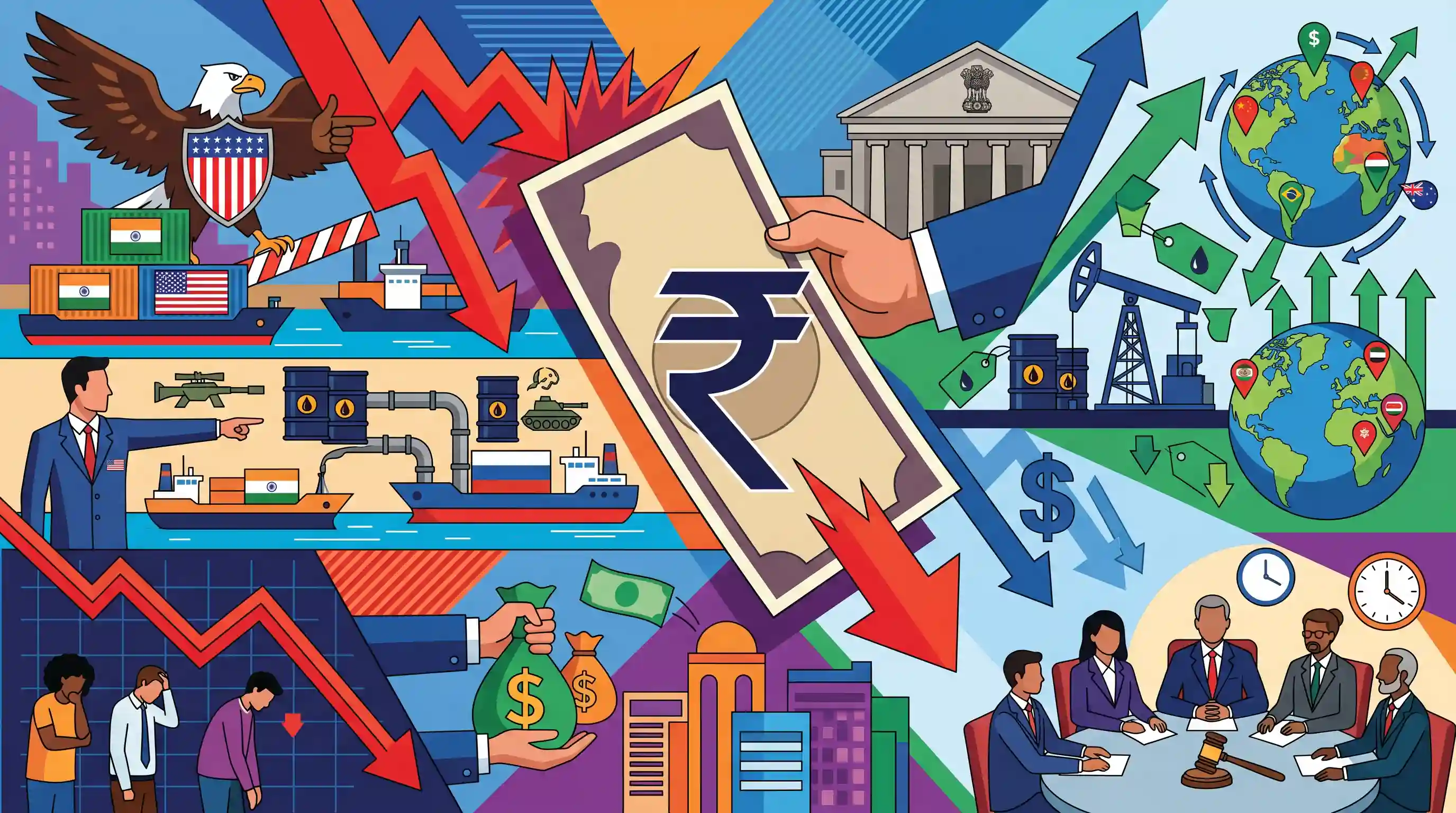
The Indian rupee depreciated against the US dollar, closing at 87.82, amid a broader risk-off sentiment fueled by US tariff threats. US President Donald Trump warned of increased tariffs on Indian goods due to New Delhi's continued purchase of Russian oil and military equipment, following a recent 25% duty hike. Domestic equity weakness and foreign institutional outflows added to the downward pressure. However, suspected interventions by the Reserve Bank of India (RBI), a decline in global crude oil prices due to an OPEC+ output hike, and a softer dollar index prevented steeper losses. Investors are now awaiting the RBI's Monetary Policy Committee (MPC) decision for further direction.
Key Points
- The Indian rupee fell by 16 paise to close at a low of 87.82 against the US dollar, driven by foreign fund outflows and weak domestic equities.
- Currency depreciation was exacerbated by US President Donald Trump's threats to raise tariffs on Indian goods in retaliation for India's ongoing purchases of Russian oil and military equipment.
- The Trump administration recently imposed a 25% duty on Indian goods and announced penalties for trading with Russia, stoking uncertainty around the India-US trade deal.
- Factors cushioning the rupee's fall included suspected forex intervention by the RBI, a softer US dollar globally, and lower crude oil prices following an OPEC+ agreement to increase output.
- Markets are now focused on the upcoming monetary policy decision by the RBI's Monetary Policy Committee (MPC), headed by Governor Sanjay Malhotra.
Important Terms
Reserve Bank of India (RBI)

India's central bank (est. 1935) responsible for regulating the banking system, managing foreign exchange, and ensuring monetary stability under the RBI Act, 1934.
UPSC context
GS-III: Economy; tests knowledge of the central bank's role in banking regulation and external sector management.
Monetary Policy Committee (MPC)
A six-member statutory body (est. 2016) headed by the RBI Governor that fixes the benchmark repo rate to maintain price stability and target inflation at 4% (+/- 2%).
UPSC context
GS-III: Monetary Policy; tests understanding of inflation targeting and institutional frameworks for macroeconomic stability.
OPEC+
An alliance of OPEC members and non-OPEC oil producers (like Russia) that coordinates production levels to manage global crude oil supply and stabilize energy prices.
UPSC context
GS-II/III: IR and Energy Security; impacts India's import bill, fiscal deficit, and inflation via oil price dynamics.
Tariffs
A tax or duty imposed by a government on imported goods, often used as a tool for protectionism or to negotiate trade terms with other nations.
UPSC context
GS-III: Effects of Liberalization; tests understanding of trade barriers and their impact on export competitiveness.
Currency Depreciation
The decrease in a currency's value relative to others in a floating exchange rate system, driven by market factors like trade deficits or foreign capital outflows.
UPSC context
GS-III: External Sector; tests understanding of exchange rate volatility and its impact on the trade balance.
Foreign Institutional Investors (FIIs)
Foreign entities (e.g., hedge funds, pension funds) investing in India's financial markets. Their 'outflows' refer to selling Indian assets and moving capital abroad, weakening the rupee.
UPSC context
GS-III: Resource Mobilization; tests understanding of capital market volatility and its effect on exchange rate stability.
Foreign Exchange Reserves
Assets like foreign currencies and gold held by the RBI to provide a cushion against external shocks and to intervene in the foreign exchange market.
UPSC context
GS-III: External Sector; tests knowledge of the RBI's buffer capacity to defend the rupee against excessive volatility.
Prelims Trap
The RBI devaluing the rupee to manage excessive volatility.
India follows a managed floating exchange rate. The rupee "depreciates" due to market forces; "devaluation" is an official government action strictly under a fixed exchange rate regime.
Static Concepts Connected
How does the RBI manage rupee depreciation under its managed float system?
- Selling Dollars: The RBI sells USD from its foreign exchange reserves, absorbing excess rupee liquidity and reducing immediate dollar demand.
- Forward Market Actions: The RBI also steps into the forward and futures markets to signal future currency stability without immediately depleting its physical dollar reserves.
- Volatility Targeting: The RBI does not target a specific exchange rate; it only intervenes to curb excessive intraday or short-term volatility.
What is the CAATSA framework and how does it relate to this trade friction?
- US Legislation: A US federal law that imposes secondary economic sanctions on countries engaging in significant defense or energy transactions with Russia, Iran, or North Korea.
- Strategic Impact: It creates a geopolitical overhang on India's purchase of Russian military equipment and oil, often weaponized via tariff threats against Indian exports.
Cross-Topic Patterns
Forex rates & imported inflation
A falling rupee makes crude oil and critical imports costlier, driving domestic inflation. This forces the MPC into a tightrope walk between accommodating growth and hiking rates to curb imported inflation.
Strategic autonomy vs US trade policy
India's insistence on buying discounted Russian oil tests its bilateral US ties, demonstrating how geopolitical strategic autonomy directly impacts domestic currency stability via retaliatory tariff threats.

Expect a 2026 prelims question linking RBI's managed float interventions, imported inflation, and the impact of geopolitical trade tariffs.
Linked PYQs · 5
Linked PYQs · 5
- 2022PrelimsGS1
With reference to the Indian economy, consider the following statements: 1. If the inflation is too high, Reserve Bank of India (RBI) is likely to buy government securities. 2. If the rupee is rapidly depreciating, RBI is likely to sell dollars in the market. 3. If interest rates in the USA or European Union were to fall, that is likely to induce RBI to buy dollars. Which of the statements given above are correct?
- 2019PrelimsGS1
Which one of the following is not the most likely measure the Government/RBI takes to stop the slide of Indian rupee?
- 2022PrelimsGS1
With reference to the Indian economy, consider the following statements: 1. An increase in Nominal Effective Exchange Rate (NEER) indicates the appreciation of rupee. 2. An increase in the Real Effective Exchange Rate (REER) indicates an improvement in trade competitiveness. 3. An increasing trend in domestic inflation relative to inflation in other countries is likely to cause an increasing divergence between NEER and REER. Which of the above statements are correct?
- 2012MainsGS2
Discuss the likely negative impact of the protectionist measures proposed by the US on India's software industry.
- 2012MainsGS2
How have the US sanctions against Iran affected India's bilateral relations with Iran?
