Foreign Capital Outflows and Depreciation of Indian Rupee
Source:The Hindu ↗
Why It Matters
Illustrates the vulnerability of emerging markets like India to external shocks, particularly global trade wars and protectionism, and highlights the RBI's role in balancing domestic monetary policy with exchange rate management.
Summary
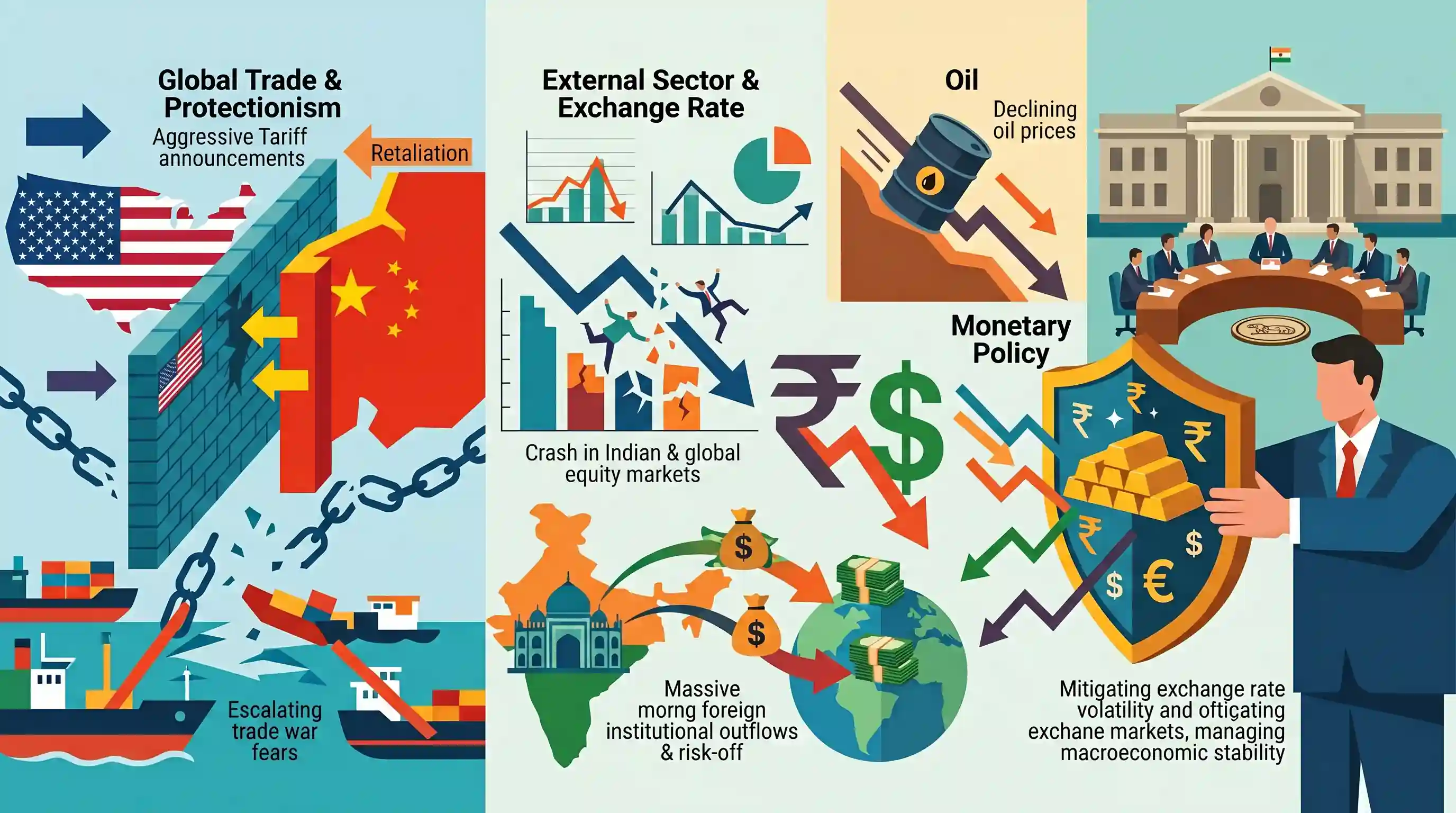
The Indian Rupee fell to 85.63 against the US dollar amid a broader crash in Indian and global equity markets, triggered by escalating global trade war fears following aggressive US tariff announcements and China's retaliation. The resultant risk-off sentiment led to massive foreign institutional outflows from Indian markets. Simultaneously, crude oil prices declined due to the tariff threats and OPEC+ production increases. The Reserve Bank of India (RBI), currently holding its MPC meeting, faces the challenge of managing macroeconomic stability and may deploy its robust forex reserves to mitigate exchange rate volatility.
Key Points
- The Indian Rupee depreciated by 19 paise to 85.63 against the US dollar, driven by relentless foreign fund outflows and a crash in domestic equity markets.
- Global trade war concerns escalated after the US announced reciprocal tariffs on ~60 countries, prompting a 34% retaliatory import duty from China, which crashed global and Indian stock markets.
- Brent crude prices dropped to $63.79 per barrel due to the combined impact of US tariffs and the OPEC+ alliance's decision to increase oil output.
- The RBI's Monetary Policy Committee (MPC) is concurrently deliberating on interest rates, while the central bank may utilize India's $665.396 billion forex reserves to intervene and curb rupee volatility.
Important Terms
Monetary Policy Committee (MPC)

A statutory six-member committee (under the RBI Act, 1934) tasked with setting the benchmark interest rate (repo rate) to maintain price stability (targeting 4% +/- 2% inflation) while supporting economic growth.
UPSC context
GS-III (Economy: Monetary Policy). Tests knowledge of institutional frameworks for inflation control and interest rate mechanisms.
Foreign Institutional Investors (FIIs)
Institutional entities (pension funds, mutual funds) based outside India that invest in Indian financial markets. As a subset of Foreign Portfolio Investors (FPIs), their 'hot money' flows significantly influence currency volatility.
UPSC context
GS-III (Economy: External Sector). Tests understanding of capital account volatility and its impact on the Indian Rupee.
OPEC+
An alliance comprising OPEC members and 10 non-OPEC oil-producing nations (e.g., Russia). It coordinates production levels to influence global crude prices, directly affecting India's import bill and domestic inflation.
UPSC context
GS-II/III (IR/Economy). Tests the impact of global energy cartels on India’s energy security and macroeconomic stability.
Foreign Exchange Reserves
Assets held by the RBI—including Foreign Currency Assets, Gold, Special Drawing Rights (SDRs), and the IMF Reserve Tranche—used to manage exchange rate volatility and ensure Balance of Payments (BoP) stability.
UPSC context
GS-III (Economy: External Sector). Tests RBI's role as custodian of reserves and tools for defending the domestic currency.
Rupee Depreciation
The decrease in the Rupee's value against major foreign currencies (like the USD) due to market forces. It leads to 'imported inflation' through costlier oil while potentially improving export competitiveness.
UPSC context
GS-III (Economy: External Sector). Tests the ability to analyze exchange rate dynamics and their impact on trade and inflation.
Prelims Trap
To arrest the rapid depreciation of the Indian Rupee, the Reserve Bank of India intervenes by buying US dollars.
This is inverse. To arrest depreciation, the RBI *sells* dollars from its forex reserves to increase USD market supply, thereby stabilizing the Rupee's value against the dollar.
Static Concepts Connected
How does the RBI manage exchange rate volatility under India's managed float system?
- Selling USD: RBI sells dollars from its forex reserves to increase dollar market supply, stemming steep Rupee depreciation.
- Buying USD: RBI purchases dollars to prevent excessive Rupee appreciation and to accumulate foreign exchange reserves.
- Sterilization: RBI uses Open Market Operations (OMOs) to absorb or inject Rupee liquidity, neutralizing the domestic money supply impact of its forex actions.
What are the primary macroeconomic impacts of a sharply depreciating Indian Rupee?
- Imported Inflation: The domestic cost of inelastic dollar-denominated imports rises, which rapidly translates into broader domestic retail inflation.
- Export Competitiveness: Indian goods become cheaper for foreign buyers, potentially boosting export volumes if overall global demand remains stable.
- Corporate Debt Burden: Indian corporates holding unhedged External Commercial Borrowings (ECBs) face significantly higher debt servicing costs in Rupee terms.
Cross-Topic Patterns
Global Trade Wars vs RBI's MPC Mandate
Trade protectionism triggers capital flight and currency depreciation, causing "imported inflation." This complicates the MPC's inflation-targeting mandate, often forcing tighter interest rates despite slowing domestic growth.
Oil Prices as a Macroeconomic Hedge
While FII outflows weaken the Rupee, falling crude prices (due to OPEC+ output hikes) simultaneously lower India's import bill, naturally cushioning the Current Account Deficit against the currency shock.

Expect a 2026 prelims question linking reciprocal tariffs, capital flight, imported inflation, and RBI's forex sterilization methods.
Linked PYQs · 3
Linked PYQs · 3
- 2022PrelimsGS1
With reference to the Indian economy, consider the following statements: 1. If the inflation is too high, Reserve Bank of India (RBI) is likely to buy government securities. 2. If the rupee is rapidly depreciating, RBI is likely to sell dollars in the market. 3. If interest rates in the USA or European Union were to fall, that is likely to induce RBI to buy dollars. Which of the statements given above are correct?
- 2019PrelimsGS1
Which one of the following is not the most likely measure the Government/RBI takes to stop the slide of Indian rupee?
- 2018MainsGS3
How would the recent phenomena of protectionism and currency manipulations in world trade affect macroeconomic stability of India?
