Indian Rupee Plummets to All Time Low Against US Dollar Amid Oil Shock
Source:The Hindu ↗
Why It Matters
Currency depreciation directly impacts India's import bill—especially for crude oil—thereby worsening inflation and the Current Account Deficit. The intersecting crises of West Asian geopolitical instability and FPI capital flight highlight the vulnerability of India's macroeconomic stability to external shocks, a critical area for UPSC economics and international relations.
Summary
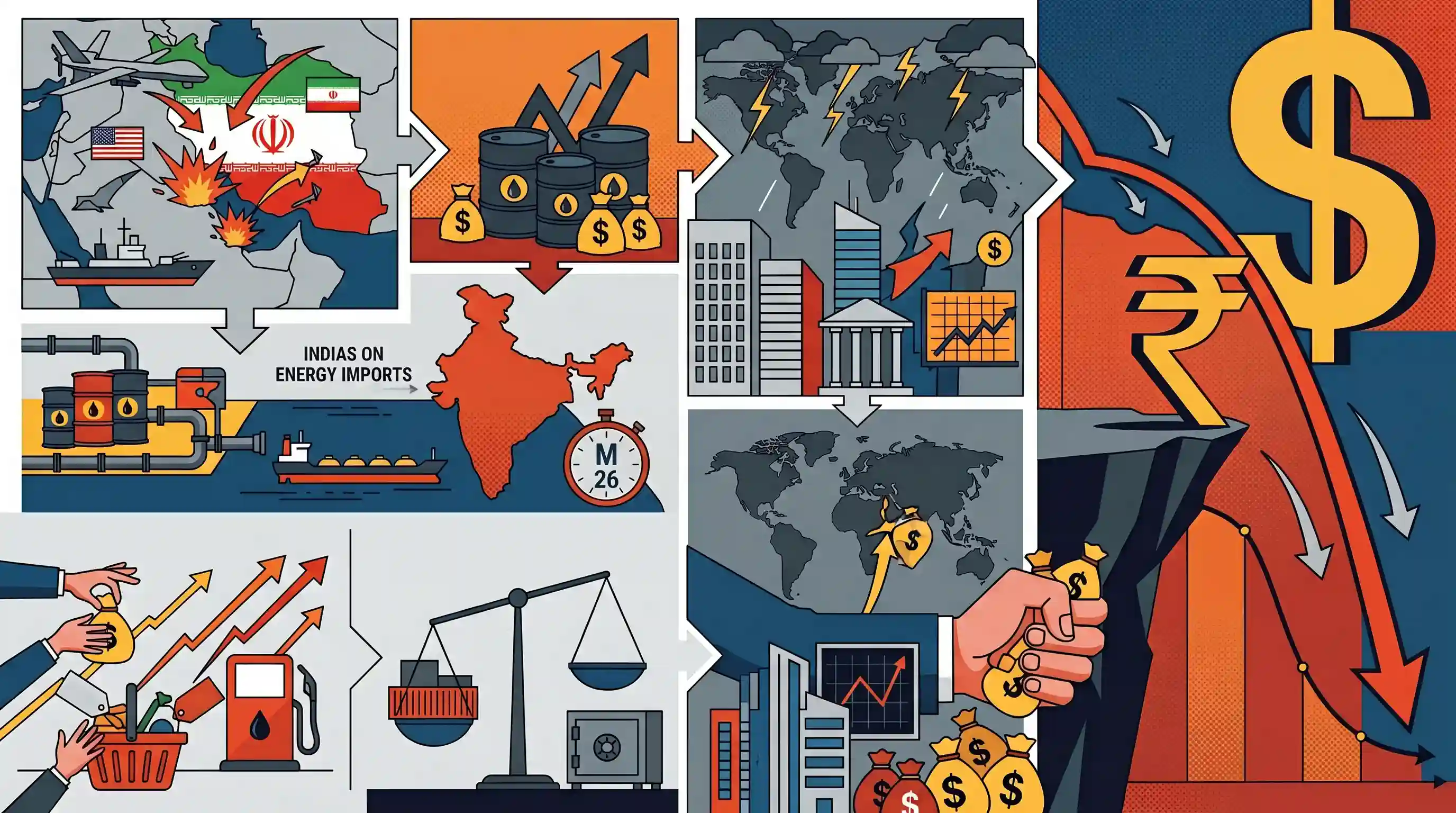
The Indian Rupee plummeted to an all-time low of 95.39 against the US Dollar in May 2026, primarily driven by soaring crude oil prices following U.S.-Iranian strikes in the Gulf. This escalation in West Asia threatens to widen India's Current Account Deficit (CAD) and stoke imported inflation. Concurrently, global risk aversion has led to significant Foreign Portfolio Investment (FPI) outflows, with over $20 billion leaving Indian assets, further depressing the domestic currency and challenging macroeconomic stability.
Key Points
- The Indian Rupee hit a historic low of 95.39 against the US Dollar on May 5, 2026, pressured by geopolitical conflicts and surging crude oil prices.
- U.S.-Iranian strikes in the Gulf have heightened risks for global energy supply, heavily impacting import-dependent India.
- The elevated oil import bill is projected to widen India's Current Account Deficit (CAD) and exacerbate imported inflation.
- Geopolitical uncertainty has triggered massive capital flight, with Foreign Portfolio Investment (FPI) outflows exceeding $20 billion between March and May 2026.
Important Terms
Exchange Rate Depreciation

A decrease in the value of a currency relative to another in a floating exchange rate system, driven by market demand and supply.
UPSC context
GS Paper 3 (Economy); tests understanding of external sector dynamics and impacts on trade competitiveness.
Current Account Deficit (CAD)
A situation where a country's total imports of goods, services, and transfers exceed its total exports, indicating a net outflow of foreign exchange.
UPSC context
GS Paper 3 (Economy); crucial for analyzing Balance of Payments (BoP) and macroeconomic stability.
Imported Inflation
Inflation caused by an increase in the prices of imported raw materials or finished goods, often triggered by currency depreciation or global price hikes.
UPSC context
GS Paper 3 (Economy); relevant for studying inflation types and the challenges of monetary policy.
Foreign Portfolio Investment (FPI)
Investments made by foreign individuals or institutions in a country's financial assets, such as stocks and bonds, characterized by higher volatility (hot money).
UPSC context
GS Paper 3 (Economy); tests knowledge of capital account components and their impact on market liquidity.
Reserve Bank of India (RBI)
India's central bank and regulatory body responsible for formulating monetary policy and intervening in forex markets to prevent excessive rupee volatility.
UPSC context
GS Paper 3 (Economy); core institution for banking, inflation control, and external sector management.
Energy Security
The reliable and affordable access to energy resources, critical for maintaining economic activity and national stability amidst global supply disruptions.
UPSC context
GS Paper 3 (Infrastructure/Energy) & GS Paper 2 (IR); vital for strategic planning and import-dependence analysis.
Prelims Trap
Depreciation of the Rupee will automatically narrow India's Current Account Deficit by making exports more competitive.
India's import basket is highly inelastic (crude oil, gold). The increased cost of these imports in Rupee terms often outpaces immediate export gains, initially widening the CAD (J-curve effect).
Static Concepts Connected
What are the primary components of the Current Account in the Balance of Payments?
- Visible Trade: Export and import of physical goods (merchandise), which consistently runs a significant deficit for India due to oil imports.
- Invisible Trade: Trade in services (software, business consulting, travel), which runs a robust surplus, partially offsetting the visible trade deficit.
- Income & Transfers: Net primary income (profits, interest, dividends) and secondary income (remittances, grants). India benefits massively from inward remittances.
How does currency depreciation trigger imported inflation?
- Cost-Push Mechanism: When the Rupee depreciates against the Dollar, foreign goods require more Rupees to purchase, directly increasing domestic input and retail costs.
- Inelastic Imports: Because India imports roughly 80% of its crude oil, currency depreciation guarantees higher domestic fuel prices, which cascades into higher transport and manufacturing costs.
- Monetary Policy Limitation: Unlike demand-pull inflation, RBI interest rate hikes are less effective against imported inflation because the root cause lies in external currency and commodity shocks.
Cross-Topic Patterns
West Asian Chokepoints & Macroeconomics
Geography meets economy: disruptions at the Strait of Hormuz not only test India's strategic petroleum reserves but mathematically guarantee a widening CAD and cost-push inflation due to heavy import dependency.
"Hot Money" vs Macro Stability
The $20B FPI exodus highlights the volatile nature of portfolio investments during global risk-aversion, contrasting sharply with stable FDI and explaining RBI's rationale for aggressive forex hoarding.

Expect a 2026 Prelims question directly linking West Asian geography (Strait of Hormuz), crude oil inelasticity, and imported inflation.
Linked PYQs · 5
Linked PYQs · 5
- 2022PrelimsGS1
With reference to the Indian economy, consider the following statements: 1. If the inflation is too high, Reserve Bank of India (RBI) is likely to buy government securities. 2. If the rupee is rapidly depreciating, RBI is likely to sell dollars in the market. 3. If interest rates in the USA or European Union were to fall, that is likely to induce RBI to buy dollars. Which of the statements given above are correct?
- 2022PrelimsGS1
Consider the following statements: 1. Tight monetary policy of US Federal Reserve could lead to capital flight. 2. Capital flight may increase the interest cost of firms with existing External Commercial Borrowings (ECBs). 3. Devaluation of domestic currency decreases the currency risk associated with ECBs. Which of the statements given above are correct?
- 2018MainsGS3
How would the recent phenomena of protectionism and currency manipulations in world trade affect macroeconomic stability of India?
- 2025MainsGS2
"Energy security constitutes the dominant kingpin of India's foreign policy, and is linked with India's overarching influence in Middle Eastern countries.” How would you integrate energy security with India's foreign policy trajectories in the coming years?
- 2018MainsGS2
In what ways would the ongoing US-Iran Nuclear Pact Controversy affect the national interest of India? How should India respond to this situation?
