Indian Rupee hits historic low against US dollar amid oil shock
Source:The Hindu ↗
Why It Matters
This incident perfectly illustrates the vulnerability of India's macroeconomic indicators (currency valuation, current account deficit, inflation) to exogenous shocks like geopolitical conflict and crude oil volatility. The Prime Minister's appeal highlights non-monetary, behavioral interventions to manage Balance of Payments (BoP) pressures, specifically targeting traditional weak points like gold imports.
Summary
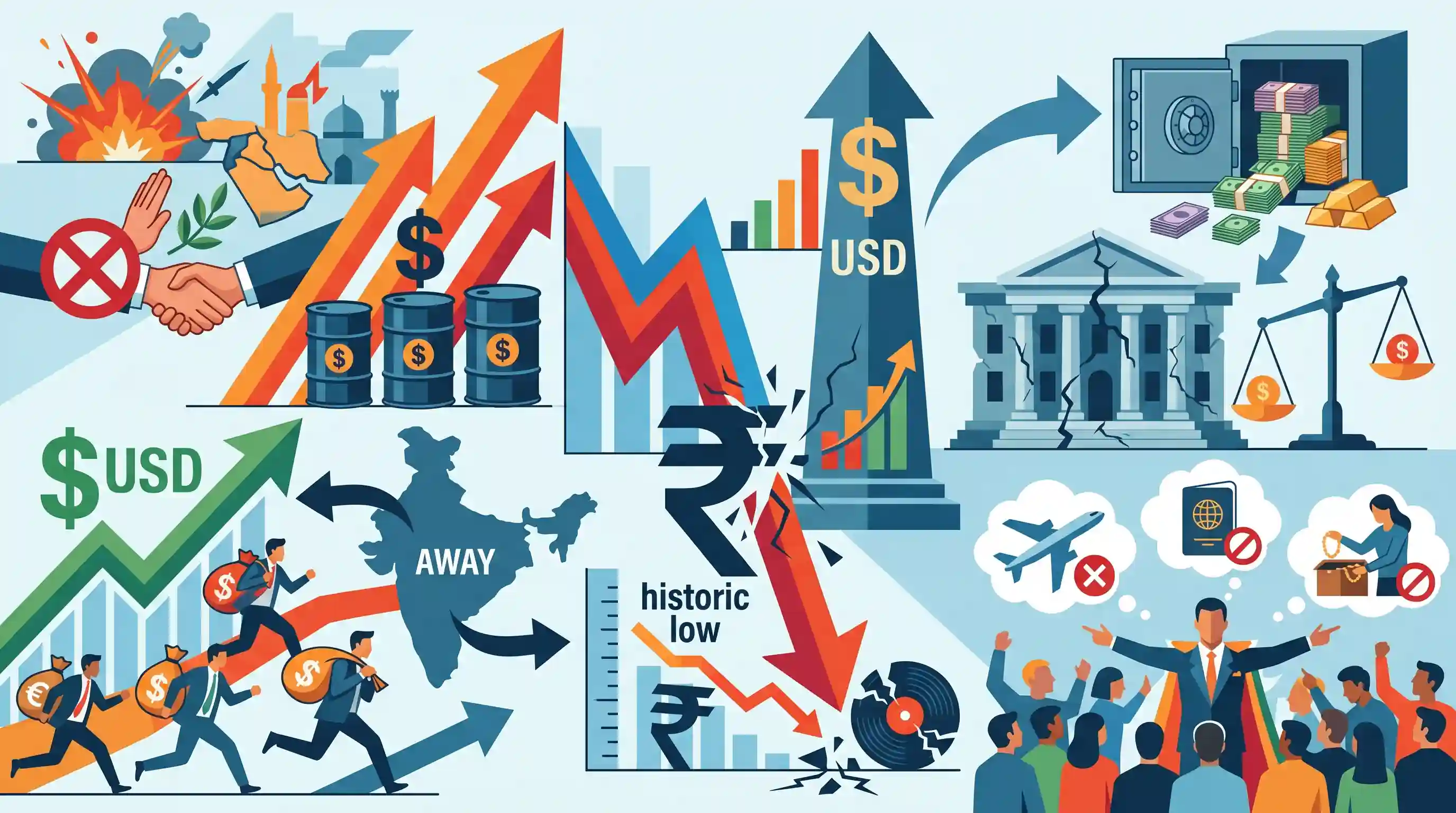
The Indian Rupee plunged to a historic low of 95.31 against the US dollar, hammered by a confluence of massive foreign capital outflows, a strengthening greenback, and soaring crude oil prices. The surge in oil to $103.8 per barrel was triggered by escalating tensions in West Asia after the US rejected Iran's peace proposal response. Facing intense pressure on India's forex reserves and macroeconomic stability, Prime Minister Narendra Modi appealed to citizens to practice austerity by deferring foreign travel and curbing gold purchases to limit non-essential foreign exchange outflows.
Key Points
- The Indian Rupee crashed 82 paise to close at an all-time low of 95.31 against the US dollar.
- The depreciation was primarily driven by aggressive equity sell-offs by Foreign Institutional Investors (FIIs) and a strengthening US dollar.
- Global crude oil prices surged (Brent crude reached $103.8 per barrel) following an escalation in the West Asia conflict, exacerbated by the US rejecting Iran's response to a peace proposal.
- Prime Minister Narendra Modi urged citizens to adopt austerity measures, such as avoiding gold purchases and postponing foreign travel, to conserve foreign exchange reserves and manage the fiscal deficit.
- The dual shock of surging oil import bills and rapid capital outflows has heavily pressured India's macro-economic fundamentals, sinking forex reserves and causing stock market indices to tumble.
Important Terms
Foreign Institutional Investors (FIIs)

International entities like hedge funds and pension funds that invest in a country's financial markets. In India, they must register with SEBI and significantly impact market liquidity.
UPSC context
GS Paper 3 (Economy); important for understanding capital flows, market volatility, and the nature of 'hot money' in external sectors.
Exchange Rate Depreciation
A market-driven decline in a currency's value against foreign currencies under a flexible exchange rate system, typically caused by high demand for foreign currency.
UPSC context
GS Paper 3 (External Sector); tests conceptual clarity between market-driven depreciation and policy-driven devaluation.
Current Account Deficit (CAD)
When a country's total imports of goods, services, and transfers exceed its exports, indicating it is a net debtor to the rest of the world.
UPSC context
GS Paper 3 (Indian Economy); critical for analyzing macroeconomic stability, trade imbalances, and twin-deficit challenges.
Foreign Exchange (Forex) Reserves
Assets held by the central bank (RBI) including Foreign Currency Assets, Gold, SDRs, and Reserve Tranche to manage currency volatility and ensure external stability.
UPSC context
GS Paper 3 (Economy); essential for understanding RBI’s intervention mechanisms and the buffer against Balance of Payments crises.
Balance of Payments (BoP)
A comprehensive record of all economic transactions between a country's residents and the rest of the world, comprising current and capital accounts.
UPSC context
GS Paper 3 (External Sector); the primary framework for evaluating a nation's global financial standing and currency health.
Brent Crude Oil
The leading global price benchmark for Atlantic basin crude oils. Rising Brent prices significantly increase India’s import bill and fuel domestic cost-push inflation.
UPSC context
GS Paper 3 (Energy Security); tests understanding of imported inflation and the vulnerability of India’s fiscal and trade balance.
Prelims Trap
"Gold imports are classified as capital assets and therefore fall under the Capital Account of the Balance of Payments."
Physical gold import is treated as a merchandise good. Therefore, it falls under the Current Account (visible trade) and directly widens the Trade Deficit, not the Capital Account.
Static Concepts Connected
Where do gold imports and FII outflows fit in India's Balance of Payments?
- Gold Imports: Treated as visible merchandise trade, it falls under the Current Account and directly contributes to the Trade Deficit.
- FII Outflows: Classified as portfolio investment, these highly volatile, short-term flows are recorded under the Capital Account.
- Foreign Travel: Spending on foreign travel falls under the 'Invisibles' (services) section of the Current Account.
How does a depreciating Rupee combined with high crude prices trigger inflation?
- Imported Inflation: A weaker Rupee requires more domestic currency to buy dollar-denominated crude oil, inflating the import bill.
- Cost-Push Cascade: Higher fuel costs inflate domestic logistics, manufacturing, and transportation expenses, causing broad-based retail inflation regardless of demand.
- Policy Squeeze: The RBI faces a dilemma: hiking interest rates to defend the Rupee and curb inflation may simultaneously stifle domestic economic growth.
Cross-Topic Patterns
West Asia Geopolitics & Macro Stability
The direct link between US-Iran tensions and India's Current Account Deficit underscores how external geopolitical shocks translate immediately into domestic macroeconomic stress and imported inflation.
Hot Money vs Sticky Capital
Sudden FII equity sell-offs (hot money) causing rapid Rupee depreciation contrasts with stable FDI. UPSC frequently tests this distinction during periods of global monetary tightening.

Expect a multi-statement question in 2026 linking crude price shocks, 'imported inflation', and RBI's forex intervention mechanisms.
Linked PYQs · 5
Linked PYQs · 5
- 2022PrelimsGS1
With reference to the Indian economy, consider the following statements: 1. If the inflation is too high, Reserve Bank of India (RBI) is likely to buy government securities. 2. If the rupee is rapidly depreciating, RBI is likely to sell dollars in the market. 3. If interest rates in the USA or European Union were to fall, that is likely to induce RBI to buy dollars. Which of the statements given above are correct?
- 2019PrelimsGS1
Which one of the following is not the most likely measure the Government/RBI takes to stop the slide of Indian rupee?
- 2015MainsGS3
Craze for gold in Indians has led to a surge in import of gold in recent years and put pressure on balance of payments and external value of rupee. In view of this, examine the merits of the Gold Monetization Scheme.
- 2018MainsGS3
How would the recent phenomena of protectionism and currency manipulations in world trade affect macroeconomic stability of India?
- 2017MainsGS2
The question of India's Energy Security constitutes the most important part of India's economic progress. Analyze India's energy policy cooperation with West Asian countries.
