Bihar Reservation Quota Laws and Ninth Schedule Inclusion Debate
Source:The Hindu ↗
Why It Matters
The article is highly relevant for UPSC aspirants as it touches upon significant constitutional concepts such as the Ninth Schedule's protection against judicial review, the limitations and scope of reservation policies (Indira Sawhney judgement implications), and the practical challenges of implementing Directive Principles like liquor prohibition (Article 47). It also underscores the enduring legacy of Bhakti movement saints in modern social justice discourse.
Summary
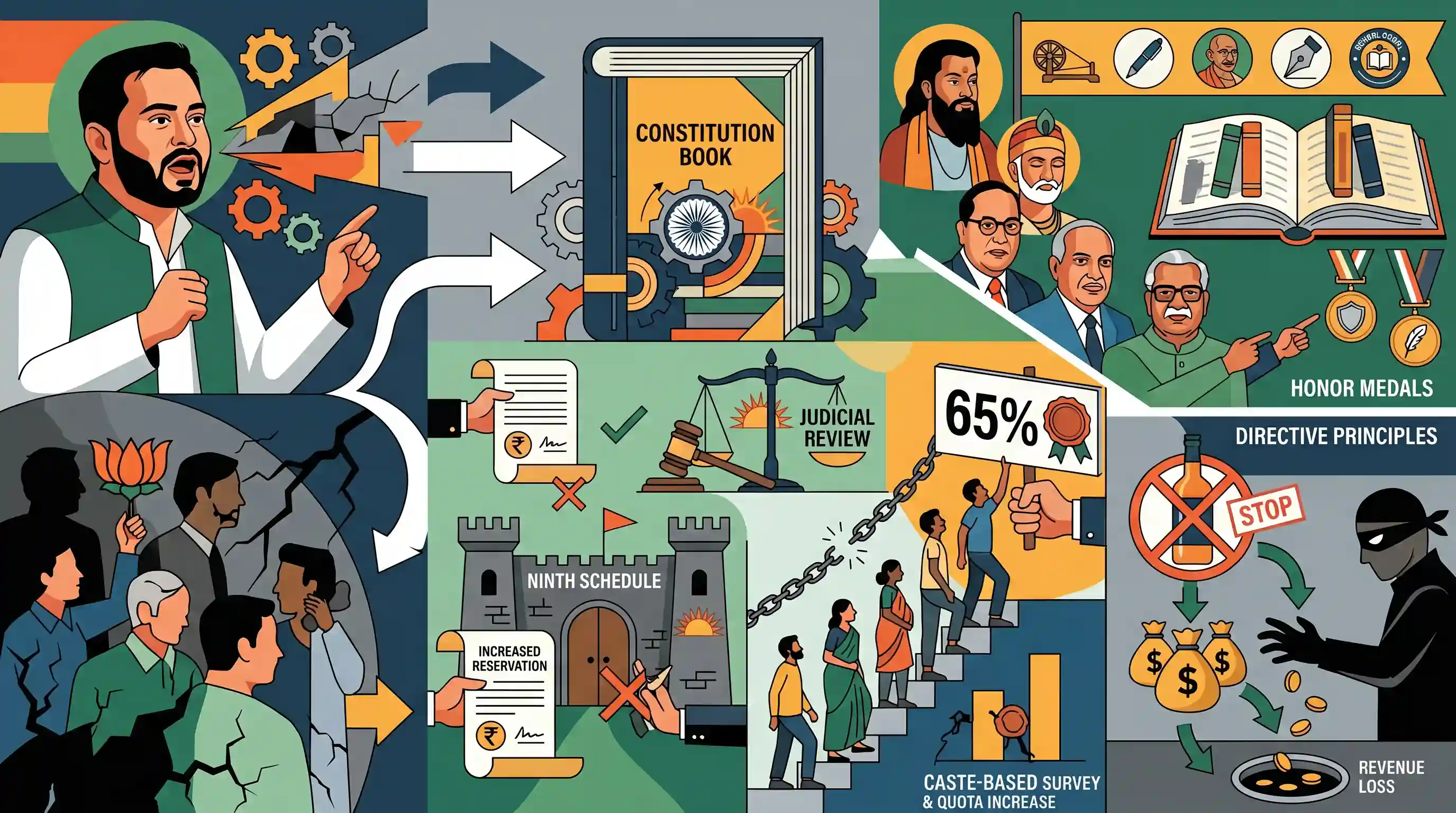
RJD leader Tejashwi Yadav launched a strong critique against the BJP-led NDA government in Bihar, accusing them of undermining constitutional values while celebrating the birth anniversary of Sant Shiromani Ravidas. He highlighted the achievements of the previous RJD-led government, specifically the successful execution of the caste-based survey and the subsequent increase in the state reservation quota to 65%. Yadav alleged that the new ruling coalition intentionally stalled efforts to place this enhanced reservation law into the Ninth Schedule of the Constitution, thereby exposing it to legal challenges. He further criticized the state's liquor prohibition policy, asserting that it has completely failed, leading to massive revenue losses and the rise of a powerful liquor mafia. Emphasizing the need for social justice, he demanded the inclusion of teachings by Dr. B.R. Ambedkar, Sant Ravidas, and Kabir in the education syllabus, and called for awarding the Bharat Ratna to prominent Dalit figures Kanshi Ram and Jagjivan Ram.
Key Points
- RJD leader Tejashwi Yadav accused the ruling NDA government in Bihar of conspiring to weaken the Constitution and promoting the ideologies of Godse and Golwalkar.
- Yadav highlighted the previous RJD government's role in conducting a caste-based survey and increasing reservations for backward classes to 65%.
- He alleged that the BJP and the current state government deliberately prevented the inclusion of the 65% reservation law in the Ninth Schedule of the Constitution, leaving it vulnerable to judicial review.
- He advocated for the inclusion of the teachings of Dalit icons and Bhakti movement saints like Dr. B.R. Ambedkar, Sant Ravidas, and Kabir in the school curriculum to promote equality.
- He criticized the complete failure of the liquor ban in Bihar, pointing out that it has spawned an illegal liquor mafia and caused massive revenue losses to the state.
- He demanded the Bharat Ratna for prominent Dalit leaders and social reformers Kanshi Ram and former Deputy PM Jagjivan Ram.
Important Terms
Ninth Schedule of the Constitution

A list of central and state laws immune from judicial review under Article 31B. Added by the 1st Amendment (1951), though post-1973 entries remain open to 'basic structure' scrutiny.
UPSC context
GS Paper II: Significant provisions and amendments; tests the limits of parliamentary sovereignty versus judicial review.
Bihar Caste-based Survey
A 2023 socio-economic enumeration by the Bihar government. It found that OBCs and EBCs comprise over 63% of the state's population, influencing subsequent reservation and welfare policies.
UPSC context
GS Paper I (Society) and II (Social Justice): Tests understanding of demographic data in policy-making and social justice.
65% Reservation Law (Bihar)
Bihar's 2023 amendment increasing quotas for SCs, STs, and OBCs to 65% in jobs and education. Struck down by the Patna High Court (2024) for exceeding judicial limits.
UPSC context
GS Paper II: Fundamental Rights (Articles 14-16) and the legal evolution of the 50% reservation ceiling.
Article 47 (Liquor Prohibition)
A Directive Principle of State Policy (DPSP) mandating the state to improve public health and prohibit the consumption of intoxicating drinks and drugs (except for medicinal use).
UPSC context
GS Paper II: DPSP implementation and government policies; tests the balance between state duties and individual liberties.
Nirguna Bhakti School
A monotheistic sub-tradition of the Bhakti movement involving saints like Kabir and Ravidas. It rejects idol worship and caste hierarchies, preaching devotion to a formless (Nirguna) Supreme Being.
UPSC context
GS Paper I: Art & Culture and History; focus on medieval social reformers and their impact on egalitarianism.
Prelims Trap
Laws placed in the Ninth Schedule are completely immune from judicial review.
The I.R. Coelho judgment (2007) ruled that laws added to the Ninth Schedule after April 24, 1973, are open to judicial review if they violate the Basic Structure.
Static Concepts Connected
How does the 9th Schedule relate to Judicial Review and the Basic Structure?
- Origins (1951): Added via the First Amendment Act (1951) to protect agrarian reform and abolition of Zamindari laws from fundamental rights challenges.
- I.R. Coelho Case: The Supreme Court ruled that laws added to the 9th Schedule post-April 24, 1973, are not granted blanket immunity.
- Basic Structure Test: Such post-1973 laws can be struck down if they abrogate fundamental rights that form part of the Basic Structure (Articles 14, 19, 21).
What are the key contributions of Sant Ravidas to the Bhakti movement?
- Nirguna School: He was a 15th-century mystic poet-saint who worshipped a formless Supreme Being, opposing caste hierarchy and untouchability.
- Concept of Begampura: He conceptualized a casteless, classless utopian society without sorrow or discrimination, emphasizing human equality.
- Literary Impact: Over 40 of his devotional hymns are incorporated into the Sikh holy scripture, the Guru Granth Sahib.
Cross-Topic Patterns
Reservation caps + 9th Schedule protection
Bihar's demand mirrors Tamil Nadu's 1994 strategy, which used the 76th Amendment to place its 69% reservation law in the 9th Schedule, seeking immunity from the Indra Sawhney 50% ceiling.
Article 47 (Prohibition) + Fiscal Federalism
Debates around liquor bans connect the moral mandate of DPSP Article 47 with fiscal federalism challenges, specifically massive state excise revenue losses and parallel black economies.

Expect a 2026 Polity question linking the Indra Sawhney 50% ceiling, 9th Schedule immunity (I.R. Coelho), and state reservation powers.
Linked PYQs · 4
Linked PYQs · 4
- 2018PrelimsGS1
Consider the following statements: 1. The Parliament of India can place a particular law in the Ninth Schedule of the Constitution of India. 2. The validity of a law placed in the Ninth Schedule cannot be examined by any court and no judgement can be made on it. Which of the statements given above is/are correct?
- 2019PrelimsGS1
The Ninth Schedule was introduced in the Constitution of India during the prime ministership of
- 2019PrelimsGS1
Consider the following statements: 1. Saint Nimbarka was a contemporary of Akbar. 2. Saint Kabir was greatly influenced by Shaikh Ahmad Sirhindi. Which of the statements given above is/are correct?
- 2008PrelimsGS1
Which of the following is/are included in the Directive Principles of State Policy? 1. Prohibition of traffic in human beings and forced labour 2. Prohibition of consumption except for medicinal purposes of intoxicating drinks and of other drugs which are injurious to health Select the correct answer using the code given below: Code:
