Maharashtra Clarifies NEP Three Language Policy Amid Hindi Row
Source:Indian Express ↗
Why It Matters
This incident highlights ongoing Centre-State tensions regarding linguistic identity and federalism. It serves as a practical example for UPSC aspirants to understand the challenges in implementing the NEP 2020's Three-Language Formula across culturally diverse states sensitive to the 'imposition' of Hindi.
Summary
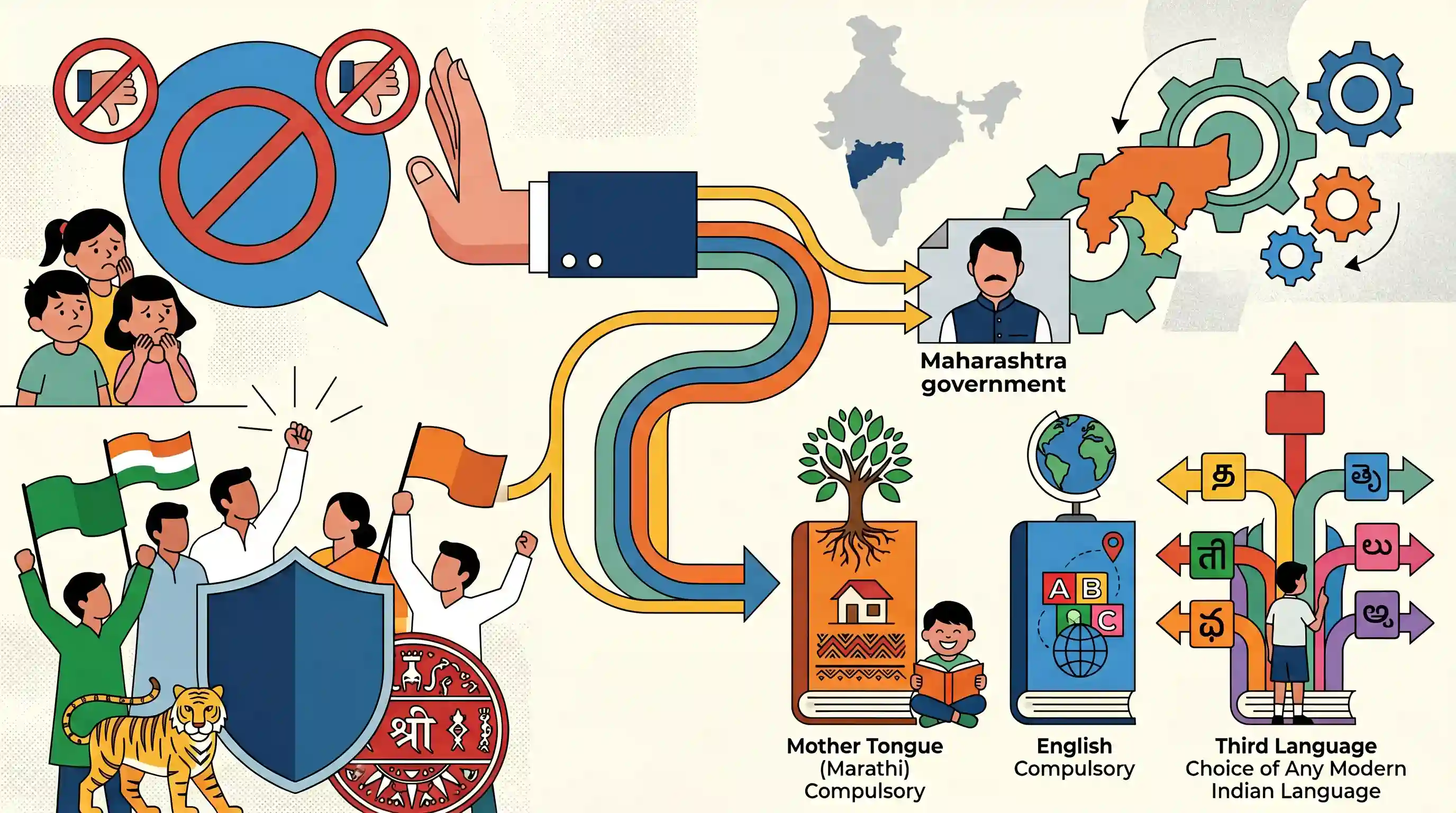
A political controversy erupted in Maharashtra over the state government's decision regarding language instruction for Classes 1 to 5. After initial reports suggested Hindi was being made mandatory, facing severe backlash from opposition parties (Congress, NCP-SP, and MNS) who called it a threat to linguistic identity, the government clarified its stance. According to the state's interpretation of the National Education Policy (NEP) 2020's three-language formula, learning the mother tongue (Marathi) and English remains compulsory, while students can choose any modern Indian language—not strictly Hindi—as their third language option.
Key Points
- The Maharashtra education department's move to seemingly make Hindi mandatory for Classes 1 to 5 sparked a political row, leading the government to issue a clarification.
- Deputy CM Devendra Fadnavis clarified that under the NEP 2020's three-language formula, learning the mother tongue and English is mandatory, while the third language can be any Indian language.
- The updated resolution states Hindi is not compulsory; schools can teach any Indian language as the third option if a minimum of 20 students choose it.
- Opposition parties, including the MNS, Congress, and NCP-SP, vehemently opposed the initial move, framing it as an 'imposition' of Hindi that threatens Marathi linguistic identity and regional culture.
Important Terms
National Education Policy (NEP) 2020

A 2020 framework transforming Indian education, emphasizing mother-tongue instruction until Class 5, pedagogical flexibility (5+3+3+4), and a non-mandatory approach to language choice.
UPSC context
GS Paper II (Social Justice/Education); tests governance, human resource development, and center-state policy alignment.
Three-Language Formula
A policy framework requiring students to learn three languages: their regional tongue, English, and a third Indian language (often Hindi in non-Hindi states).
UPSC context
GS Paper II (Government Policies); examines federal educational balances and national integration efforts.
Eighth Schedule
Part of the Indian Constitution (Articles 344 & 351) recognizing 22 official languages, providing them protection, and guiding the development of the Three-Language Formula.
UPSC context
GS Paper II (Polity); essential for understanding linguistic rights and the constitutional framework for official languages.
Linguistic Identity
A sense of belonging to a group based on shared language, historically driving the reorganization of Indian states and continuing to influence regional politics.
UPSC context
GS Paper I (Post-Independence Consolidation); tests concepts of cultural assertion and its impact on national unity.
Concurrent List
A list of 52 items in the Seventh Schedule where both the Centre and States can legislate; education was moved here by the 42nd Amendment (1976).
UPSC context
GS Paper II (Polity/Federalism); critical for understanding the division of power and center-state educational disputes.
Regionalism
Loyalty to a specific geographic area based on language or culture, which can drive positive local development or negative sub-nationalist tensions.
UPSC context
GS Paper I (Social Issues); tests the understanding of diversity and challenges to national integration.
Prelims Trap
"NEP 2020 mandates Hindi as the compulsory third language in all non-Hindi speaking states."
NEP 2020 explicitly prohibits the imposition of any language. It only stipulates that of the three languages chosen by a student, at least two must be native to India.
Static Concepts Connected
What are the key constitutional safeguards for linguistic minorities in India?
- Article 350A: Mandates states and local authorities to provide adequate facilities for instruction in the mother-tongue at the primary stage of education for linguistic minorities.
- Article 350B: Establishes a Special Officer for Linguistic Minorities, appointed by the President, to investigate matters relating to constitutional safeguards provided to these groups.
- Article 347: Allows the President to direct that a language spoken by a substantial population of a State be officially recognized throughout that State.
How did the Three-Language Formula evolve in India's education policy?
- Kothari Commission: First formulated during 1964-66 to promote national integration and bridge the North-South linguistic divide.
- NPE 1968: Formally adopted the formula: Hindi, English, and a modern Indian language in Hindi belts; and Hindi, English, and regional language in non-Hindi states.
- NEP 2020: Retains the formula but adds flexibility: no language is imposed on states, and students can choose any languages if two are native to India.
Cross-Topic Patterns
Linguistic Identity and Sub-Nationalism
Language controversies echo the legacy of the States Reorganisation Act 1956. Perceived impositions frequently fuel sub-nationalist political mobilization, illustrating language as a potent base of Indian regionalism.
Eighth Schedule and Classical Status
The NEP's flexible language provisions intersect with ongoing state demands for inclusion of regional languages in the Eighth Schedule and the expansion of Classical Languages recognition.

Expect a multi-statement Prelims question comparing NEP 2020's language formula flexibility with constitutional duties under Article 350A.
Linked PYQs · 3
Linked PYQs · 3
- 2020MainsGS2
National Education Policy 2020 is in conformity with the Sustainable Development Goal-4 (2030). It intends to restructure and reorient education system in India. Critically examine the statement.
- 2019MainsGS1
Are we losing our local identity for the global identity? Discuss.
- 2021PrelimsGS1
Consider the following statements : 1. 21st February is declared to be the International Mother Language Day by UNICEF. 2. The demand that Bangla has to be one of the national languages was raised in the Constituent Assembly of Pakistan. Which of the above statements is/are correct?
