Make in India Initiative and Global Supply Chain Sourcing Growth
Source:Indian Express ↗
Why It Matters
Increased sourcing by global retail giants acts as a catalyst for the domestic manufacturing sector. It fulfills the core objectives of the 'Make in India' initiative by creating employment, integrating local MSMEs into global value chains, and attracting productive foreign investments that strengthen the broader economy.
Summary
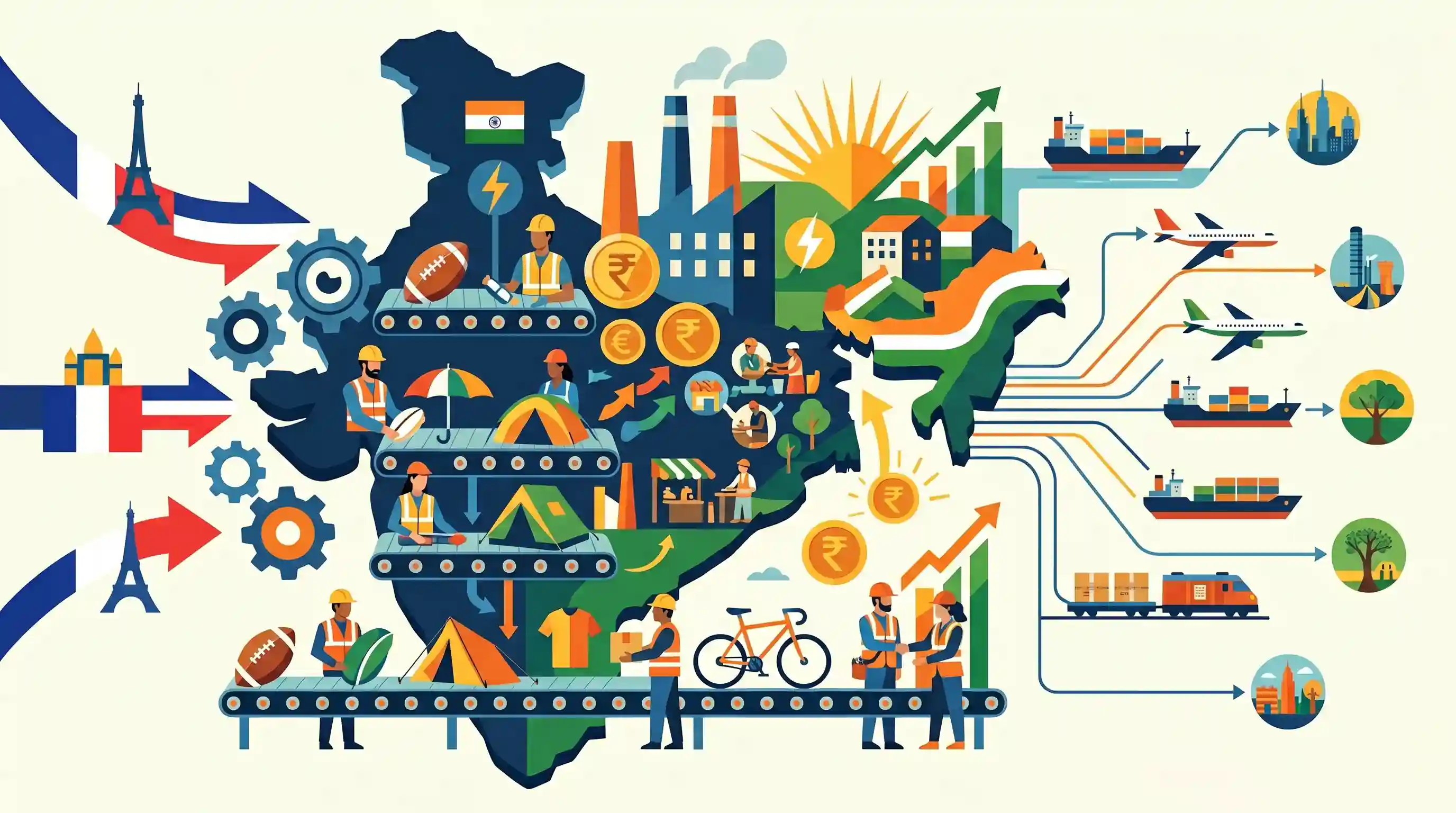
French sporting goods giant Decathlon has announced plans to significantly increase its sourcing and manufacturing footprint in India, expanding its local procurement of items ranging from rugby balls to umbrellas. This move reflects growing global confidence in India's manufacturing capabilities and supply chain resilience. The development aligns seamlessly with the government's 'Make in India' initiative, which aims to transform the country into a global manufacturing hub, boost employment, and reduce import dependence. It also highlights the positive impact of progressive Foreign Direct Investment (FDI) policies and local sourcing norms in the single-brand retail sector, encouraging multinational companies to deeply integrate Indian suppliers into their global value chains.
Key Points
- French sporting goods retailer Decathlon plans to significantly scale up its product sourcing from India, encompassing diverse items from rugby balls to umbrellas.
- The expansion underscores India's rising prominence as a reliable manufacturing hub and a critical node in global supply chains.
- This development acts as a testament to the success of the 'Make in India' initiative, driving job creation and boosting local manufacturing ecosystems.
- Progressive FDI policies and local sourcing norms for single-brand retail are actively incentivizing multinational corporations to partner with domestic MSMEs.
Important Terms
Make in India

A flagship government initiative launched in 2014 to transform India into a global manufacturing hub, aiming to increase the manufacturing sector's GDP contribution to 25%.
UPSC context
GS Paper 3: Indian Economy, Industrial Policy, and growth. Tests knowledge of manufacturing targets and self-reliance (Atmanirbhar Bharat).
Foreign Direct Investment (FDI) Policy
Investment by a foreign entity into Indian business interests. In retail, it is categorized into Single Brand and Multi-Brand, each with specific entry routes and conditions.
UPSC context
GS Paper 3: Investment models. Critical for understanding how foreign capital influences domestic manufacturing and retail sectors.
Single Brand Retail Trading (SBRT)
A retail model where a foreign entity sells products under one brand name. India allows 100% FDI under the automatic route for this sector.
UPSC context
GS Paper 3: Growth of the retail sector and regulatory frameworks for multinational corporations like Decathlon or Apple.
Local Sourcing Norms
A mandatory requirement for SBRT entities with foreign investment exceeding 51% to procure 30% of their goods' value from Indian suppliers, particularly MSMEs.
UPSC context
GS Paper 3: Impact of FDI on MSMEs and local industry. Tests understanding of value-addition and employment generation rules.
Global Value Chains (GVCs)
The international fragmentation of production where various stages (design, manufacturing, assembly) are distributed across different countries to maximize efficiency and reduce costs.
UPSC context
GS Paper 3: Effects of liberalization on the economy. Tests understanding of India's role in global trade and supply chain resilience.
Decathlon
A French sporting goods giant and a key example of a global retailer integrating Indian suppliers into its international production and export network.
UPSC context
Current Affairs/GS Paper 3: Case study for manufacturing success, FDI benefits, and the 'Make in India' for the world strategy.
Prelims Trap
"The 30% mandatory local sourcing norm applies to all Single-Brand Retail FDI in India."
The 30% local sourcing mandate only applies when FDI in Single-Brand Retail Trading (SBRT) exceeds 51%. If the FDI is 51% or below, this local sourcing condition is not mandatory.
Static Concepts Connected
What are the FDI limits and routes for the retail sector in India?
- Single-Brand Retail: 100% FDI is permitted under the Automatic Route (subject to local sourcing norms if equity exceeds 51%).
- Multi-Brand Retail: Up to 51% FDI is permitted under the Government Approval Route, subject to specific conditions and state government concurrence.
- E-commerce Retail: 100% FDI under Automatic Route is allowed in the marketplace model, but not permitted in the inventory-based model.
What are the primary bottlenecks to India's integration into Global Value Chains (GVCs)?
- High Logistics Costs: Currently hovering around 13-14% of GDP, hindering cost-competitiveness. The National Logistics Policy targets reducing this to 8%.
- Tariff Unpredictability: Frequent changes in import duties on intermediate goods disrupt the seamless flow necessary for GVC linkages.
- Regulatory Overhang: Inflexible labor laws and slow contract enforcement deter large anchor investments by multinational corporations.
Cross-Topic Patterns
SBRT Sourcing + MSME Formalization
The 30% sourcing mandate for >51% FDI in single-brand retail acts as a catalyst for MSME formalization, pushing informal manufacturers into formal credit and global standard-compliance networks.
China-Plus-One + Labor Intensive Manufacturing
While PLI schemes target high-tech sectors like electronics, local sourcing by MNC retailers builds necessary capacity in labor-intensive, low-skill manufacturing sectors like textiles, sporting goods, and footwear.

A comparison of FDI norms and routes between Single-Brand, Multi-Brand, and E-commerce models is highly probable for Prelims 2026.
Linked PYQs · 3
Linked PYQs · 3
- 2023MainsGS3
Faster economic growth requires increased share of the manufacturing sector in GDP, particularly of MSMEs. Comment on the present policies of the Government in this regard.
- 2020PrelimsGS1
With reference to Foreign Direct Investment in India, which one of the following is considered its major characteristic?
- 2021PrelimsGS1
Consider the following : 1. Foreign currency convertible bonds 2. Foreign institutional investment with certain conditions 3. Global depository receipts 4. Non-resident external deposits Which of the above can be included in Foreign Direct Investments?
