US Foreign Policy and Strategic Empathy in Diplomacy
Source:The Hindu ↗
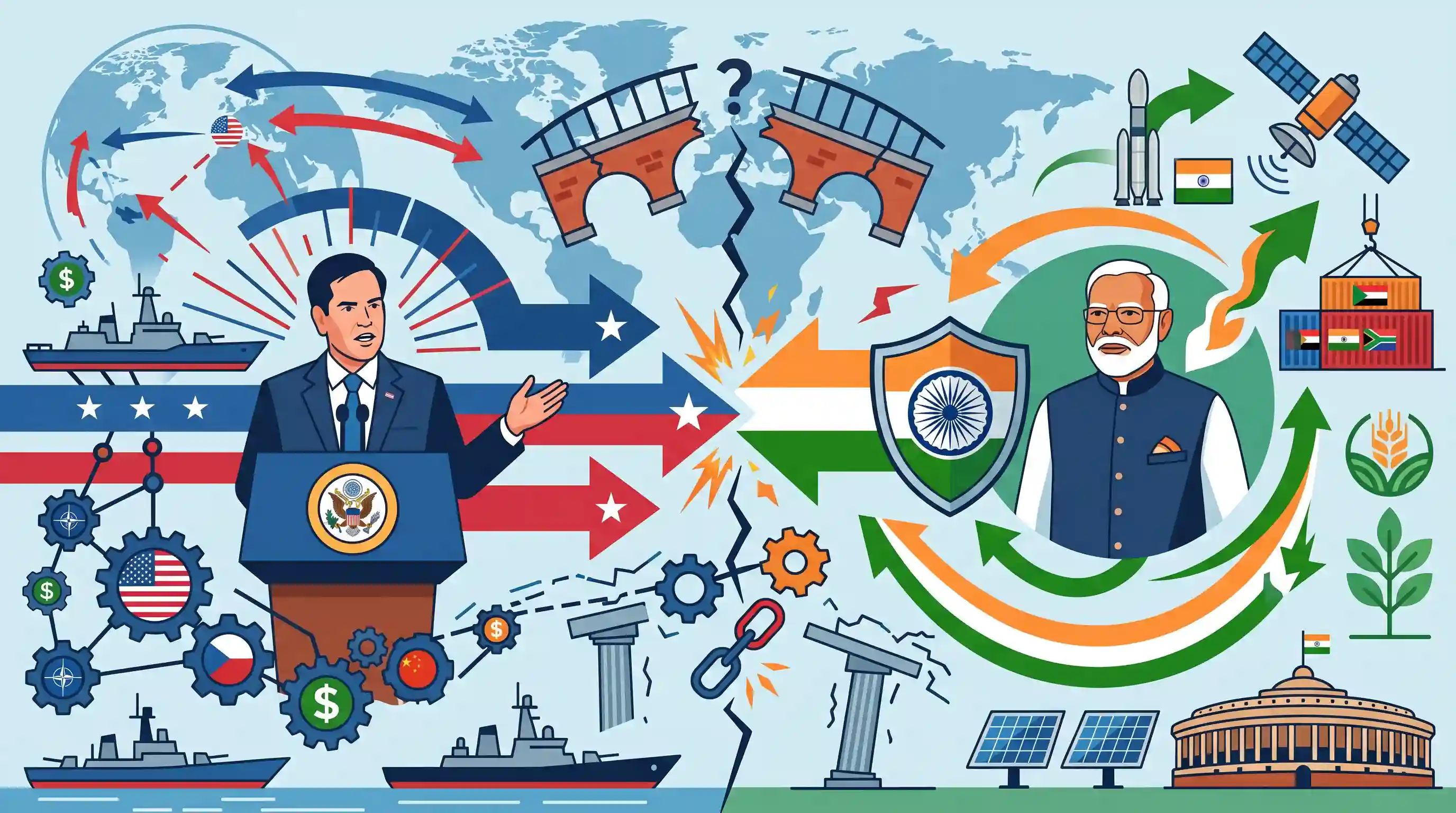
Why It Matters
Understanding 'strategic empathy' provides critical vocabulary for analyzing bilateral frictions, especially the recurrent disconnects in India-US relations over strategic autonomy. It helps aspirants evaluate the structural constraints of great-power diplomacy.
Summary
The article critically examines US Secretary of State Marco Rubio's recent remarks through the lens of 'strategic empathy'. It highlights the limitations of US foreign policy when it fails to grasp the complex geopolitical and domestic constraints of partner nations, particularly regarding India's pursuit of strategic autonomy. By not accommodating the nuanced national interests and independent foreign policy choices of its allies, the US risks introducing friction into its broader global strategy, underscoring the critical need for mutual understanding in contemporary diplomacy.
Key Points
- Marco Rubio's recent remarks highlight a deficit of 'strategic empathy' in the contemporary US foreign policy posture.
- Strategic empathy in diplomacy necessitates understanding the underlying geopolitical, historical, and domestic constraints that drive a partner nation's actions.
- For India, a lack of strategic empathy from Washington can lead to friction, particularly concerning New Delhi's pursuit of strategic autonomy and independent foreign policy.
- Effective international relations require accommodating the nuanced national interests of allies rather than imposing rigid, unyielding expectations.
Important Terms
Strategic Empathy

The diplomatic skill of understanding the underlying perspectives, motives, and constraints of other nations to better anticipate their behavior and navigate complex negotiations.
UPSC context
GS-II International Relations; vital for understanding tools of diplomacy and India's engagement with global powers like the US.
Strategic Autonomy
The principle of maintaining the independence to make foreign policy and security decisions based on national interest, without being constrained by rigid military alliances or external pressure.
UPSC context
GS-II International Relations; core pillar of India's foreign policy and a frequent friction point in India-US ties.
Multi-alignment
A foreign policy approach where a country engages with multiple, often competing, power blocs simultaneously to maximize its strategic space and national benefits.
UPSC context
GS-II International Relations; evolution of India's non-alignment strategy in a multipolar world.
US State Department
The federal executive department of the U.S. government responsible for the nation's foreign policy, international relations, and diplomatic missions, headed by the Secretary of State.
UPSC context
GS-II Bilateral Relations; essential for understanding the institutional framework of US foreign policy affecting India.
Strategic Partnership
A high-level diplomatic framework for cooperation between two nations on shared long-term goals, such as defense, technology, and economic security, without a formal treaty-based alliance.
UPSC context
GS-II Bilateral Relations; describes the status of India-US engagement (Comprehensive Global Strategic Partnership).
National Interest
The fundamental objectives of a sovereign state, typically encompassing national security, economic prosperity, and the preservation of its sovereign integrity and cultural values.
UPSC context
GS-II International Relations; the primary driver of any country’s foreign policy decisions and negotiations.
Prelims Trap
"India's policy of Strategic Autonomy means strict non-alignment and a refusal to join any strategic or security dialogues."
Strategic autonomy is not isolationism or strict non-alignment. It actively involves multi-alignment and issue-based partnerships (like Quad) while avoiding formal, binding military alliances.
Static Concepts Connected
How does Strategic Autonomy differ from traditional Non-Alignment (NAM)?
- NAM (Historical): Rooted in the Cold War, it focused on distancing from both the US and Soviet blocs and championing anti-colonialism.
- Strategic Autonomy: A proactive, issue-based multi-alignment strategy prioritizing national interest, allowing simultaneous engagement with rival blocs (e.g., Quad and BRICS).
What are the 4 foundational defense agreements between India and the US?
- GSOMIA: General Security of Military Information Agreement (2002) allows the sharing of classified military intelligence.
- LEMOA: Logistics Exchange Memorandum of Agreement (2016) allows both militaries to use each other's bases for resupply and repair.
- COMCASA: Communications Compatibility and Security Agreement (2018) facilitates interoperability and secure communication networks.
- BECA: Basic Exchange and Cooperation Agreement (2020) allows for the sharing of geospatial intelligence and mapping data.
Cross-Topic Patterns
Multi-alignment vs. Western Sanctions
India's simultaneous purchase of Russian oil amidst US sanctions and its deepening US defense ties perfectly illustrates the practical application—and diplomatic friction—of strategic autonomy.
US Domestic Politics & Trade Protectionism
A lack of US 'strategic empathy' often spills into trade, where aggressive US protectionism (like generalized tariffs) disregards the unique developmental constraints of Global South partners.

Mains 2026: Expect a question contrasting India's 'Strategic Autonomy' in the Quad with historical NAM, focusing on US alliance pressures.
Linked PYQs · 3
Linked PYQs · 3
- 2019MainsGS2
‘What introduces friction into the ties between India and the United States is that Washington is still unable to find for India a position in its global strategy, which would satisfy India's national self-esteem and ambitions.’ Explain with suitable examples.
- 2023MainsGS2
‘The expansion and strengthening of NATO and a stronger US-Europe strategic partnership works well for India.’ What is your opinion about this statement ? Give reasons and examples to support your answer.
- 2022MainsGS4
Apart from intellectual competency and moral qualities, empathy and compassion are some of the other vital attributes that facilitate the civil servants to be more competent in tackling the crucial issues or taking critical decisions. Explain with suitable illustrations.
