US Secretary of State India visit and Quad cooperation
Source:The Hindu ↗
Why It Matters
Understanding India-US relations is pivotal for UPSC aspirants, especially regarding how the two nations navigate friction points (like trade tariffs and visas) while deepening strategic and technological cooperation. The role of the Quad in the Indo-Pacific and the implications of the West Asia crisis on global energy security are also key themes in GS Paper 2.
Summary
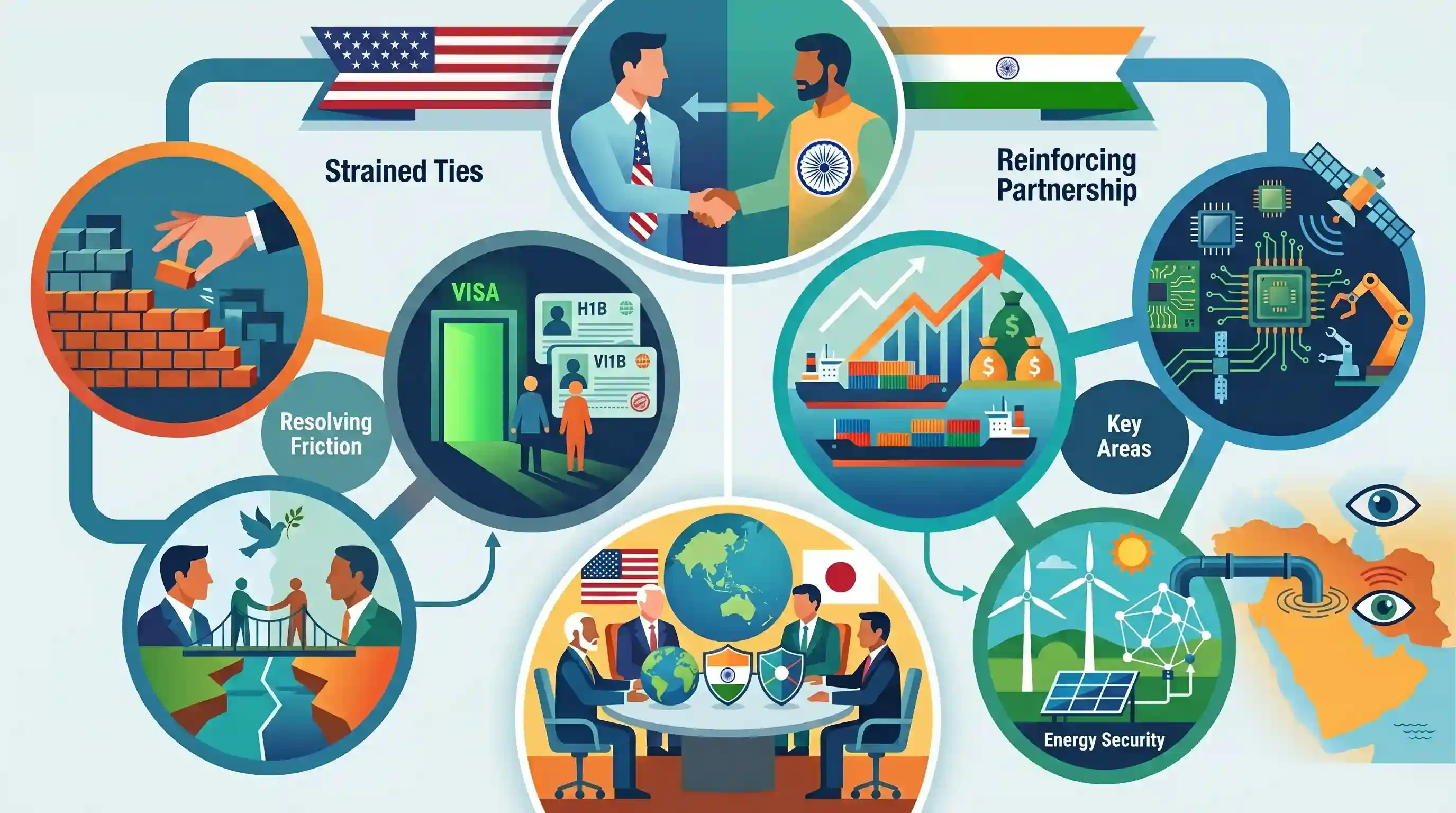
U.S. Secretary of State Marco Rubio is on a maiden four-day visit to India aimed at repairing strained bilateral ties and reinforcing the strategic partnership. His itinerary includes wide-ranging talks with External Affairs Minister S. Jaishankar, meetings with Prime Minister Narendra Modi, and attending the Quad Foreign Ministers' meeting. The discussions intend to resolve recent friction points, such as punitive tariffs, immigration policies (H1B visas), and controversies surrounding the India-Pakistan conflict. Key areas of focus will include energy, trade, investment, critical technology, and addressing the geopolitical and economic fallout of the West Asia crisis, particularly its impact on energy security.
Key Points
- U.S. Secretary of State Marco Rubio is undertaking his maiden visit to India to repair bilateral ties and bolster the strategic partnership.
- Discussions will focus on energy, trade, investment, critical technologies, people-to-people exchanges, and H1B visa policies.
- Rubio will participate in the Quad Foreign Ministers' meeting in New Delhi to enhance Indo-Pacific cooperation.
- Bilateral talks will also cover the economic impact of the ongoing West Asia crisis, particularly focusing on global energy supplies and stability.
- The visit aims to stabilize relations following recent tensions over U.S. punitive tariffs and assertions regarding India-Pakistan military conflicts.
Important Terms
Quad

Short for Quadrilateral Security Dialogue, this informal strategic forum of India, the US, Japan, and Australia promotes a 'free and open Indo-Pacific' and enhances regional security.
UPSC context
GS Paper II (International Relations). Tests knowledge of regional groupings, Indo-Pacific strategy, and India's balancing act between global powers.
H-1B Visa Policy
A US non-immigrant visa allowing employers to hire foreign professionals in specialty occupations; India consistently accounts for over 70% of all H-1B visa approvals.
UPSC context
GS Paper II (Indian Diaspora). Tests understanding of the socio-economic impact of developed-country policies on Indian interests and remittances.
iCET (Initiative on Critical and Emerging Technology)
A framework to expand strategic technology partnership and defense industrial cooperation in areas like artificial intelligence, semiconductors, quantum computing, and space exploration.
UPSC context
GS Paper II & III. Tests awareness of bilateral strategic shifts and high-tech cooperation aimed at resilient supply chains.
Energy Security
The uninterrupted availability of energy sources at an affordable price; for India, this involves mitigating risks from geopolitical shocks and high import dependence.
UPSC context
GS Paper III (Energy/Economy). Tests understanding of India's strategic petroleum reserves and the impact of global oil price volatility.
West Asia Crisis
Ongoing geopolitical instability in West Asia that threatens energy supply routes (e.g., Strait of Hormuz), global crude prices, and the safety of the Indian diaspora.
UPSC context
GS Paper II (International Relations). Tests understanding of regional conflicts and their direct consequences for India’s energy and food security.
Punitive Tariffs
High taxes imposed by a country on imported goods to retaliate against trade practices or protect domestic industries, often creating bilateral trade friction.
UPSC context
GS Paper III (Economy). Tests knowledge of trade barriers, protectionism, and the nuances of international commercial disputes.
Prelims Trap
"The Quad functions as a formal military alliance with a mutual defense pact in the Indo-Pacific."
The Quad is an informal strategic dialogue, not a military alliance. It has no mutual defense treaty (unlike NATO), focusing instead on critical tech, climate, and maritime domain awareness.
Static Concepts Connected
What are the primary objectives and characteristics of the Quad?
- Diplomatic mechanism: It is an informal strategic forum comprising India, US, Japan, and Australia. It is strictly a diplomatic network, not a treaty-based military alliance.
- Expanded mandate: Evolving beyond traditional maritime security, its modern agenda covers critical technologies, resilient supply chains, clean energy, and cybersecurity.
- Indo-Pacific focus: It aims to ensure a free, open, and prosperous Indo-Pacific region, implicitly countering China's assertiveness without explicitly naming it.
What are the key categories of US work visas relevant to India?
- H-1B Visa: A non-immigrant visa allowing US employers to temporarily employ foreign workers in specialty occupations, highly utilized by the Indian IT sector.
- L-1 Visa: Facilitates temporary intracompany transfers of executives, managers, or employees with specialized knowledge to the US.
- H-4 Visa: Issued to dependent family members (spouses and children under 21) of H-1B visa holders.
Cross-Topic Patterns
iCET + Supply Chain Resilience
The US-India Initiative on Critical and Emerging Technology (iCET) directly maps onto the Quad’s economic resilience agenda to de-risk global semiconductor and AI supply chains from China.
West Asia crisis + Import Inflation
Conflict in West Asia directly threatens India's energy security, requiring policymakers to balance US strategic alignment with the macroeconomic need to secure affordable crude and prevent imported inflation.

Expect a GS-2 question analyzing the paradox of India-US ties: deepening tech/defense synergy (iCET/Quad) vs persistent trade/visa friction.
Linked PYQs · 5
Linked PYQs · 5
- 2020MainsGS2
Quadrilateral Security Dialogue (Quad)' is transforming itself into a trade bloc from a military alliance, in present times - Discuss.
- 2020MainsGS2
What is the significance of Indo-US defence deals over Indo-Russian defence deals? Discuss with reference to stability in the Indo-Pacific region.
- 2024MainsGS2
‘The West is fostering India as an alternative to reduce dependence on China's supply chain and as a strategic ally to counter China's political and economic dominance.’ Explain this statement with examples.
- 2017MainsGS2
The question of India's Energy Security constitutes the most important part of India's economic progress. Analyze India's energy policy cooperation with West Asian countries.
- 2025MainsGS2
"Energy security constitutes the dominant kingpin of India's foreign policy, and is linked with India's overarching influence in Middle Eastern countries.” How would you integrate energy security with India's foreign policy trajectories in the coming years?
