US Secretary of State Visits Heritage Sites Ahead of Quad Meeting
Source:The Hindu ↗
Why It Matters
The article provides a perfect example of cultural diplomacy blending with strategic interests. For UPSC, it connects the Quad's Indo-Pacific focus with broader energy security concerns in the Middle East (Strait of Hormuz), while also highlighting traditional water management systems (Amber Fort) relevant to GS1 Geography and Art & Culture.
Summary
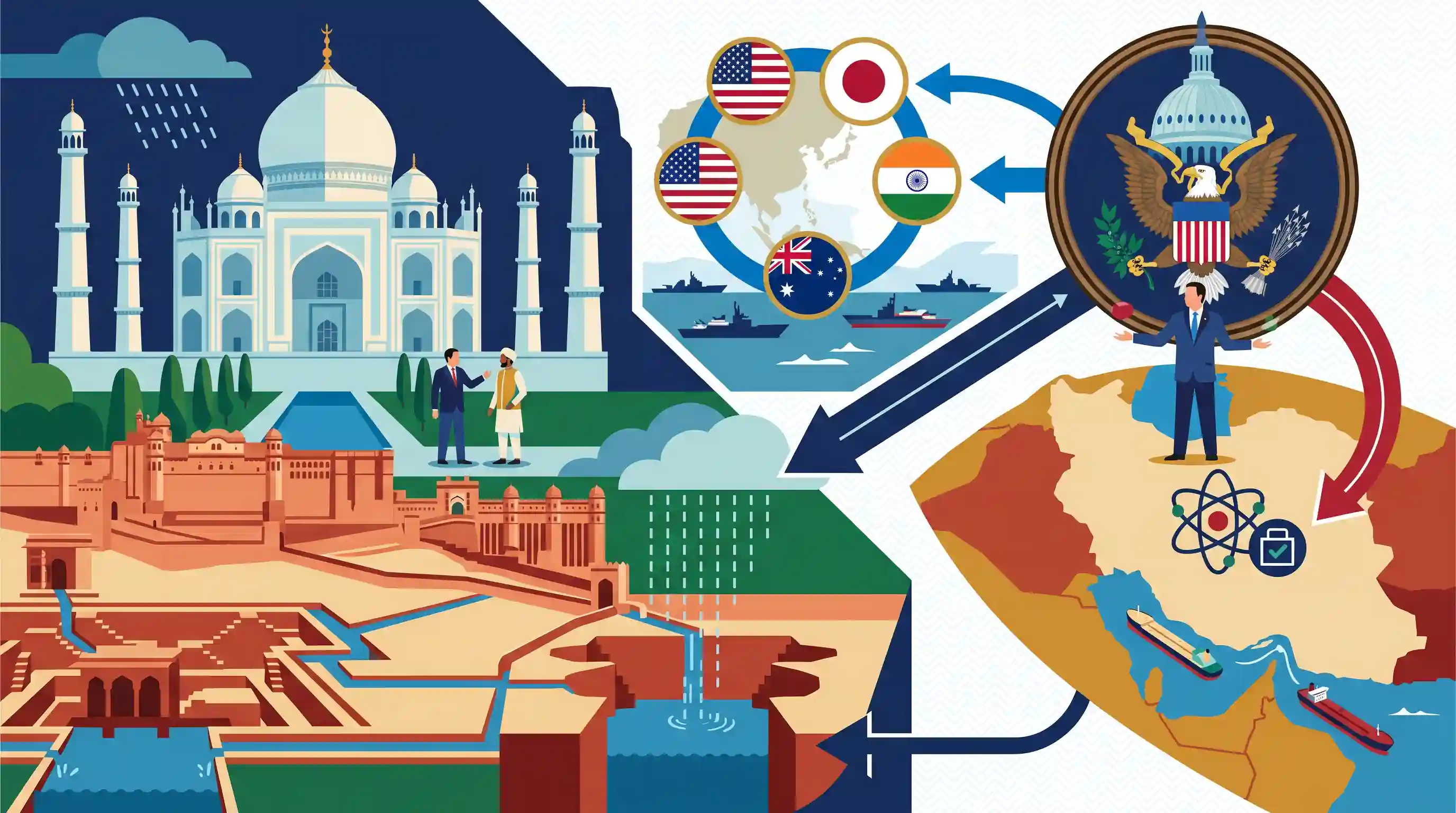
Ahead of the Quad Foreign Ministers' meeting, U.S. Secretary of State Marco Rubio engaged in cultural diplomacy by visiting the Taj Mahal and Amber Fort, where he observed traditional Rajput rainwater harvesting systems. His visit occurs against a backdrop of complex global geopolitics, as the U.S. seeks to balance its Indo-Pacific strategy via the Quad with pressing security concerns in the Middle East, notably pursuing a deal with Iran to secure the Strait of Hormuz and address nuclear proliferation.
Key Points
- U.S. Secretary of State Marco Rubio visited UNESCO World Heritage sites Taj Mahal and Amber Fort ahead of the Quad Foreign Ministers' meeting in India.
- During his visit to Amber Fort, Rubio showed particular interest in its traditional rainwater harvesting and water management systems.
- The visit sets the stage for diplomatic engagements concerning Indo-Pacific security alongside counterparts from India, Japan, and Australia.
- Prior to arriving in India, Rubio emphasized the need for a peace deal with Iran, focusing on nuclear containment and ensuring the Strait of Hormuz remains open for global shipping.
Important Terms
Quad (Quadrilateral Security Dialogue)

An informal strategic forum comprising India, United States, Japan, and Australia. It promotes a free, open, and rules-based Indo-Pacific through cooperation in maritime security, technology, and climate action.
UPSC context
GS Paper 2: Bilateral and regional groupings; critical for understanding India’s role in the Indo-Pacific and maritime security.
UNESCO
A UN agency that designates World Heritage Sites of outstanding universal value. It aims to preserve cultural and natural heritage globally, with India currently hosting 44 recognized sites.
UPSC context
GS Paper 1: Art and Culture; tests knowledge of international heritage preservation and India’s cultural landmarks.
Amber Fort (Amer Fort)
A 16th-century hill fort in Jaipur, Rajasthan, and a UNESCO World Heritage Site. It is renowned for its Rajput-Mughal architectural synthesis and sophisticated ancient water management systems.
UPSC context
GS Paper 1: Indian Architecture; significant for medieval history and the "Hill Forts of Rajasthan" serial nomination.
Taj Mahal
A 17th-century Mughal mausoleum in Agra, built by Emperor Shah Jahan. A UNESCO World Heritage Site, it represents the zenith of Mughal architecture, blending Indian, Persian, and Islamic styles.
UPSC context
GS Paper 1: Art and Culture; frequently features in questions regarding Mughal architectural elements and global heritage.
Strait of Hormuz
A critical maritime chokepoint between Iran and Oman. It carries ~20% of the world’s oil supply, making it vital for global energy security and India’s crude imports.
UPSC context
GS Paper 2: International Relations; essential for studying West Asian geopolitics and India’s energy security vulnerabilities.
Rajput Rainwater Harvesting
Traditional water conservation methods used in Rajasthan's arid terrain, such as Maota Lake and the pulley-based relay-rehant system at Amber Fort, designed to ensure year-round water security.
UPSC context
GS Paper 3: Water Conservation; serves as a historical model for sustainable water management in drought-prone regions.
Prelims Trap
"Mehrangarh Fort is included in the UNESCO Hill Forts of Rajasthan."
Aspirants often assume Mehrangarh is included due to its fame. The actual six are Chittorgarh, Kumbhalgarh, Ranthambore, Gagron, Amer, and Jaisalmer.
Static Concepts Connected
What are the key traditional water management structures used in arid Rajasthan?
- Baolis (Stepwells): Deep trenches or architectural wells with descending steps to reach deep groundwater tables (e.g., Chand Baori).
- Tankas: Covered, underground cylindrical tanks traditionally built in or near houses to store harvested rainwater for drinking.
- Johads: Small earthen check dams that capture and conserve rainwater, improving percolation and groundwater recharge.
What is the strategic geography of the Strait of Hormuz?
- Connected Waters: It serves as the critical maritime chokepoint linking the oil-rich Persian Gulf to the Gulf of Oman and the Arabian Sea.
- Bordering Nations: The strait is bordered by Iran to the north, and by Oman (via the Musandam Peninsula) and the UAE to the south.
- Trade Significance: It facilitates the transit of nearly 20% of global oil consumption and significant LNG exports, making it vital for India's energy security.
Cross-Topic Patterns
Culture meets Climate Adaptation
UPSC increasingly links historical architecture with environmental utility, comparing ancient sites like Dholavira or Rajput forts against modern climate resilience and water conservation needs.
Indo-Pacific & Gulf energy corridors
The Quad's maritime focus intersects with West Asian geopolitics. India and Japan rely heavily on the Strait of Hormuz, meaning Middle Eastern stability is a prerequisite for broader Indo-Pacific security.

Expect a 2026 Prelims mapping question pairing traditional water conservation systems (Tankas, Johads, Baolis) with their states.
Linked PYQs · 4
Linked PYQs · 4
- 2020MainsGS2
Quadrilateral Security Dialogue (Quad)' is transforming itself into a trade bloc from a military alliance, in present times - Discuss.
- 2025MainsGS2
"Energy security constitutes the dominant kingpin of India's foreign policy, and is linked with India's overarching influence in Middle Eastern countries.” How would you integrate energy security with India's foreign policy trajectories in the coming years?
- 2018MainsGS1
The ideal solution of depleting ground water resources in India is water harvesting system." How can it be made effective in urban areas?
- 2024PrelimsGS1
Consider the following properties included in the World Heritage List released by UNESCO: 1. Shantiniketan 2. Rani-ki-Vav 3. Sacred Ensembles of the Hoysalas 4. Mahabodhi Temple Complex at Bodhgaya How many of the above properties were included in 2023 ?
