US China Strategic Stability and Nuclear Arms Control
Source:The Hindu ↗
Why It Matters
The geopolitical equilibrium between the U.S. and China dictates the global economic and security environment. For India, U.S. efforts to reduce reliance on Chinese supply chains present strategic economic opportunities (the 'China Plus One' strategy). Meanwhile, discussions surrounding trilateral nuclear treaties are pivotal for global disarmament and regional security architecture, particularly in the Indo-Pacific.
Summary
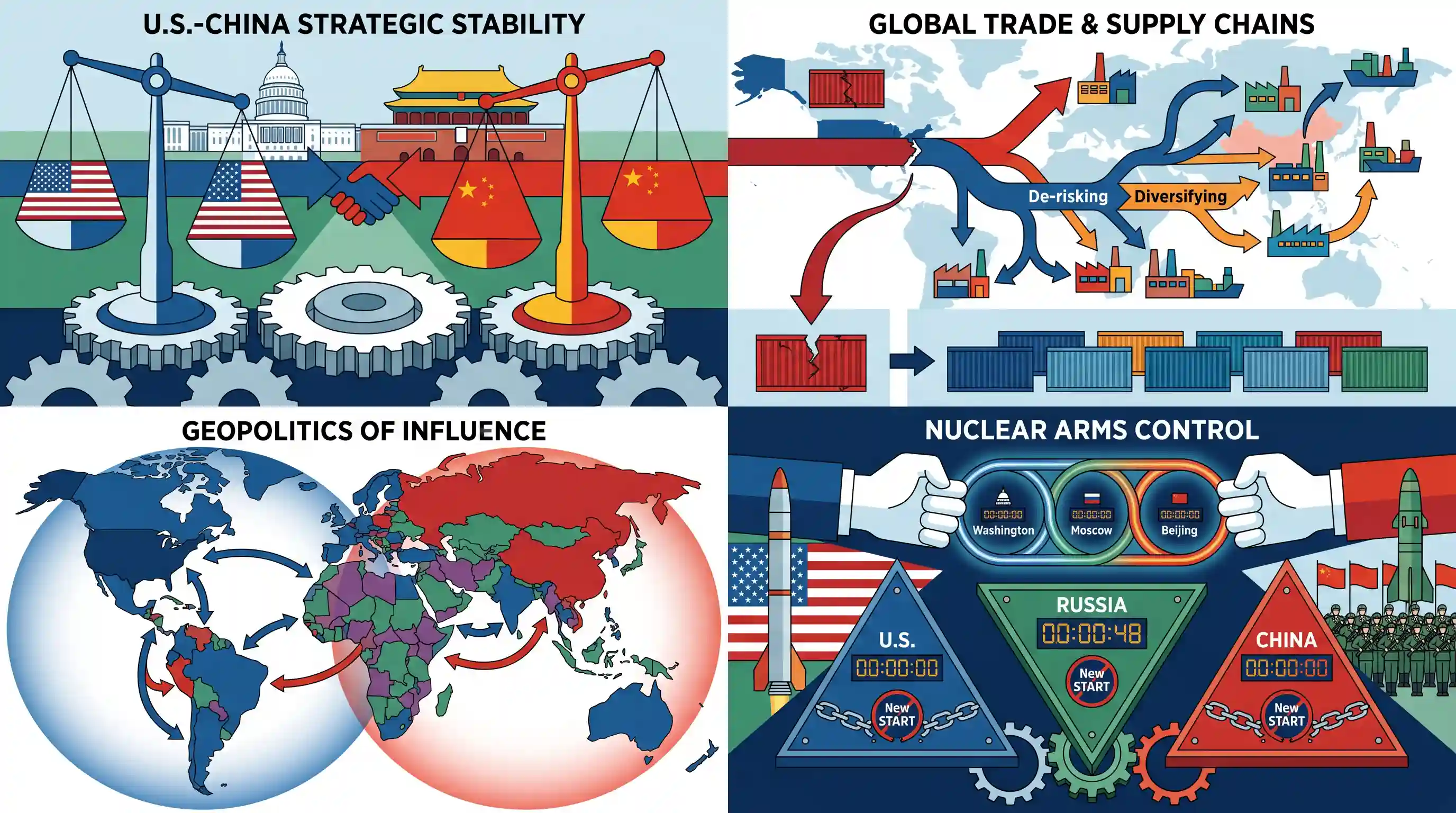
U.S. Secretary of State Marco Rubio declared that the U.S. and China have achieved a level of "strategic stability" as President Donald Trump prepares for an upcoming diplomatic visit to Beijing. While acknowledging that an all-out trade war would be mutually disastrous, Rubio emphasized that the U.S. will persistently seek to de-risk and diversify its supply chains away from Chinese reliance. In the security domain, the U.S. is pushing Beijing to join a three-way nuclear arms control framework with Washington and Moscow, driven by concerns over China's military expansion and the expiration of the bilateral New START treaty.
Key Points
- U.S. Secretary of State Marco Rubio noted a degree of "strategic stability" between the U.S. and China ahead of President Donald Trump's visit to Beijing.
- Both countries share an understanding that an unchecked global trade war would cause severe mutual devastation.
- Despite the stabilization, the U.S. remains committed to diversifying its critical supply chains away from Chinese dominance.
- Rubio urged China to participate in a trilateral nuclear arms control agreement alongside the U.S. and Russia, especially following the expiration of the New START treaty.
Important Terms
New START treaty

The last remaining US-Russia bilateral nuclear arms control treaty limiting deployed strategic warheads to 1,550. It expired in February 2026, leaving no legal caps on the world's two largest nuclear arsenals.
UPSC context
GS Paper II (IR): Important for topics on bilateral agreements, nuclear disarmament, and global security architecture.
De-risking
A strategic policy of reducing economic reliance on a single nation (typically China) in critical sectors to mitigate supply chain vulnerabilities and coercion without pursuing a total economic separation (decoupling).
UPSC context
GS Paper II/III: Critical for analyzing trade wars, supply chain resilience, and India's 'China Plus One' potential.
Strategic Stability
A state of international relations where nuclear powers have no incentive to launch a first strike due to mutual vulnerability, ensuring predictability and preventing a destabilizing arms race.
UPSC context
GS Paper II: Central concept in major power geopolitics, nuclear deterrence, and Indo-Pacific security dynamics.
Trilateral Arms Control Framework
A proposed arms control model aiming to include China alongside the US and Russia in legally binding nuclear limits, responding to Beijing’s rapid modernization of its nuclear triad.
UPSC context
GS Paper II: Relevant for discussions on the evolving global nuclear order and US-China-Russia strategic competition.
Supply Chain Diversification
An economic strategy to build resilience by spreading manufacturing and procurement across multiple countries to prevent disruptions from geopolitical tensions or local crises in a single dominant supplier nation.
UPSC context
GS Paper III: Vital for topics on industrial policy, global manufacturing shifts, and economic sovereignty.
Prelims Trap
"The New START treaty was a trilateral nuclear arms control agreement encompassing the US, Russia, and China."
New START was strictly bilateral between the US and Russia. The US is only now advocating for a trilateral framework due to China's expanding arsenal and the treaty's 2026 expiration.
Static Concepts Connected
What is the difference between economic 'de-risking' and 'decoupling'?
- De-risking: Reducing geopolitical vulnerabilities in critical sectors (e.g., semiconductors, rare earths) by diversifying supply chains without halting broad trade.
- Decoupling: A complete severance of economic integration and bilateral trade between two major powers, historically seen during the Cold War.
- Current Policy Posture: US and EU have officially adopted de-risking toward China to protect national security while acknowledging that full decoupling would trigger mutual economic devastation.
What was the New START treaty and why is its expiration critical?
- Core Objective: Signed in 2010, it capped deployed strategic nuclear warheads (at 1,550) and delivery vehicles for both the United States and Russia.
- Verification Regime: It included robust mutual on-site inspections and data exchanges, mechanisms critical for maintaining predictability and preventing accidental nuclear escalation.
- Post-2026 Vacuum: It formally expired in February 2026. Without a replacement, there are currently no binding limits on the world's two largest nuclear arsenals.
Cross-Topic Patterns
De-risking via Quad & Minerals Security Partnership
US 'de-risking' relies heavily on alliances like the Quad and the Minerals Security Partnership, directly tying this geopolitical shift to India's domestic critical minerals mapping and strategic autonomy goals.
Multipolar nuclear deterrence & India's doctrine
The push for a US-Russia-China pact marks the definitive end of the Cold War bipolar nuclear architecture, deeply complicating India's nuclear deterrence strategy and 'No First Use' doctrine against two armed neighbors.

Expect a 2026 Prelims multi-statement question on New START's expiration, the proposed trilateral nuclear framework, and de-risking.
Linked PYQs · 3
Linked PYQs · 3
- 2024MainsGS2
‘The West is fostering India as an alternative to reduce dependence on China's supply chain and as a strategic ally to counter China's political and economic dominance.’ Explain this statement with examples.
- 2021MainsGS2
“The USA is facing an existential threat in the form of a China, that is much more challenging than the erstwhile Soviet Union.” Explain.
- 2011PrelimsGS1
The "New START" treaty was in the news. What is this treaty?
